
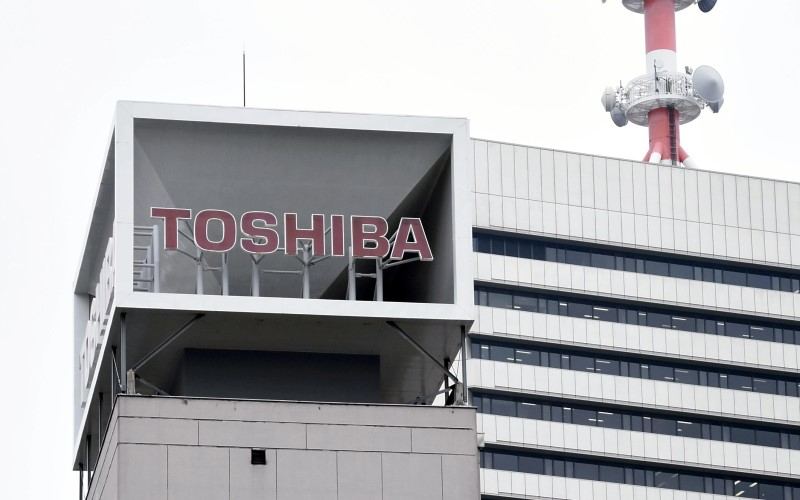
The headquarters of Toshiba Corp. is seen in Minato Ward, Tokyo, in July 2020.
14:18 JST, June 23, 2021
The government is considering further tightening its control over foreign investment in domestic companies that have critical technologies in such fields as nuclear power and defense, The Yomiuri Shimbun has learned. Its aim is to keep an eye on such foreign investors’ moves as shareholders, to prevent the outflow of the nation’s security-related technologies.
The government plans to draw up specific measures by the end of this year to establish necessary legislation, according to sources.
The envisioned plan would enable the government to deter demands from foreign investment funds and businesses as shareholders of Japanese companies, if their demands could reduce the firms’ competitiveness or result in the outflow of their technologies. The government is also mulling a measure under which it could even call for such foreign shareholders to sell their holdings, the sources said.
The revised Foreign Exchange and Foreign Trade Law, which came into effect last year, has enabled the government to tighten preliminary screening processes on foreign investment in domestic companies. Foreign investors are required to go through such screenings when they acquire 1% or more of outstanding shares or 1% or more of voting rights in Japanese companies. That threshold had been 10% under the law before the revision.
If any problem is found with a planned investment during the screening process, the government can issue an advisory or an order to revise or suspend the plan.
However, under the revised law, the government has limited control over the actions that foreign investors may take once they have invested in domestic companies. This has prompted the government to examine the envisioned scheme so that it can remain involved to some extent in the management of Japanese companies with foreign shareholders and thus help them maintain and develop critical technologies, according to the sources.
The government is considering further tightening control over foreign investment because Toshiba Corp. has been struggling in its relationship with foreign investment funds.
Toshiba increased its capital in 2017 after falling into a financial crisis triggered by huge losses at its U.S. nuclear business arm. Toshiba could have gone bankrupt if foreign investment funds had not joined in the capital increase.
Once Toshiba’s management stabilized, however, some of the investment funds began to insist that the company implement measures that could help raise its stock price, such as share buybacks and paying higher dividends. Throughout this period, the government has remained involved in Toshiba’s management behind the scenes because the company has a number of critical technologies in fields such as quantum cryptography and nuclear power generation.
The United States and European countries have established schemes to regulate the actions taken by foreign funds after they invest in companies in their own nations. The Japanese government is stepping up efforts to compile details for its own future system by referring to similar systems overseas, the sources said.






Most Read
Popular articles in the past 24 hours
-

Moai Statue Shows Lasting Bond Between Miyagi Pref. Town, Easter ...
-
Japan's Defense Ministry: North Korea Appears to Have Fired Balli...
-

Milano Cortina 2026: Japan’s Oguri Wins Para Snowboard Silver at ...
-

National Intelligence Council: Proposed Body Must Be Utilized To ...
-

Aichi Fisheries Cooperatives Use Smart Tech to Farm Triploid Oyst...
-
Teachers Support Students’ Inquiry Learning behind the Scenes
-
Japan's Lower House Passes Budget Proposal; Could Be Delayed in U...
-
CARTOON OF THE DAY (March 14)
Popular articles in the past week
-

Japan Figure Skating Legend Yuzuru Hanyu Is Proud Disaster Surviv...
-
Govt to Utilize ODA for Ensuring Economic Security; Securing Ener...
-
15 Measles Patients Confirmed in Tokyo in Past 6 Days; 1 May Have...
-
Massive Sewer Pipe Found Jutting Out of Highway in Osaka
-
Japan Govt to Tighten Requirements to Receive Permanent Residency...
-
JR Tokai Breaks Ground on Yamanashi Maglev Station; Will Be Part ...
-
Power Outage Forces About 980 Passengers in Yokohama to Walk to T...
-

Beckoning Cats Get Makeover to Fit Modern Lifestyles with Sleek D...
Popular articles in the past month
-

Producer Behind Pop Group XG Arrested for Cocaine Possession
-

Japan PM Takaichi’s Cabinet Resigns en Masse
-

Man Infected with Measles Reportedly Dined at Restaurant in Tokyo...
-

Videos Plagiarized, Reposted with False Subtitles Claiming ‘Ryuky...
-
Japan Figure Skating Legend Yuzuru Hanyu Is Proud Disaster Surviv...
-

iPS Treatments Pass Key Milestone, but Broader Applications Far f...
-

Sanae Takaichi Elected Prime Minister of Japan; Keeps All Cabinet...
-

Nepal Bus Crash Kills 19 People, Injures 25 Including One Japanes...
Top Articles in Politics
-
Japan PM Takaichi’s Cabinet Resigns en Masse
-
Sanae Takaichi Elected Prime Minister of Japan; Keeps All Cabinet Appointees from Previous Term
-

Japan’s Govt to Submit Road Map for Growth Strategy in March, PM Takaichi to Announce in Upcoming Policy Speech
-
LDP Begins Training New Lawmakers to Avoid Scandal, Gaffes; Historic Victory in Latest Election Heightens Focus on Party
-
Japan PM Sanae Takaichi Welcomes Peach Ambassadors Koga Momo Musume to Official Residence
JN ACCESS RANKING
-
Producer Behind Pop Group XG Arrested for Cocaine Possession
-
Japan PM Takaichi’s Cabinet Resigns en Masse
-
Man Infected with Measles Reportedly Dined at Restaurant in Tokyo Station
-
Videos Plagiarized, Reposted with False Subtitles Claiming ‘Ryukyu Belongs to China’; Anti-China False Information Also Posted in Japan
-
Japan Figure Skating Legend Yuzuru Hanyu Is Proud Disaster Survivor and Gold Medalist, Vows to Continue Support Efforts