
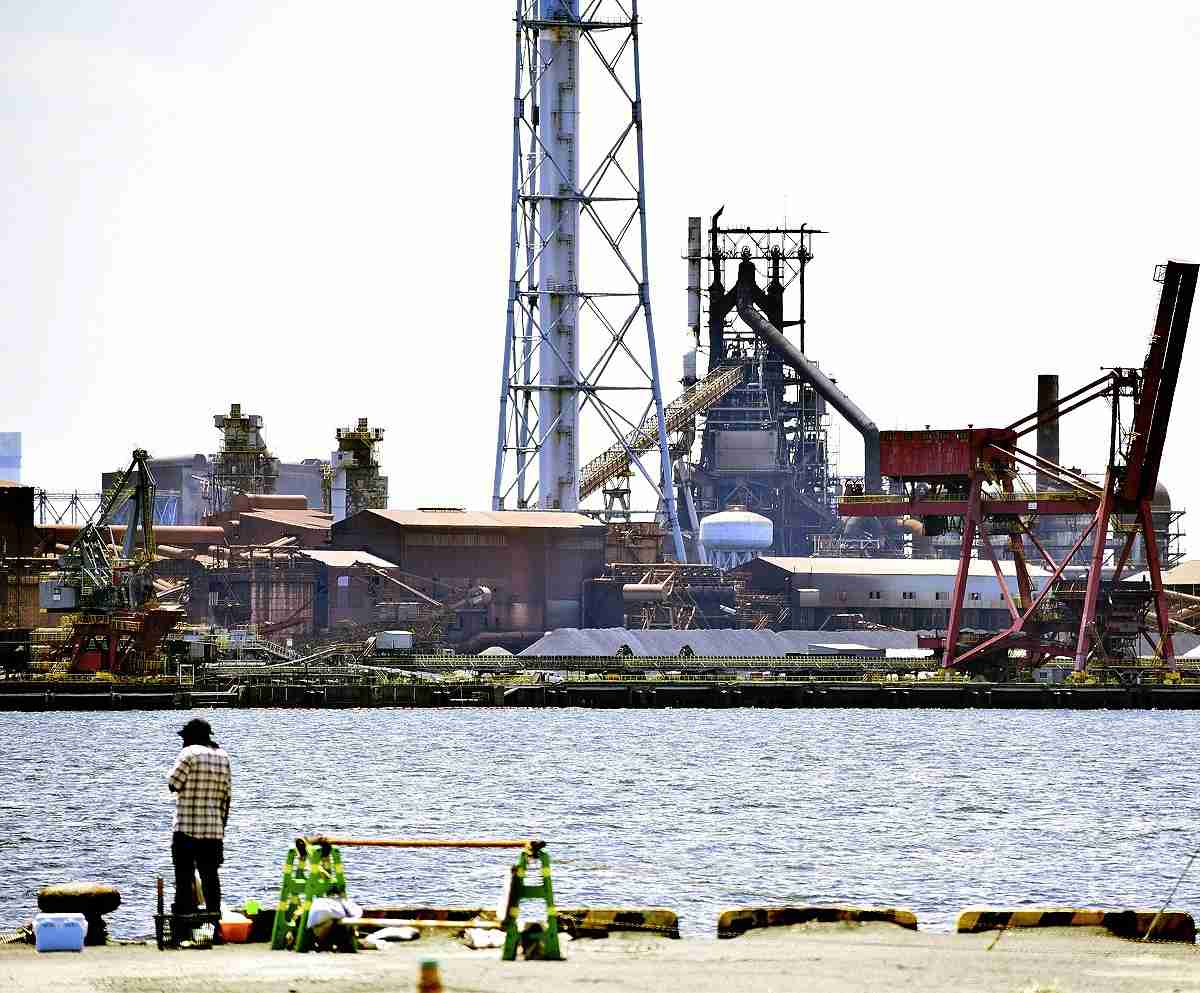
Ironworks blast furnaces, under pressure to reduce greenhouse gas emissions, are seen in Chiba Prefecture.
15:06 JST, December 22, 2020
The government’s goal of net-zero carbon emissions by 2050 has raised concerns and demands from Japanese industry. Although it cannot resist the global trend of decarbonization, there is a sense of crisis that if domestic regulations are drastically tightened, the nation will lose industrial competitiveness.
The business community has been demanding research and development help as well as financial support from the government, saying the public and private sectors should join forces in the fight.
The board of the Japan Automobile Manufacturers Association (JAMA) unanimously decided on Dec. 17 to cooperate with the government’s target of net-zero carbon emissions. Chairman Akio Toyoda, also president of Toyota Motor Corp., told reporters online, “This is a very difficult challenge, and I would like to ask for the equivalent financial and policy support as is seen in the United States, Europe and China.”
An initial hurdle is that factories which produce cars use a lot of electricity. Toyoda pointed out that thermal power generation, such as coal-fired plants, is the main power source in Japan and expressed a sense of crisis by saying: “It could become impossible to produce cars in Japan. The auto industry’s business model could collapse.”
Electric vehicles (EV) also require electricity for manufacturing as well as charging. Toyoda insisted that simply popularizing EVs would lead to power shortages, saying, “It will be difficult [to achieve the goal] without a major change in the nation’s energy policy.”
Eiji Hashimoto, chairman of the Japan Iron and Steel Federation and president of Nippon Steel Corp., said at a press conference on Dec. 17, “It is impossible for individual companies to continue R&D from scratch.”
It is difficult to significantly reduce carbon dioxide emissions in steel mills with the current production method using blast furnaces, and the industry is in need of technological innovation.
Japan Chemical Industry Association Chairman Kohei Morikawa, also president of Showa Denko K.K., said in a bitter voice on Dec. 18, “If it is left to individual companies, putting [revolutionary new technologies] in practical use cannot be realized even after 100 years.”
In a proposal released earlier this month, Japan Business Federation (Keidanren) called on the government to consider how to bear the costs of decarbonization and how to support it. Hiroaki Nakanishi, chairman of Keidanren, said, “Technological innovation and [the next generation of] power systems is the challenge.” He then called for wider cooperation between the government and the industrial organizations.
The government has positioned strengthening environmental technologies as a pillar of its growth strategy.
Prime Minister Yoshihide Suga has emphasized a virtuous cycle of environment and growth. The government envisions that tightening environmental regulations will encourage companies to innovate, which will attract investment funds and lead to economic growth.
Under the government’s action plan to be compiled by the end of this month, all new car sales in Japan will be electrified vehicles, including all-electric and hybrid vehicles, by the mid-2030s.
However, the government’s discussions may be affected by calls for careful consideration from industries concerned with domestic employment.




Most Read
Popular articles in the past 24 hours
-

Japan Figure Skating Legend Yuzuru Hanyu Is Proud Disaster Surviv...
-
Hawaii Museum on Tsunami Including Japan's 2011 Disaster at Risk ...
-

Japan Train Company to Increase Fares, Including in Tokyo Metropo...
-

Japan’s Mitsui O.S.K. Lines Container Ship Anchored in Persian Gu...
-

Struggling Onosato Pulls out of Spring Tourney
-

Japan’s Mitsui O.S.K. Lines Container Ship Anchored in Persian Gu...
-

Tail of ANA Plane Struck Runway During Landing in Houston; No Inj...
-

Iran Targets Busiest International Airport as Top UN Body Demands...
Popular articles in the past week
-
Japan Figure Skating Legend Yuzuru Hanyu Is Proud Disaster Surviv...
-

Nippon Life Insurance's U.S. Arm Sues OpenAI Over Legal Assistanc...
-

Ibaraki Pref.'s 1st Foreign Bus Driver Hired in Tsukuba
-
Govt to Utilize ODA for Ensuring Economic Security; Securing Ener...
-
Massive Sewer Pipe Found Jutting Out of Highway in Osaka
-

Amid Strait of Hormuz Blockade, Shipping Companies Scramble to Ge...
-

Beckoning Cats Get Makeover to Fit Modern Lifestyles with Sleek D...
-
Japan Govt Survey Finds Just 10% of Workers Want Working Hours to...
Popular articles in the past month
-

Producer Behind Pop Group XG Arrested for Cocaine Possession
-

Japan PM Takaichi’s Cabinet Resigns en Masse
-

Man Infected with Measles Reportedly Dined at Restaurant in Tokyo...
-

Videos Plagiarized, Reposted with False Subtitles Claiming ‘Ryuky...
-

iPS Treatments Pass Key Milestone, but Broader Applications Far f...
-

Sanae Takaichi Elected Prime Minister of Japan; Keeps All Cabinet...
-

Nepal Bus Crash Kills 19 People, Injures 25 Including One Japanes...
-

South Korea Tightens Rules on Foreigners Buying Homes in Seoul Me...
Top Articles in Politics
-
Japan PM Takaichi’s Cabinet Resigns en Masse
-
Sanae Takaichi Elected Prime Minister of Japan; Keeps All Cabinet Appointees from Previous Term
-

Japan’s Govt to Submit Road Map for Growth Strategy in March, PM Takaichi to Announce in Upcoming Policy Speech
-
CRA Leadership Election Will Center on Party Rebuilding; Lower House Defeat Leaves Divisions among Former CDPJ, Komeito Members
-
LDP Begins Training New Lawmakers to Avoid Scandal, Gaffes; Historic Victory in Latest Election Heightens Focus on Party
JN ACCESS RANKING
-
Producer Behind Pop Group XG Arrested for Cocaine Possession
-
Japan PM Takaichi’s Cabinet Resigns en Masse
-
Man Infected with Measles Reportedly Dined at Restaurant in Tokyo Station
-
Videos Plagiarized, Reposted with False Subtitles Claiming ‘Ryukyu Belongs to China’; Anti-China False Information Also Posted in Japan
-
iPS Treatments Pass Key Milestone, but Broader Applications Far from Guaranteed