
PM Takaichi’s Online Popularity Also Drives LDP to Landslide Victory in Japan’s Election, Followers on X Increased Rapidly During Campaign

A large crowd gathers to hear Prime Minister Sanae Takaichi deliver a stump speech in support of a local candidate in front of JR Himeji Station in Hyogo Prefecture on Jan. 29.
21:00 JST, February 10, 2026
A surge of social media interest in Prime Minister Sanae Takaichi may have fueled the Liberal Democratic Party’s historic landslide victory in Sunday’s House of Representatives election, potentially swaying voter behavior toward the ruling party.
“I could sense the prime minister’s devotion through the social media clips of her touring the country despite her chronic illness,” said a 25-year-old organization employee in Kita Ward, Tokyo.
Moved by the daily stream of Takaichi’s speeches and edited highlight clips that he watched on his smartphone, he cast his ballot for the LDP candidate in his single-seat constituency, he said.
In the House of Councillors election last July, he cast his vote for a Democratic Party for the People candidate who pledged to increase after-tax income, after a feed on his smartphone was flooded with videos from the DPFP and Sanseito.
Social media algorithms are designed to serve a continuous stream of related content once a user views a specific video. While the man understands how the system works, he admitted that “seeing her almost every day created a sense of familiarity.”

Prime Minister Takaichi raises her right hand, which is taped, while delivering a speech in Nisshin, Aichi Prefecture, on Feb. 1.
Turning point on Feb. 1
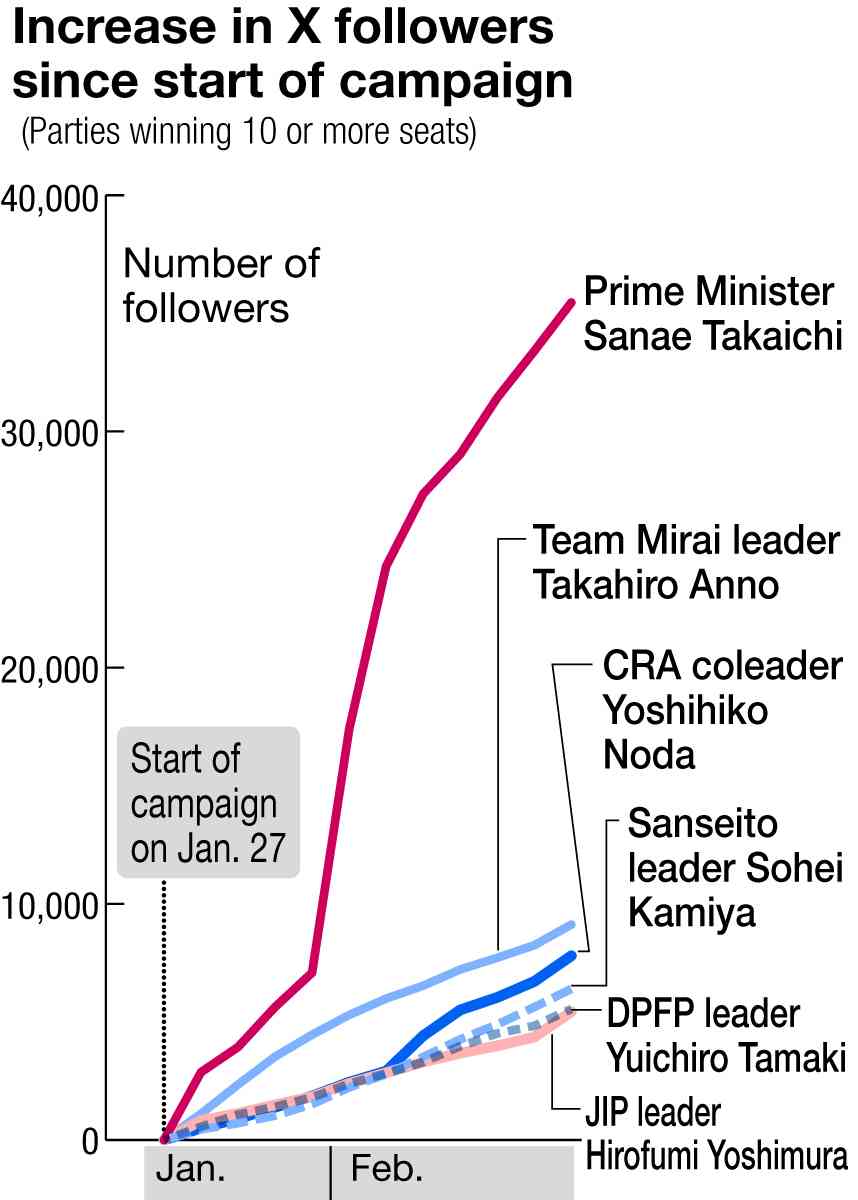
Takaichi’s official X account outpaced all other party leaders during the campaign, gaining about 35,000 followers — a figure that overshadowed those of her rivals.
These findings come from a Yomiuri Shimbun study that used tools from the data analysis firm User Local Inc. to track the follower counts of each leader’s account.
The sharpest spike occurred on Feb. 1, with a single-day gain of about 10,300 followers, despite Takaichi abruptly canceling her appearance on an NHK debate program featuring party leaders that same day.
“I have a chronic condition of rheumatoid arthritis, and my hand has become swollen,” Takaichi posted on X to explain her absence. She clarified that the injury occurred during the campaign, when her hand was strained while shaking hands with supporters at stumping sites, and that she missed the program to receive medical treatment.
Following her treatment, she pressed ahead with her original schedule, traveling through Gifu and Aichi prefectures to deliver a series of stump speeches.
After Feb. 1, a barrage of posts on X attacked Takaichi for supposedly dodging the debate.
However, sympathetic voices were equally prominent, with supporters arguing in posts such as, “Fleeing? Far from it. This is the price of her resolve to stay on the front lines.” Some of the posts defending her went viral, racking up millions of views.
While the LDP’s follower growth on X outpaced that of other parties, it remained eclipsed by the prime minister’s own numbers. This gap underscores how public interest shifted overwhelmingly toward Takaichi as an individual during the campaign.
200 million views
The intense focus on Takaichi was equally striking on YouTube, where election-related videos and livestreams centered on her commanded exceptional levels of engagement.
The total view count for the LDP’s official YouTube content, including advertisements, surpassed the 200 million mark. This figure represents videos posted from one week before the official start of the campaign through the day before the election.
Notably, a video advertisement in which Takaichi declares, “The future is something we must forge with our own hands,” was viewed more than 150 million times.
“With paid video ads, you cannot simply buy your way to high view counts,” observed Tsukasa Tanihara, an associate professor of social informatics at Ritsumeikan University. He noted that Takaichi’s personal popularity was likely the true engine that drove the numbers to such heights.
Videos related to the House of Representatives election posted between the start of the campaign on Jan. 27 and Thursday have garnered a total of about 1.86 billion views, according to the election information website Senkyo.com.
Third-party content, including videos from YouTubers unaffiliated with any campaign, accounted for about 80% of the overall viewership, outperforming official party channels.
The majority of these were edited highlight clips, frequently showcasing Takaichi defeating opposition leaders in debates or maintaining a resolute, unyielding stance toward China.
“Content creators seeking advertising revenue cashed in on Takaichi’s popularity by flooding the platform with videos, which ensured they reached a vast audience,” said Kunikazu Suzuki, the editor-in-chief of Senkyo.com. “This cycle likely played a key role in her landslide victory.”
It is highly likely that Takaichi’s popularity on social media directly converted into tangible votes at the ballot box.
An exit poll conducted on election day by The Yomiuri Shimbun, in collaboration with NHK and Nippon TV network stations, revealed that 24% of respondents relied most on social media and video-sharing sites when deciding whom to vote for.
Among this group, 35% said they voted for the LDP in the proportional representation segment, a dramatic surge from the 7% recorded in last summer’s upper house election.
With the percentage of voters backing Sanseito or the DPFP declining, it appears that those who rely on social media and videos for information have shifted their support to the LDP.


Related Tags


Most Read
Popular articles in the past 24 hours
-

Japanese Shipping Giants Halt Strait of Hormuz Transit as Iran Co...
-

U.S. Launches Attacks on Iran: Avoid Escalation of Conflict by An...
-

Japan Shares and Yen Fall, Jgbs Rise as Iran Strikes Continue
-

Takaichi: Japan Striving to Ensure Safety of Japanese Nationals; ...
-

Sawtooth Roof Factory Stands as Monument to Ashikaga Textile Hist...
-

Kyoto Animation President Hideaki Hatta Dies of Illness at 76; Co...
-

Parents of Japanese Teen Shot in U.S. Strive for Gun Control
-

Disinformation Spreads About Team Mirai, Ballot Readers; Online P...
Popular articles in the past week
-

Nepal Bus Crash Kills 19 People, Injures 25 Including One Japanes...
-

Milano Cortina 2026: Japanese Gold Medalist Figure Skater Miura S...
-

Tokyo Spends Big on Children, Wins Over Parents
-

McDonald's Japan Raises Prices; Big Mac to Cost ¥500, Double Chee...
-

Japan’s Miura, Kihara Announce Withdrawal from Figure Skating Wor...
-

Exhibition Featuring Yoshiharu Tsuge’s Manga World Underway in Ch...
-

Yokohama to Test Out Renewable-Powered Offshore Floating Data Cen...
-

BOJ Keeping Eye on Economy and Takaichi's ‘Proactive Fiscal Polic...
Popular articles in the past month
-

Producer Behind Pop Group XG Arrested for Cocaine Possession
-

Japan PM Takaichi’s Cabinet Resigns en Masse
-

Man Infected with Measles Reportedly Dined at Restaurant in Tokyo...
-

Israeli Ambassador to Japan Speaks about Japan’s Role in the Reco...
-

Videos Plagiarized, Reposted with False Subtitles Claiming ‘Ryuky...
-

Man Infected with Measles May Have Come in Contact with Many Peop...
-

Prudential Life Insurance Plans to Fully Compensate for Damages C...
-

Woman with Measles Visited Hospital in Tokyo Multiple Times Befor...
Top Articles in Politics
-
Japan PM Takaichi’s Cabinet Resigns en Masse
-

Sanae Takaichi Elected Prime Minister of Japan; Keeps All Cabinet Appointees from Previous Term
-

Japan’s Govt to Submit Road Map for Growth Strategy in March, PM Takaichi to Announce in Upcoming Policy Speech
-

LDP Wins Historic Landslide Victory
-

LDP Wins Landslide Victory, Secures Single-party Majority; Ruling Coalition with JIP Poised to Secure Over 300 seats (UPDATE 1)
JN ACCESS RANKING
-
Producer Behind Pop Group XG Arrested for Cocaine Possession
-
Japan PM Takaichi’s Cabinet Resigns en Masse
-
Man Infected with Measles Reportedly Dined at Restaurant in Tokyo Station
-
Israeli Ambassador to Japan Speaks about Japan’s Role in the Reconstruction of Gaza
-
Videos Plagiarized, Reposted with False Subtitles Claiming ‘Ryukyu Belongs to China’; Anti-China False Information Also Posted in Japan