
Overseas Media Criticize Japanese Parties’ Plans to Lower Consumption Tax, Including PM Takaichi’s Temporary Cut Proposal
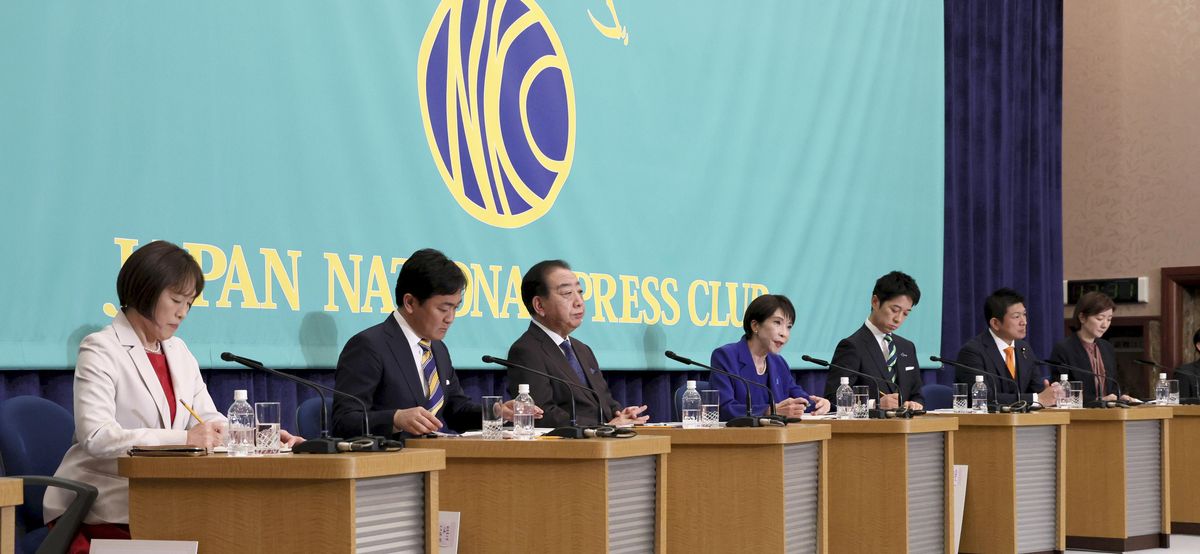
Prime Minister Sanae Takaichi, fourth from left, and other leaders of major parties participate in a debate in Chiyoda Ward, Tokyo, on Jan. 26.
17:29 JST, February 3, 2026
LONDON/BRUSSELS — Many overseas media outlets have criticized the pledges being made by Japan’s major political parties to cut the consumption tax rate in their campaigns for the upcoming House of Representatives election, scheduled for Feb. 8.
Foreign media are concerned that amid increasing government expenditures for social security, Japan would lose a huge amount of revenue and the nation’s fiscal condition would worsen.
Comments have been made likening the tax cut plans to the turmoil caused by then British Prime Minister Liz Truss, whose large-scale tax cut plan drove down government bond prices, stock prices and the value of the British currency.
“Japanese Prime Minister Sanae Takaichi’s plan to temporarily cut the consumption tax on food to zero is undoubtedly a bad idea, and a rather nakedly political one,” a columnist wrote in Bloomberg.
The article directly criticized a joint pledge by the Liberal Democratic Party and the Japan Innovation Party that they would accelerate discussions on eliminating the consumption tax on food for two years.
The reasoning behind the statements is that if the consumption tax rate on food is reduced to zero, the government’s tax revenue is predicted to decrease by about ¥5 trillion annually.
The article suggested that the pledge is just a policy proposal being used to win the general election.
It also urged Japan to invest in fields such as artificial intelligence, semiconductors and defense spending.
“If Japan has a spare 5 trillion yen lying around, as the cut is expected to cost, it could use it far more effectively than as a temporary political boon.”
As for opposition parties, the Centrist Reform Alliance is pledging to make the consumption tax rate on food “permanently” zero, while the Democratic Party for the People is vowing to lower the rate on all goods and services from 10% to 5% under certain conditions.
French newspaper Les Echos stated that because Japan’s outstanding government debt is 230% of the nation’s gross domestic product, it is necessary to maintain the consumption tax as a stable source of revenue.
Even if the LDP’s tax cut plan were realized, the newspaper said that there would be zero effect on boosting GDP in the second year.
Although the LDP and JIP plan to cut the consumption tax on food for a two-year period, it is predicted that resuming the tax would face opposition from the public, who will see it as effectively being a tax hike.
Thus, it is being questioned whether the government would actually be able to resume the tax rate on food.
Les Echos’ article predicted that no Japanese administration would be brave enough to resume the consumption tax rate on food.
In Japan, long-term interest rates have been rising over concern that the country’s fiscal condition will worsen.
Belgian newspaper De Standaard presented a view that Takaichi will face a situation similar to the one that Truss experienced.


Related Tags


Most Read
Popular articles in the past 24 hours
-

Trump Fires Homeland Security Secretary Noem after Mounting Criti...
-

Japanese Nationals in 4 Gulf Countries to Be Evacuated with Chart...
-

China’s National People’s Congress Opens: Military Expansion Cont...
-

Hanamaruki to Sell Liquid 'Shio-Koji' Seasoning to U.S. Consumers
-

Strawberry Prince’s Rinu Discusses His Dream of Voice Acting, Suc...
-
Japan Foreign Minister Confirms Two Japanese Detained in Iran
-

CARTOON OF THE DAY (March 6)
-

Donald Keene’s Drinking Buddy and Translator Yukio Kakuchi Pays T...
Popular articles in the past week
-

South Korea Tightens Rules on Foreigners Buying Homes in Seoul Me...
-

2 Unpublished Early Novellas by Japan's Kenzaburo Oe Discovered, ...
-

Strait of Hormuz Closure Shakes Markets; Prolonged Closure Could ...
-

Iran Situation: Japan Must Exert Diplomatic Efforts without Merel...
-

Amid Strait of Hormuz Blockade, Shipping Companies Scramble to Ge...
-
Measles Patient Visited Hospital in Bunkyo Ward, Tokyo, Metropoli...
-

Ibaraki Pref.'s 1st Foreign Bus Driver Hired in Tsukuba
-

Tokyo’s ‘Strawberry War’ Intensifies as Producers Vie to Become ‘...
Popular articles in the past month
-

Producer Behind Pop Group XG Arrested for Cocaine Possession
-

Japan PM Takaichi’s Cabinet Resigns en Masse
-

Man Infected with Measles Reportedly Dined at Restaurant in Tokyo...
-

Videos Plagiarized, Reposted with False Subtitles Claiming ‘Ryuky...
-

Prudential Life Insurance Plans to Fully Compensate for Damages C...
-

Woman with Measles Visited Hospital in Tokyo Multiple Times Befor...
-

iPS Treatments Pass Key Milestone, but Broader Applications Far f...
-

Sanae Takaichi Elected Prime Minister of Japan; Keeps All Cabinet...
Top Articles in Politics
-
Japan PM Takaichi’s Cabinet Resigns en Masse
-
Sanae Takaichi Elected Prime Minister of Japan; Keeps All Cabinet Appointees from Previous Term
-

Japan’s Govt to Submit Road Map for Growth Strategy in March, PM Takaichi to Announce in Upcoming Policy Speech
-

LDP Wins Landslide Victory, Secures Single-party Majority; Ruling Coalition with JIP Poised to Secure Over 300 seats (UPDATE 1)
-

LDP Wins Historic Landslide Victory
JN ACCESS RANKING
-
Producer Behind Pop Group XG Arrested for Cocaine Possession
-
Japan PM Takaichi’s Cabinet Resigns en Masse
-
Man Infected with Measles Reportedly Dined at Restaurant in Tokyo Station
-
Videos Plagiarized, Reposted with False Subtitles Claiming ‘Ryukyu Belongs to China’; Anti-China False Information Also Posted in Japan
-
Prudential Life Insurance Plans to Fully Compensate for Damages Caused by Fraudulent Actions Without Waiting for Third-Party Committee Review