
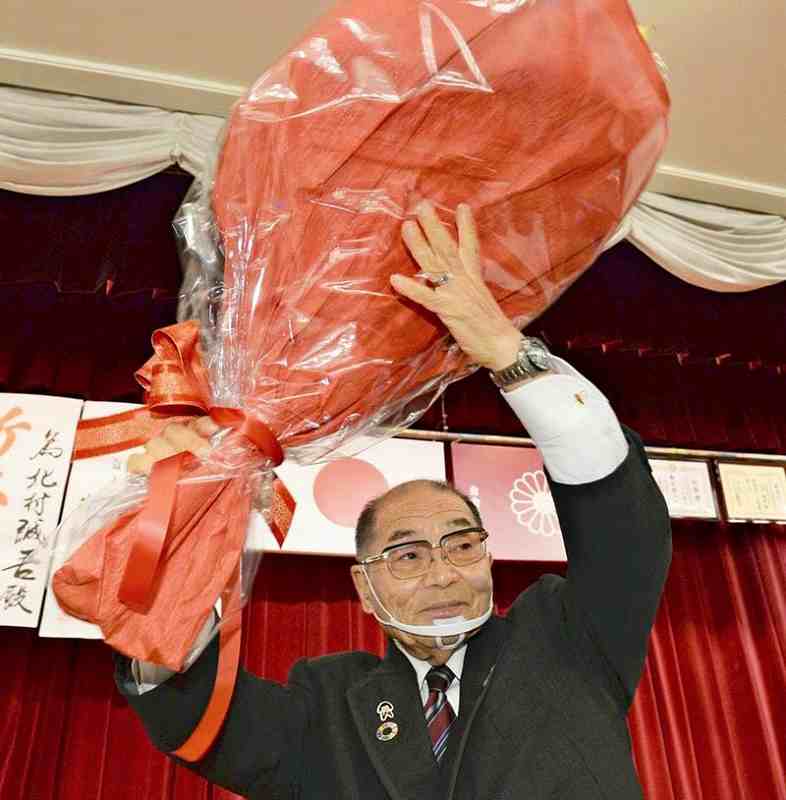
Liberal Democratic Party member Seigo Kitamura celebrates his victory in Nagasaki Constituency No. 4 early on Monday in Sasebo, Nagasaki Prefecture.
November 4, 2021
Of the 187 LDP candidates who won their single-seat constituencies in Sunday’s House of Representatives election, 34 of them prevailed by margins of less than five percentage points.
This was twice as many as the 17 narrow winners in the 2012 election. In the 2014 election, there were 22, going up to 27 in the previous general election in 2017.
In Sunday’s election, there were also 28 opposition party candidates who won with the same narrow margin.
The LDP seems to have maintained its majority by barely winning more one-on-one battles against candidates fielded jointly by five opposition parties in the bulk of single-seat constituencies.
The narrowest victory for the LDP was by 391 votes in Nagasaki Constituency No. 4. Seigo Kitamura, 74, who had once been minister of state for regional revitalization, defeated a never-before-elected Constitutional Democratic Party of Japan candidate by 0.3 percentage points.
“During the campaign, I was anxious and had no idea what was going to happen,” Kitamura said early Monday morning after he was declared the victor. “I’m so full of emotion.”
Of the 34 narrow LDP victors, 33 were pitted against a single candidate fielded by the five opposition parties, leading a senior LDP official to admit that the opposition’s strategy was effective to a certain degree.
In the 62 constituencies decided by less than five percentage points, the LDP’s record was 34-28. In Hokkaido, where the opposition parties are strong, the CDPJ had a 3-2 record in close battles, and in Tokyo with its many independents, the CDPJ was 5-3. On the other hand, in Aichi Prefecture, where labor unions have strong influence on voting, the LDP had a 4-0 record, and in Nagano Prefecture, where the CDPJ has built a strong base, the LDP was 2-0. Even in Okinawa Prefecture, the LDP was 1-1.
“The figures show that our party used all its strength to win in close constituencies,” said Hiroshige Seko, secretary general for the LDP in the House of Councillors.
Overall, 59 LDP candidates won by a margin of less than 10 percentage points. If they had all lost, the LDP would not have secured a single-party majority of 233 seats.
Since the LDP returned to power in 2012, the number of LDP candidates who won by a margin of more than 10 percentage points has been on the decline, from 188 that year to 128 in Sunday’s election.
Public opinion tends to have a strong influence on single-seat constituencies.
“We must govern with a greater sense of vigilance than before,” a member of Prime Minister Fumio Kishida’s Cabinet said.







Most Read
Popular articles in the past 24 hours
-
JR Tokai Breaks Ground on Yamanashi Maglev Station; Will Be Part ...
-
‘King Kazu’ Discusses His Connection to Fukushima
-

Japan’s Gunma Official Suspended For Unauthorized Absence From Wo...
-

Milano Cortina 2026: Japan’s Alpine Skier Muraoka Extends P...
-
Rising Kabuki Star Works to Ensure Deaf Audience's Enjoyment of P...
-

Lady Bess: Iroha Okuda, Mayuko Kominami Discuss Performing Elizab...
-

Japan Considering Taking Part in U.S. ‘Golden Dome’ Defense Syste...
-

Trump Discourages Iranian Soccer Team from Attending the World Cu...
Popular articles in the past week
-

Japan Figure Skating Legend Yuzuru Hanyu Is Proud Disaster Surviv...
-

Nippon Life Insurance's U.S. Arm Sues OpenAI Over Legal Assistanc...
-
Govt to Utilize ODA for Ensuring Economic Security; Securing Ener...
-
Massive Sewer Pipe Found Jutting Out of Highway in Osaka
-
15 Measles Patients Confirmed in Tokyo in Past 6 Days; 1 May Have...
-

Beckoning Cats Get Makeover to Fit Modern Lifestyles with Sleek D...
-

Japan Govt to Tighten Requirements to Receive Permanent Residency...
-
Japan Govt Survey Finds Just 10% of Workers Want Working Hours to...
Popular articles in the past month
-

Producer Behind Pop Group XG Arrested for Cocaine Possession
-

Japan PM Takaichi’s Cabinet Resigns en Masse
-

Man Infected with Measles Reportedly Dined at Restaurant in Tokyo...
-

Videos Plagiarized, Reposted with False Subtitles Claiming ‘Ryuky...
-
Japan Figure Skating Legend Yuzuru Hanyu Is Proud Disaster Surviv...
-

iPS Treatments Pass Key Milestone, but Broader Applications Far f...
-

Sanae Takaichi Elected Prime Minister of Japan; Keeps All Cabinet...
-

Nepal Bus Crash Kills 19 People, Injures 25 Including One Japanes...
Top Articles in Politics
-
Japan PM Takaichi’s Cabinet Resigns en Masse
-
Sanae Takaichi Elected Prime Minister of Japan; Keeps All Cabinet Appointees from Previous Term
-

Japan’s Govt to Submit Road Map for Growth Strategy in March, PM Takaichi to Announce in Upcoming Policy Speech
-
LDP Begins Training New Lawmakers to Avoid Scandal, Gaffes; Historic Victory in Latest Election Heightens Focus on Party
-

Japan PM Sanae Takaichi Welcomes Peach Ambassadors Koga Momo Musume to Official Residence
JN ACCESS RANKING
-
Producer Behind Pop Group XG Arrested for Cocaine Possession
-
Japan PM Takaichi’s Cabinet Resigns en Masse
-
Man Infected with Measles Reportedly Dined at Restaurant in Tokyo Station
-
Videos Plagiarized, Reposted with False Subtitles Claiming ‘Ryukyu Belongs to China’; Anti-China False Information Also Posted in Japan
-
Japan Figure Skating Legend Yuzuru Hanyu Is Proud Disaster Survivor and Gold Medalist, Vows to Continue Support Efforts