
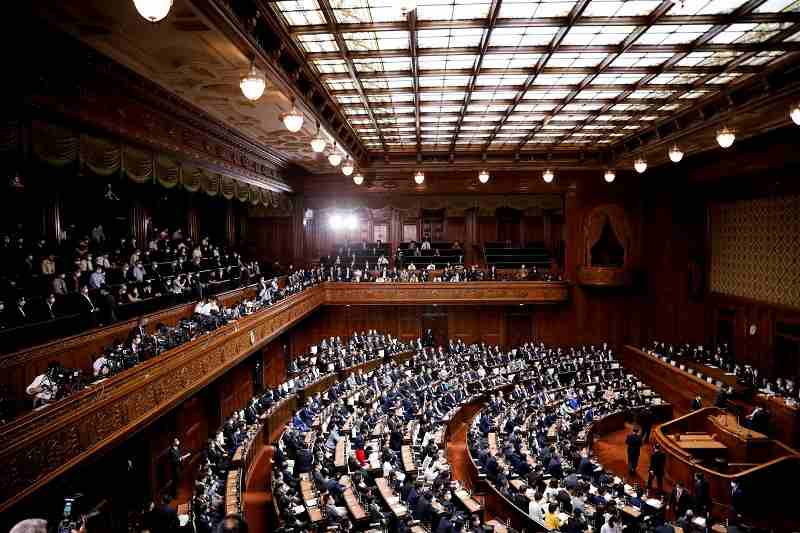
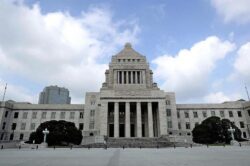
Lawmakers attend a session to cast a vote to elect Japan’s new prime minister at the Lower House of the Parliament in Tokyo, Japan October 4, 2021.
17:32 JST, October 28, 2021
A Yomiuri Shimbun survey of candidates running in the upcoming House of Representatives election has shown clear differences among the parties regarding foreign and security policies.
Ruling coalition candidates of the Liberal Democratic Party and Komeito were split over the issue of possessing the capability to attack enemy bases based on the right of self-defense.
In the survey, 77% of LDP candidates were in favor of having the capability, while 83% of Komeito candidates were against it.
Among the opposition parties, almost all respondents from the Constitutional Democratic Party of Japan, Japanese Communist Party and Social Democratic Party were against the idea, while 93% of Nippon Ishin no Kai (Japan Innovation Party) candidates supported it.
Regarding defense spending, 79% of LDP candidates and 89% of Ishin candidates said it should be increased, the highest percentages among the parties, while 69% of Komeito candidates and 59% of CDPJ candidates said spending on defense should remain unchanged. Nearly all JCP candidates said defense spending should be reduced.
Candidates’ stances on defense capabilities appeared to be linked to their party’s views on Japan’s relationship with the United States and China: 59% of the candidates who prioritized ties with the United States were positive about increasing defense spending, while 72% of those who thought Asia was the priority said defense costs should be cut.
A similar trend was seen regarding whether Japan should have the capability to attack enemy bases.
The responses also appear to have been influenced by the candidates’ views on China’s maritime expansion — such as its intrusions into territorial waters around the Senkaku Islands in Okinawa Prefecture and the navigation of its warships in waters around the Nansei island chain.
Overall, respondents appeared to be concerned about human rights issues in China, which has strengthened hegemonic moves by steadily building up its military. However, most were in favor of maintaining the bilateral relationship with Japan’s largest trading partner in the economic field.
Western countries have continued to impose de facto economic sanctions against China over human rights concerns in the Xinjiang Uygur Autonomous Region. Just under 60% of the respondents said Japan should also impose sanctions — 66% of LDP candidates, 51% of CDPJ candidates, 61% of JCP candidates, 86% of Ishin candidates and 63% of Democratic Party for the People candidates.
On the other hand, 61% of respondents said they are in favor of maintaining the status quo regarding economic ties with China, with little difference among the ruling and opposition parties. Notably, the figure was also 61% among respondents who said sanctions should be imposed against China.
Meanwhile, the majority of Komeito candidates were negative about sanctions, with 86% of its candidates saying dialogue with China should continue.
The Japan-China relationship was once described as being “politically cool and economically hot,” with economic ties maintained even when diplomatic relations deteriorate.
The results of the survey indicate that candidates still seem to favor such a relationship.
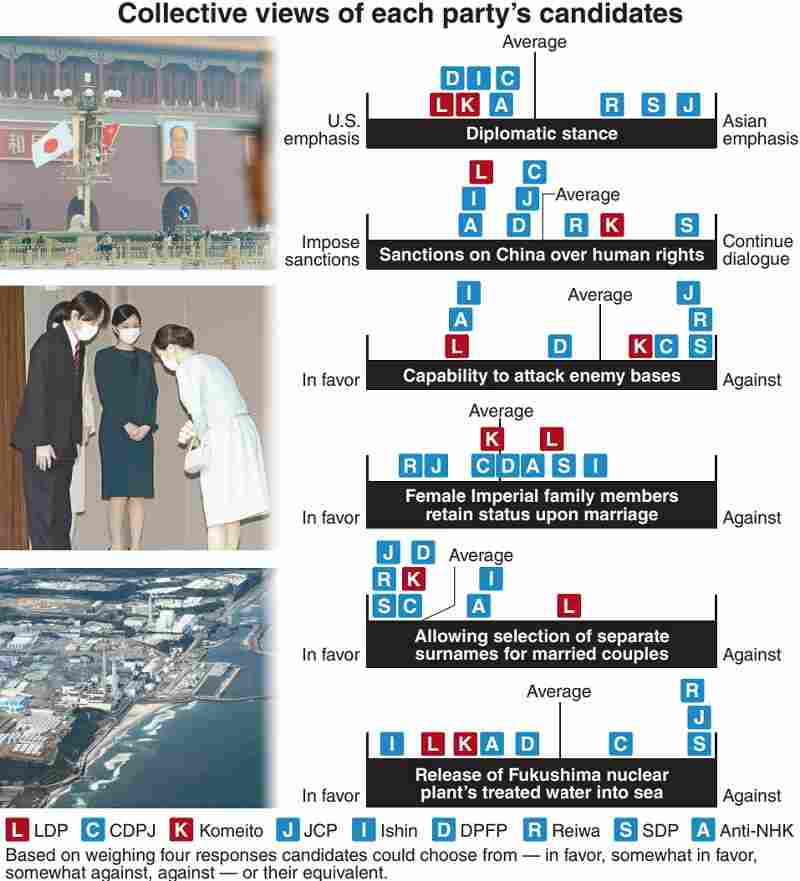
An Illustration : Collective views of each party’s candidates





Most Read
Popular articles in the past 24 hours
-
Japanese High School Student Aims to Share Kaiten History Through...
-
Business Hotels Expanding into Regional Areas in Japan, Aiming to...
-
Milano Cortina 2026: Japan Sees Leap in Olympic Performance Throu...
-

Milano Cortina 2026: Japan's Satoshi Furuno Places 4th in Men's S...
-

Milano Cortina 2026: Speed Skater Takagi Finishes 6th in the 1,50...
-

Osaka: 40 Ninjas Display Shuriken Throwing Skills at Japan Champi...
-

Fiji Defense Minister Hopes Japan Will Support Stabilization of P...
-

Milano Cortina 2026: Malinin Highlights Dangers of Social Media i...
Popular articles in the past week
-

Japan PM Takaichi’s Cabinet Resigns en Masse
-

Man Infected with Measles Reportedly Dined at Restaurant in Tokyo...
-

Sanae Takaichi Elected Prime Minister of Japan; Keeps All Cabinet...
-

Japan's Govt to Submit Road Map for Growth Strategy in March, PM ...
-

Bus Carrying 40 Passengers Catches Fire on Chuo Expressway; All E...
-

Milano Cortina 2026: Figure Skaters Riku Miura, Ryuichi Kihara Pa...
-

Japan, U.S. Name 3 Inaugural Investment Projects; Reached Agreeme...
-
U.S. Firm to Build Training Hub in Fukushima N-plant for Debris R...
Popular articles in the past month
-
Japan PM Takaichi’s Cabinet Resigns en Masse
-

Japan Institute to Use Domestic Commercial Optical Lattice Clock ...
-

Israeli Ambassador to Japan Speaks about Japan’s Role in the Reco...
-
Man Infected with Measles Reportedly Dined at Restaurant in Tokyo...
-

Videos Plagiarized, Reposted with False Subtitles Claiming ‘Ryuky...
-

Man Infected with Measles May Have Come in Contact with Many Peop...
-

Prudential Life Insurance Plans to Fully Compensate for Damages C...
-

Woman with Measles Visited Hospital in Tokyo Multiple Times Befor...
Top Articles in Politics
-
Japan PM Takaichi’s Cabinet Resigns en Masse
-
Sanae Takaichi Elected Prime Minister of Japan; Keeps All Cabinet Appointees from Previous Term
-
Japan’s Govt to Submit Road Map for Growth Strategy in March, PM Takaichi to Announce in Upcoming Policy Speech
-

LDP Wins Historic Landslide Victory
-

LDP Wins Landslide Victory, Secures Single-party Majority; Ruling Coalition with JIP Poised to Secure Over 300 seats (UPDATE 1)
JN ACCESS RANKING
-
Japan PM Takaichi’s Cabinet Resigns en Masse
-
Japan Institute to Use Domestic Commercial Optical Lattice Clock to Set Japan Standard Time
-
Israeli Ambassador to Japan Speaks about Japan’s Role in the Reconstruction of Gaza
-
Man Infected with Measles Reportedly Dined at Restaurant in Tokyo Station
-
Videos Plagiarized, Reposted with False Subtitles Claiming ‘Ryukyu Belongs to China’; Anti-China False Information Also Posted in Japan