
Takaichi’s Strategy of Preemptively Telling Trump Plan to Increase Defense Expense Appears Successful for Now
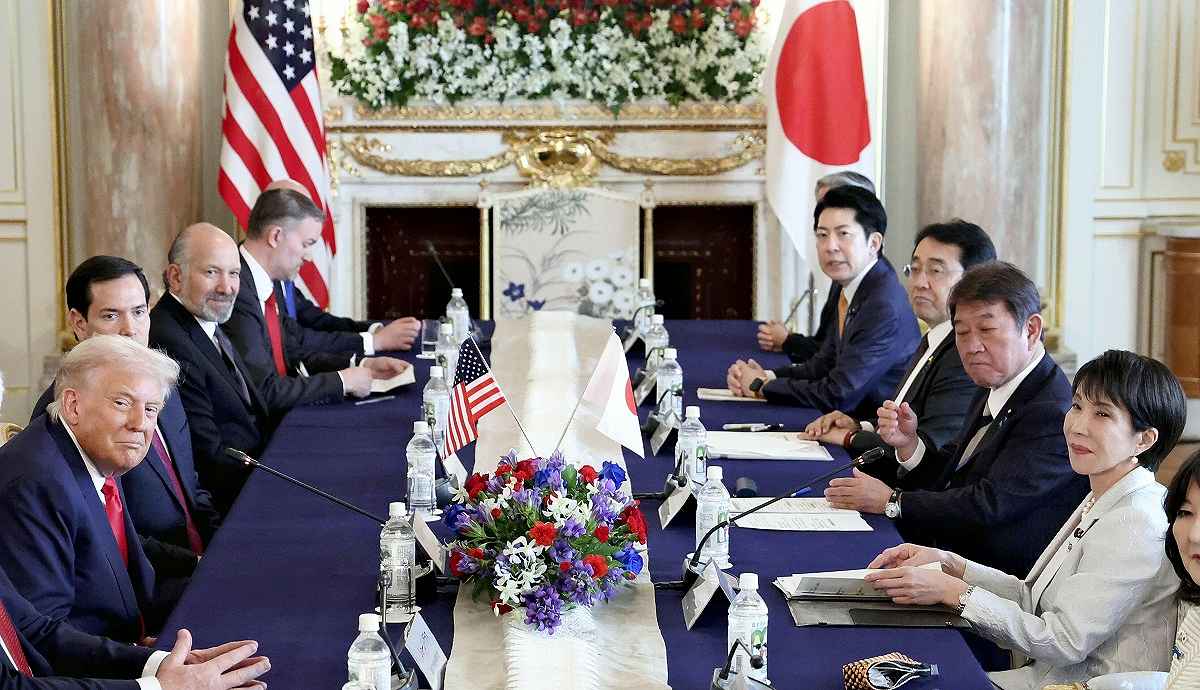
Prime Minister Sanae Takaichi, far right, and U.S. President Donald Trump, far left, hold a Japan-U.S. summit meeting on Tuesday at the State Guest House Akasaka Palace in Tokyo.
14:02 JST, October 29, 2025
One of the main subjects that was expected to be discussed in Tuesday’s Japan-U.S. summit was an increase in defense spending, which U.S. President Donald Trump has been demanding of many allies and like-minded nations.
Prime Minister Sanae Takaichi told Trump about her plan to increase Japan’s defense spending before he could demand it; however, it remains possible that he will ask for Japan to specify the exact size of the increase in the future.
“I told him that Japan is determined to make proactive efforts to increase defense spending and boost its defense capabilities,” Takaichi said to reporters after she met with Trump.
She is believed to have explained to Trump her plan to work on raising security-related expenditures, including defense spending — which sat at approximately ¥8.47 trillion for fiscal 2025, to 2% of the gross domestic product this fiscal year, as well as to revise the three security documents, including the National Security Strategy, ahead of schedule.
Japanese officials were aware that Trump did not make any specific demand for Australia to increase defense spending during his summit meeting with that country’s leadership this month. Thus, there was speculation within the Foreign Ministry that Trump might not make such a demand of Japan, either. Takaichi, however, chose a strategy of seeking to satisfy him by preemptively telling him of the increase.
The Japanese government’s preparation was so thorough that the Defense Ministry had coordinated and obtained approval from the Finance Ministry beforehand regarding Takaichi’s plan to tell Trump of the intended budget increase.
This strategy succeeded, and Trump did not mention the scale of the defense spending increase. A senior government official breathed a sigh of relief, saying, “He basically understood Japan’s efforts.”
However, the North Atlantic Treaty Organization (NATO) has decided to raise its requirement for defense-related spending, including infrastructure development, to 5% of each member country’s GDP by 2035, reflecting Trump’s demands. Taiwan has also decided to increase its defense spending to 3.32% of GDP in its next fiscal year budget proposal. Japan may eventually have no choice but to specify exactly how much it will add to its defense budget.
Negotiations over Japan’s share of the cost of stationing U.S. forces in Japan are also expected to be difficult. The current deal expires in March 2027. During the first Trump administration, the U.S. government demanded that Japan pay shoulder a significantly greater part of the financial burden.
A senior Defense Ministry official said, “We are prepared for intense discussions with representatives of the U.S.”


Related Tags
Most Read
Popular articles in the past 24 hours
-

‘Dry Bonsai’ Gives New Life to Withered Trees, Allows Free Artist...
-

McDonald's Japan Raises Prices; Big Mac to Cost ¥500, Double Chee...
-

Nepal Bus Crash Kills 19 People, Injures 25 Including One Japanes...
-

Japan’s Nikkei Stock Average Rises as AI-Related Stocks Shine; Co...
-

Aggression against Ukraine: Malignant Precedent Must Not Be Set t...
-
Joruri Bunraku Narrative Performed in Honor of Donald Keene by La...
-

Astellas Collaborates with Vir to Develop Its Experimental Prosta...
-

Early-Blooming Kawazu Cherry Blossoms Create Sea of Pink at Park ...
Popular articles in the past week
-

Producer Behind Pop Group XG Arrested for Cocaine Possession
-

Japan PM Takaichi’s Cabinet Resigns en Masse
-

Sanae Takaichi Elected Prime Minister of Japan; Keeps All Cabinet...
-

Japan's Govt to Submit Road Map for Growth Strategy in March, PM ...
-

Bus Carrying 40 Passengers Catches Fire on Chuo Expressway; All E...
-

Japan, U.S. Name 3 Inaugural Investment Projects; Reached Agreeme...
-

Riku-Ryu Pair Wins Gold Medal: Their Strong Bond Leads to Major C...
-
Tokyo Skytree's Elevator Stops, Trapping 20 People; All Rescued (...
Popular articles in the past month
-
Producer Behind Pop Group XG Arrested for Cocaine Possession
-
Japan PM Takaichi’s Cabinet Resigns en Masse
-

Japan Institute to Use Domestic Commercial Optical Lattice Clock ...
-

Man Infected with Measles Reportedly Dined at Restaurant in Tokyo...
-

Israeli Ambassador to Japan Speaks about Japan’s Role in the Reco...
-

Videos Plagiarized, Reposted with False Subtitles Claiming ‘Ryuky...
-

Man Infected with Measles May Have Come in Contact with Many Peop...
-

Prudential Life Insurance Plans to Fully Compensate for Damages C...
Top Articles in Politics
-
Japan PM Takaichi’s Cabinet Resigns en Masse
-
Sanae Takaichi Elected Prime Minister of Japan; Keeps All Cabinet Appointees from Previous Term
-
Japan’s Govt to Submit Road Map for Growth Strategy in March, PM Takaichi to Announce in Upcoming Policy Speech
-

LDP Wins Historic Landslide Victory
-

LDP Wins Landslide Victory, Secures Single-party Majority; Ruling Coalition with JIP Poised to Secure Over 300 seats (UPDATE 1)
JN ACCESS RANKING
-
Producer Behind Pop Group XG Arrested for Cocaine Possession
-
Japan PM Takaichi’s Cabinet Resigns en Masse
-
Japan Institute to Use Domestic Commercial Optical Lattice Clock to Set Japan Standard Time
-
Man Infected with Measles Reportedly Dined at Restaurant in Tokyo Station
-
Israeli Ambassador to Japan Speaks about Japan’s Role in the Reconstruction of Gaza