
Ishiba Seeks Continued U.S. Involvement in Ukraine; Warns Against Letting Russia See Democracies Divided
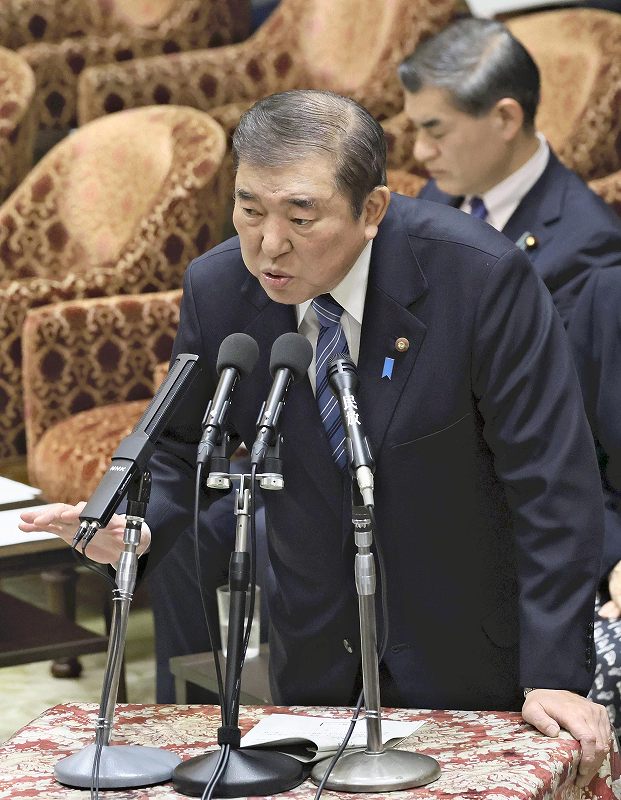
Prime Minister Shigeru Ishiba answers questions at the House of Representatives Budget Committee on Monday.
13:22 JST, March 4, 2025
Prime Minister Shigeru Ishiba said Monday he believed that continued U.S. involvement was crucial for Ukraine and that he would strive for that to happen in the wake of the sudden breakdown in talks between U.S. President Donald Trump and Ukrainian President Volodymyr Zelenskyy.
Ishiba also called for unity among the Group of Seven nations, which includes four European countries.
“Without the United States’ involvement, will this [Russia’s aggression against Ukraine] really end?” Ishiba said at a House of Representatives Budget Committee meeting when asked about the breakdown of the recent U.S.-Ukraine summit meeting in the White House.
The remark highlights Ishiba’s belief that the backing of the United States is essential for a ceasefire. He then added, “I want to work hard to keep the United States involved.”
After the breakdown, European countries and others came to the defense of Zelenskyy, distancing themselves from the United States in ways such as by putting together a plan to send a peacekeeping force to Ukraine after a ceasefire.
“Most of all, the G7 must remain united,” Ishiba said, calling for cooperation between the United States and Europe.
At the same time, Ishiba stressed that he had “no intention of taking either sides” between the United States and Ukraine. He seemed to believe that allowing Russia to see division among Japan, the United States and Europe is not a good idea. He will likely observe how each country responds in the future.
A senior Foreign Ministry official said, “It is not productive to judge which side — the United States or Ukraine — is right in promoting ceasefire negotiations.”
Chief Cabinet Secretary Yoshimasa Hayashi also told reporters Monday that he saw the breakdown as “a step in the process of breaking through the difficult situation.”
Japan, meanwhile, has felt a sense of crisis that a ceasefire could be reached in a way that would allow Russia to change the status quo by force, an outcome that could provoke a similar situation over Taiwan, where China is increasing its pressure.
Ishiba said Monday at the meeting, “We must think about how to make our deterrent capability effective in the Taiwan Strait.”





Most Read
Popular articles in the past 24 hours
-

3,000 Accounts Posting, Spreading Content Critical of Japan on X;...
-

Milano Cortina 2026: Sakamoto Serves as Flag Bearer; Japan Earns ...
-

A Packed Bus Plunges off a Nepal Highway, Killing 19 and Injuring...
-

Milano Cortina 2026: There Were Cheers across the Country, after ...
-

Luna Sea Drummer Shinya Dies at 56; Powerful Drummer Behind ‘Desi...
-

Milano Cortina 2026: ‘Magical’ Italian Games Close wi...
-

Milano Cortina 2026: Riku-Ryu Duo Stick Together During Closing C...
-
Emperor Receives Well-Wishes from Public on His 66th Birthday
Popular articles in the past week
-

Japan PM Takaichi’s Cabinet Resigns en Masse
-

Man Infected with Measles Reportedly Dined at Restaurant in Tokyo...
-

Sanae Takaichi Elected Prime Minister of Japan; Keeps All Cabinet...
-

Japan's Govt to Submit Road Map for Growth Strategy in March, PM ...
-

Bus Carrying 40 Passengers Catches Fire on Chuo Expressway; All E...
-

U.S. Firm to Build Training Hub in Fukushima N-plant for Debris R...
-

Japan, U.S. Name 3 Inaugural Investment Projects; Reached Agreeme...
-

Riku-Ryu Pair Wins Gold Medal: Their Strong Bond Leads to Major C...
Popular articles in the past month
-
Japan PM Takaichi’s Cabinet Resigns en Masse
-

Japan Institute to Use Domestic Commercial Optical Lattice Clock ...
-

Israeli Ambassador to Japan Speaks about Japan’s Role in the Reco...
-
Man Infected with Measles Reportedly Dined at Restaurant in Tokyo...
-

Videos Plagiarized, Reposted with False Subtitles Claiming ‘Ryuky...
-

Man Infected with Measles May Have Come in Contact with Many Peop...
-

Prudential Life Insurance Plans to Fully Compensate for Damages C...
-

Woman with Measles Visited Hospital in Tokyo Multiple Times Befor...
Top Articles in Politics
-
Japan PM Takaichi’s Cabinet Resigns en Masse
-
Sanae Takaichi Elected Prime Minister of Japan; Keeps All Cabinet Appointees from Previous Term
-
Japan’s Govt to Submit Road Map for Growth Strategy in March, PM Takaichi to Announce in Upcoming Policy Speech
-

LDP Wins Historic Landslide Victory
-

LDP Wins Landslide Victory, Secures Single-party Majority; Ruling Coalition with JIP Poised to Secure Over 300 seats (UPDATE 1)
JN ACCESS RANKING
-
Japan PM Takaichi’s Cabinet Resigns en Masse
-
Japan Institute to Use Domestic Commercial Optical Lattice Clock to Set Japan Standard Time
-
Israeli Ambassador to Japan Speaks about Japan’s Role in the Reconstruction of Gaza
-
Man Infected with Measles Reportedly Dined at Restaurant in Tokyo Station
-
Videos Plagiarized, Reposted with False Subtitles Claiming ‘Ryukyu Belongs to China’; Anti-China False Information Also Posted in Japan