
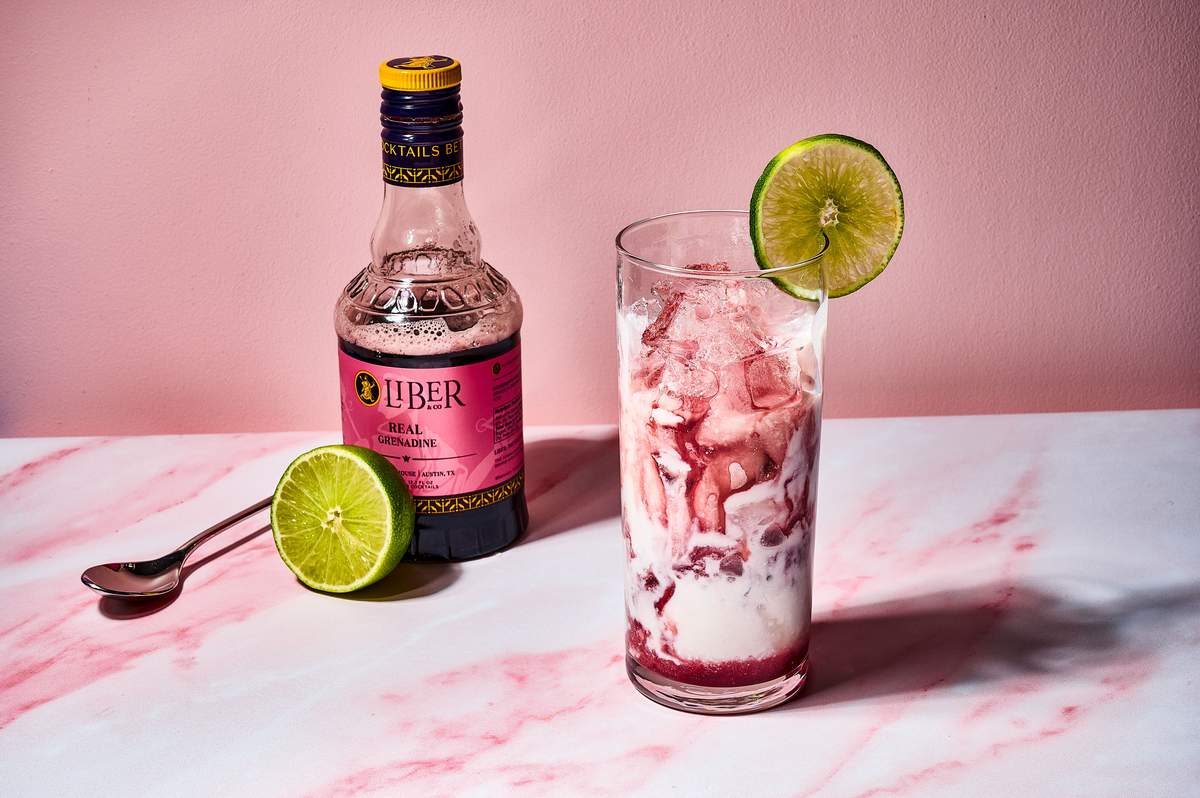
Grenadine Egg Cream, pictured before the soda is added to the glass, highlights the ruby-red color and bright, fruity flavors of real grenadine.
13:15 JST, February 10, 2026
The first time I had grenadine – and the first time you probably had grenadine – was in a kiddie cocktail. A Shirley Temple. (Or a Roy Rogers, if the restaurant believed in rigid gender binaries.) It felt thrilling, because it was your first brush with the adult bar, a tiny act of culinary transgression. Grenadine! That was the stuff grown-ups used. Pour a little into a glass of soda, drop in a cherry, add a paper umbrella or a plastic sword, and suddenly you were the most sophisticated 6-year-old in the dining room.
Then you grow up and discover that grenadine, at least as most Americans know it, isn’t very fancy at all. What is it exactly? This syrup that’s the color of a casino carpet and roughly as natural? Ask the average American what grenadine actually is, and you’ll witness the birth of a guess in real time.
Cherry syrup? No? Berries, then? Still no? Ummm … maybe red-flavored … red stuff?
Unfortunately, yes.
It wasn’t always this way, of course. Like many great American stories, this one begins with an immigrant who crossed an ocean with a dream, and the foolish belief that if you make something good and work as hard as you can, the market might reward you for it.
Victor Rillet, a 21-year-old Frenchman, disembarked the steamship Washington at Ellis Island in October 1864, carrying the kind of optimism that fuels both great innovation and spectacular disappointment. Exactly five years after his arrival, he took his first big step toward the American Dream, securing U.S. Patent 0095605-A for “An Improved Sirup for Flavoring Beverages.”
His process was impressive. Whole, pressed pomegranates were fermented, clarified with glue and egg whites, blended with sugar and vanilla, tinted with red dye derived from crushed cochineal insects, before the concoction was bottled up and called grenadine – from “grenade,” the French word for pomegranate. It was labor-intensive, costly to produce and tasted like the fruit from which it came, which at the time wasn’t commercially farmed in America, and certainly not grown anywhere close to New York City. There were easier products to bank one’s fortunes on, but Rillet knew he had a good thing and was certain the public would appreciate it.
And they did. So much so that by June 1870, Rillet filed a trademark injunction with the New York Supreme Court, trying to stop a competitor who had borrowed the name while abandoning the process. Justice Calvin E. Pratt initially sided with Rillet – pointing out that one man had invested heavily in creating both product and trust, while the other was simply coasting off the hard work of others – and refused to dismiss the complaint. Honesty and integrity persevered!
For three months.
When the case was brought to trial that September, the defendant argued that the name “grenadine” was at its core a French word, and it wouldn’t be right for anyone to be able to trademark a piece of a foreign language. The judge agreed.
Grenadine was no longer a recipe, but a branding opportunity. And with that, Victor Rillet’s name, business and product disappear from history.
This is the part of the story where Americans traditionally reassure themselves that competition improves quality. What it often improves, of course, is margin.
What followed was a free-market free-for-all in which the flavor of pomegranates was fictional; beverage manuals from the late 1800s list formulas involving clove oil, orange oil, ginger extract, phosphoric acid, maraschino liqueur and red dye, and even that was considered trying too hard for the majority of the marketplace. If you were drinking grenadine in the late 19th century, it was nearly identical to what you are drinking today: water, sugar, powdered acid and enough added coloring to glow like a hazard light.
This sort of skulduggery wasn’t limited to just the grenadine market, of course. Without any sort of legal regulations, America’s industrial food market was rife with tampering, from milk diluted with pond water to cheese made more orange with red lead. It wasn’t until 1906 that the government got involved, when Theodore Roosevelt signed the Pure Food and Drug Act, a piece of controversial legislation born from the radical belief that food should, at the bare minimum, be food.
Six years later, federal authorities in Boston seized a shipment of “Guaranteed Wholesome Artificially Colored Grenadine Syrup” from the C.A. Theller Co. and brought the company to court, alleging that as per the name, grenadine implied a pomegranate-based syrup. But Theller Co. argued that the public didn’t actually know what grenadine was, or was supposed to be, because most Americans didn’t speak French. Moreover, the company claimed it had made a true and honest attempt to use real pomegranate in its product, but found the results “unsatisfactory both as to color and flavor” in comparison with red-dyed sugar water.
Once again, the courts ruled for profits over pomegranates.
The matter came up again in 1915 in United States v. Wakem & McLaughlin, when the federal government was taxing grenadine as a fruit syrup, but the manufacturers – who were categorizing and selling it as a fruit product – claimed that as an artificial product made with synthetically produced citric acid, it should be taxed at a lower rate. Under oath, a representative for the company stated that within the trade, the inclusion of actual fruit isn’t necessary for something to be considered a fruit syrup. And with that, the matter was settled for good.
And so, for more than a century, most grenadine sold in the United States has tasted … fine. Cloying. Vaguely red. Perfectly acceptable when diluted into soda and nostalgia, but not the kind of ingredient you’d want to build a drink around.
Fortunately, things change. As drinkers have begun demanding more from what’s in their glass – alcoholic or otherwise – a handful of producers have brought back real grenadine. Brands like Liber & Co. make theirs with actual pomegranate juice and a whisper of orange flower water. El Guapo takes a Cajun turn, folding Ponchatoula strawberries into the mix. The result is something that tastes like fruit, not food coloring.
You can also make grenadine at home with little more than pomegranate juice and sugar. And real grenadine is genuinely good – complex, tart, floral and bright. It’s something you actually want to taste.
That matters more than ever as nonalcoholic cocktails move beyond juice blends and into zero-proof spirits that cost enough to feel like an indulgence. When alcohol isn’t there to blur the edges, every ingredient has to earn its place. A syrup that tastes thin or artificial has nowhere to hide.
But good grenadine isn’t just for mocktails or cocktails. It’s excellent stirred into lemonade or iced tea, or added to sparkling water for something that feels celebratory without being sweet. And it shines in one of my favorite retro drinks: a ruby-red egg cream.
Because most grenadines (including homemade versions) are slightly acidic, they’ll curdle dairy milk. Coconut milk, however, is a different story. It turns the drink lush and creamy, with just enough sweetness to balance the pomegranate’s bite. A squeeze of lime pulls it all together, transforming a childhood soda fountain classic into something a little more grown up – the kind of drink that would have made your 6-year-old self feel impossibly cool.
Turns out grenadine really was fancy all along. We just forgot what it was supposed to taste like.








Most Read
Popular articles in the past 24 hours
-

Seeking Nuclear Waste Site, Japan Eyes Remote Island of Minami-To...
-

Japan’s Govt Says No Immediate Impact on Oil Supply; No Releases ...
-

Japan Ministry Asks to Conduct Nuclear Waste Disposal-related Sur...
-

Total Lunar Eclipse Visible for Some in Japan, While Clouds Block...
-

WBC to Begin: All the Pieces are in Place for Japan’s Second Stra...
-

Tokyo High Court Upholds Unification Church Dissolution Order; Li...
-
Artisans from Disaster-Hit Areas Work Together to Keep Memories o...
-

Milano Cortina 2026: Ceremony for Winter Paralympic Torch Relay T...
Popular articles in the past week
-

Tokyo Spends Big on Children, Wins Over Parents
-

Japan’s Miura, Kihara Announce Withdrawal from Figure Skating Wor...
-

South Korea Tightens Rules on Foreigners Buying Homes in Seoul Me...
-

BOJ Keeping Eye on Economy and Takaichi's ‘Proactive Fiscal Polic...
-

Tokyo Measles Patient Traveled to Fukuoka Aboard JAL Planes; Susp...
-

Nidec Chairman Resigns Amid Accounting Scandal at Major Japanese ...
-

Strait of Hormuz Closure Shakes Markets; Prolonged Closure Could ...
-

Tourists Ignore Safety Barriers Near Famous Zao ‘Snow Monsters’ i...
Popular articles in the past month
-

Producer Behind Pop Group XG Arrested for Cocaine Possession
-

Japan PM Takaichi’s Cabinet Resigns en Masse
-

Man Infected with Measles Reportedly Dined at Restaurant in Tokyo...
-

Israeli Ambassador to Japan Speaks about Japan’s Role in the Reco...
-

Videos Plagiarized, Reposted with False Subtitles Claiming ‘Ryuky...
-

Prudential Life Insurance Plans to Fully Compensate for Damages C...
-

Woman with Measles Visited Hospital in Tokyo Multiple Times Befor...
-

iPS Treatments Pass Key Milestone, but Broader Applications Far f...
Top Articles in News Services
-

Survey Shows False Election Info Perceived as True
-

Hong Kong Ex-Publisher Jimmy Lai’s Sentence Raises International Outcry as China Defends It
-

Japan’s Nikkei Stock Average Falls as US-Iran Tensions Unsettle Investors (UPDATE 1)
-
Japan’s Nikkei Stock Average Touches 58,000 as Yen, Jgbs Rally on Election Fallout (UPDATE 1)
-
Japan’s Nikkei Stock Average Rises on Tech Rally and Takaichi’s Spending Hopes (UPDATE 1)
JN ACCESS RANKING
-
Producer Behind Pop Group XG Arrested for Cocaine Possession
-
Japan PM Takaichi’s Cabinet Resigns en Masse
-
Man Infected with Measles Reportedly Dined at Restaurant in Tokyo Station
-
Israeli Ambassador to Japan Speaks about Japan’s Role in the Reconstruction of Gaza
-
Videos Plagiarized, Reposted with False Subtitles Claiming ‘Ryukyu Belongs to China’; Anti-China False Information Also Posted in Japan