
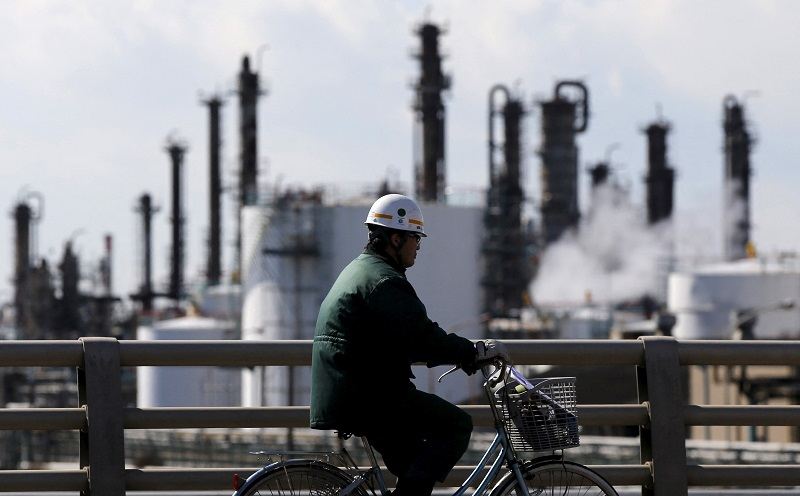
A worker cycles near a factory at the Keihin industrial zone in Kawasaki, Japan February 17, 2016. Japan’s automaker labour unions are reducing their demands for pay rises for the next fiscal year from amounts sought the previous year, a move that could hamper the Abe government’s efforts to stoke demand and defeat deflation.
11:13 JST, August 15, 2022
TOKYO (Reuters) – Japan’s economy rebounded at a slower-than-expected pace in the second quarter from a COVID-induced slump, data showed on Monday, highlighting uncertainty on whether consumption will grow enough to bolster a much-delayed, fragile recovery.
While rising consumption propped up April-June growth, the outlook has been clouded by a resurgence in infections, slowing global growth, supply constraints and rising raw material prices that are boosting households’ living costs.
“Consumption and capital expenditure will continue to drive growth in July-September. But momentum may not be that strong as rising inflation is cooling household spending,” said Atsushi Takeda, chief economist at Itochu Economic Research Institute.
“While domestic demand may continue to expand, falling exports could put a brake on Japan’s recovery,” he said.
The world’s third-largest economy expanded an annualized 2.2% in April-June, government data showed, marking the third straight quarter of increase but falling short of median market forecasts for a 2.5% gain. It followed a revised 0.1% rise in gross domestic product (GDP) in January-March, when surging COVID cases hurt spending.
The growth was driven largely by a 1.1% gain in private consumption, the data showed, as businesses re-opened after the lifting of pandemic-related curbs on economic activity.
The rise in consumption, however, was smaller than market forecasts for a 1.3% increase. Wage earners’ remuneration during April-June, adjusted by inflation, fell 0.9% from the previous quarter, a deeper drop than a 0.1% fall in January-March in a sign rising living costs were hurting household income.
Capital expenditure, another key driver of April-June growth, increased 1.4% from the previous quarter, exceeding a median market forecast for a 0.9% expansion, the data showed.
Domestic demand added 0.5% point to GDP growth, while external demand neither added to, nor shaved off from growth.
Japan has lagged other major economies in fully recovering from the pandemic’s hit due to weak consumption, blamed in part on curbs on activity that lasted until March.
That has turned the Bank of Japan (BOJ) into an outlier in the global monetary tightening phase sweeping across many economies amid surging inflation.
Policymakers hope pent-up demand will underpin consumption until wages rise enough to make up for increasing living costs. But there is uncertainty on whether companies will hike salaries amid heightening risks of slowing global demand, analysts say.
The BOJ has stressed its resolve to maintain ultra-loose monetary policy even as inflation exceeded its 2% target for three straight months in June, to ensure the economy makes a sustained recovery driven by solid consumption and wage growth.






Most Read
Popular articles in the past 24 hours
-
My Spendthrift Mother Constantly Asks Me for Money
-
Japanese Students Use Traditional Pickle to Create Novel Wagashi ...
-

‘Dry Bonsai’ Gives New Life to Withered Trees, Allows Free Artist...
-

McDonald's Japan Raises Prices; Big Mac to Cost ¥500, Double Chee...
-

Nepal Bus Crash Kills 19 People, Injures 25 Including One Japanes...
-

Astellas Collaborates with Vir to Develop Its Experimental Prosta...
-

Japan’s Nikkei Stock Average Rises as AI-Related Stocks Shine; Co...
-

Early-Blooming Kawazu Cherry Blossoms Create Sea of Pink at Park ...
Popular articles in the past week
-

Producer Behind Pop Group XG Arrested for Cocaine Possession
-

Japan PM Takaichi’s Cabinet Resigns en Masse
-

Sanae Takaichi Elected Prime Minister of Japan; Keeps All Cabinet...
-

Japan's Govt to Submit Road Map for Growth Strategy in March, PM ...
-

Bus Carrying 40 Passengers Catches Fire on Chuo Expressway; All E...
-

U.S. Firm to Build Training Hub in Fukushima N-plant for Debris R...
-

Japan, U.S. Name 3 Inaugural Investment Projects; Reached Agreeme...
-

Riku-Ryu Pair Wins Gold Medal: Their Strong Bond Leads to Major C...
Popular articles in the past month
-
Producer Behind Pop Group XG Arrested for Cocaine Possession
-
Japan PM Takaichi’s Cabinet Resigns en Masse
-

Japan Institute to Use Domestic Commercial Optical Lattice Clock ...
-

Man Infected with Measles Reportedly Dined at Restaurant in Tokyo...
-

Israeli Ambassador to Japan Speaks about Japan’s Role in the Reco...
-

Videos Plagiarized, Reposted with False Subtitles Claiming ‘Ryuky...
-

Man Infected with Measles May Have Come in Contact with Many Peop...
-

Prudential Life Insurance Plans to Fully Compensate for Damages C...
Top Articles in News Services
-
Survey Shows False Election Info Perceived as True
-
Hong Kong Ex-Publisher Jimmy Lai’s Sentence Raises International Outcry as China Defends It
-
Japan’s Nikkei Stock Average Touches 58,000 as Yen, Jgbs Rally on Election Fallout (UPDATE 1)
-
Japan’s Nikkei Stock Average Falls as US-Iran Tensions Unsettle Investors (UPDATE 1)
-

Trump Names Former Federal Reserve Governor Warsh as the Next Fed Chair, Replacing Powell
JN ACCESS RANKING
-
Producer Behind Pop Group XG Arrested for Cocaine Possession
-
Japan PM Takaichi’s Cabinet Resigns en Masse
-
Japan Institute to Use Domestic Commercial Optical Lattice Clock to Set Japan Standard Time
-
Man Infected with Measles Reportedly Dined at Restaurant in Tokyo Station
-
Israeli Ambassador to Japan Speaks about Japan’s Role in the Reconstruction of Gaza