
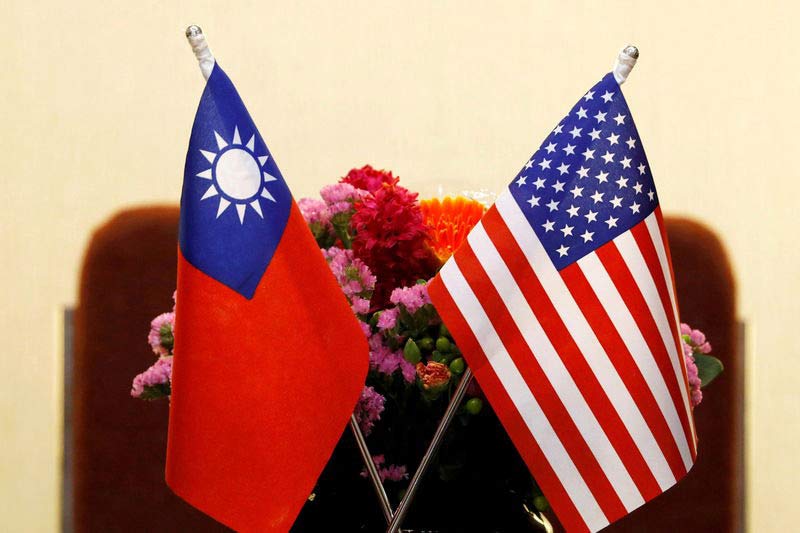
Flags of Taiwan and U.S. are placed for a meeting in Taipei on March 27, 2018.
November 18, 2021
WASHINGTON (Reuters) – Urgent measures are needed to strengthen the credibility of U.S. military deterrence of any potential Chinese aggression against Taiwan, according to a report from a bipartisan advisory body to the U.S. Congress published Wednesday.
The influential U.S.-China Economic and Security Review Commission (USCC) included a range of recommendations about Taiwan in its annual report to Congress, amid heightened tensions between the democratically ruled island and China.
The report said Congress should authorize and appropriate funds for Taiwan to purchase defense articles from the United States and finance the deployment of cruise and ballistic missiles and other munitions in the Indo-Pacific while increasing funding for surveillance.
“A lack of clarity in U.S. policy could contribute to a deterrence failure if Chinese leaders interpret that policy to mean opportunistic aggression against Taiwan might not provoke a quick or decisive U.S. response,” the report said.
China claims Taiwan as its own and has vowed to bring the island under Chinese control, by force if necessary, and tensions across the Taiwan Strait have escalated in recent months.
In a video call this week, Chinese leader Xi Jinping warned Biden that China would respond to provocations on Taiwan.
The report addressed a range of economic issues between the United States and China, including recommending Congress consider legislation to address risks to U.S. investors and interests in China investment.
China’s capital controls “may limit investors’ abilities to move money out of equity and bond investments and the lack of oversight by trusted authorities may jeopardize investors’ funds,” Commission chair Robin Cleveland said in an opening statement. “More importantly, numerous companies which will benefit from U.S. investment have been formally identified as threats to U.S. national security interests.”
The report recommends prohibiting or at least better identifying the risks of variable interest entities, where mainland Chinese companies create offshore corporate entities to circumvent China’s prohibitions on foreign direct investment in certain industries and list on U.S. exchanges.
The report said U.S. participation in China’s financial markets was increasing — reaching as much as $1.2 trillion in 2020 — and “outpacing the U.S. government’s defense” against threats posed by problematic Chinese companies.
The Biden administration has prohibited investment in 24 publicly traded Chinese companies but, Commissioners Jeffrey Feidler and Michael Wessel say, “many more should be on the list.”








Most Read
Popular articles in the past 24 hours
-

Moai Statue Shows Lasting Bond Between Miyagi Pref. Town, Easter ...
-
Japan's Defense Ministry: North Korea Appears to Have Fired Balli...
-

Milano Cortina 2026: Japan’s Oguri Wins Para Snowboard Silver at ...
-

National Intelligence Council: Proposed Body Must Be Utilized To ...
-

Aichi Fisheries Cooperatives Use Smart Tech to Farm Triploid Oyst...
-

Teachers Support Students’ Inquiry Learning behind the Scenes
-
Japan's Lower House Passes Budget Proposal; Could Be Delayed in U...
-
CARTOON OF THE DAY (March 14)
Popular articles in the past week
-

Japan Figure Skating Legend Yuzuru Hanyu Is Proud Disaster Surviv...
-

Govt to Utilize ODA for Ensuring Economic Security; Securing Ener...
-
15 Measles Patients Confirmed in Tokyo in Past 6 Days; 1 May Have...
-
Massive Sewer Pipe Found Jutting Out of Highway in Osaka
-
Japan Govt to Tighten Requirements to Receive Permanent Residency...
-

JR Tokai Breaks Ground on Yamanashi Maglev Station; Will Be Part ...
-

Power Outage Forces About 980 Passengers in Yokohama to Walk to T...
-

Beckoning Cats Get Makeover to Fit Modern Lifestyles with Sleek D...
Popular articles in the past month
-

Producer Behind Pop Group XG Arrested for Cocaine Possession
-

Japan PM Takaichi’s Cabinet Resigns en Masse
-

Man Infected with Measles Reportedly Dined at Restaurant in Tokyo...
-

Videos Plagiarized, Reposted with False Subtitles Claiming ‘Ryuky...
-
Japan Figure Skating Legend Yuzuru Hanyu Is Proud Disaster Surviv...
-

iPS Treatments Pass Key Milestone, but Broader Applications Far f...
-

Sanae Takaichi Elected Prime Minister of Japan; Keeps All Cabinet...
-

Nepal Bus Crash Kills 19 People, Injures 25 Including One Japanes...
Top Articles in News Services
-
Survey Shows False Election Info Perceived as True
-

Japan’s Nikkei Stock Average Falls as US-Iran Tensions Unsettle Investors (UPDATE 1)
-
Japan’s Nikkei Stock Average Rises on Tech Rally and Takaichi’s Spending Hopes (UPDATE 1)
-

Japan to Ban Use of Power Banks on Airplanes
-

North Korea Unveils Image of Kim Jong Un’s Teenage Daughter Firing Rifle
JN ACCESS RANKING
-
Producer Behind Pop Group XG Arrested for Cocaine Possession
-
Japan PM Takaichi’s Cabinet Resigns en Masse
-
Man Infected with Measles Reportedly Dined at Restaurant in Tokyo Station
-
Videos Plagiarized, Reposted with False Subtitles Claiming ‘Ryukyu Belongs to China’; Anti-China False Information Also Posted in Japan
-
Japan Figure Skating Legend Yuzuru Hanyu Is Proud Disaster Survivor and Gold Medalist, Vows to Continue Support Efforts