
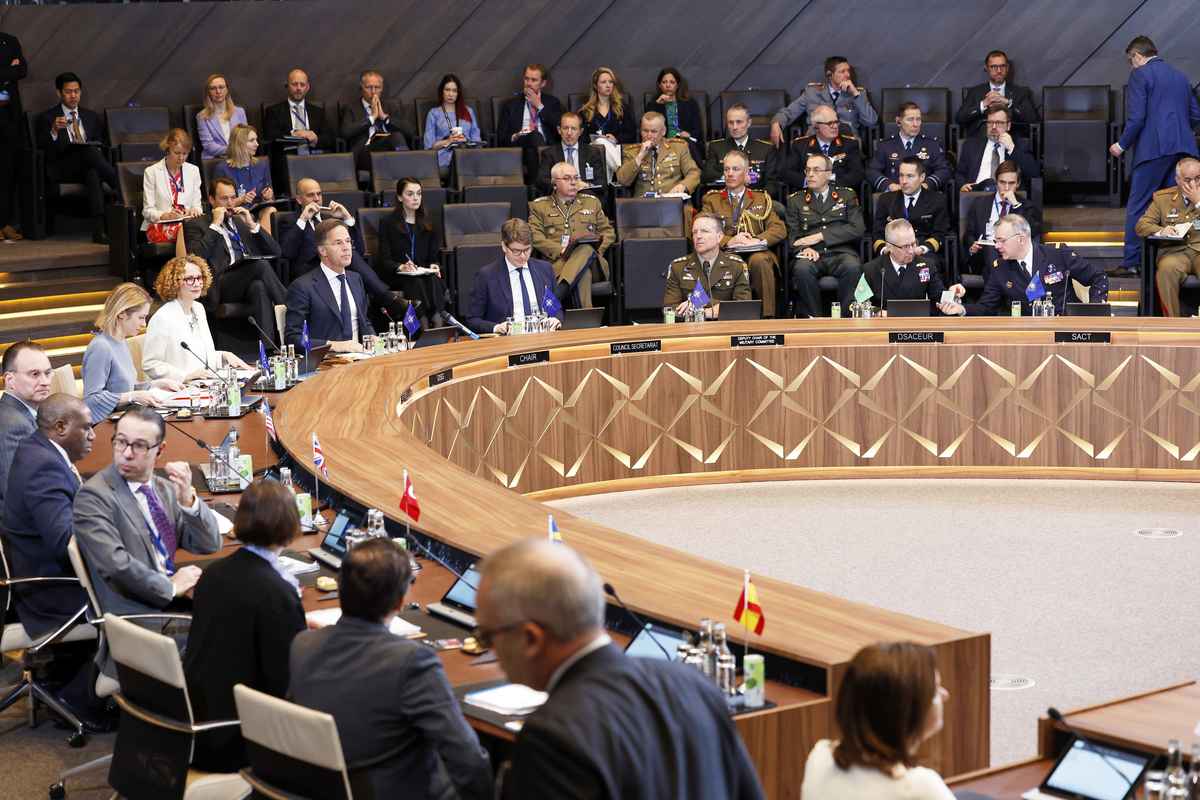
European Union foreign policy chief Kaja Kallas, third left, attends a meeting of the North Atlantic Council in foreign ministers format at NATO headquarters in Brussels, Friday, April 4, 2025.
15:45 JST, April 5, 2025
BRUSSELS (AP) — European NATO allies and Canada on Friday said they are willing to ramp up defense spending but are cool on American demands for the size of their military budgets, particularly given U.S. President Donald Trump’s readiness to draw closer to Russian leader Vladimir Putin.
U.S. allies have spent billions of dollars more on defense since Putin ordered a full-scale invasion of Ukraine more than three years ago, but almost a third of them still don’t meet NATO’s target of at least 2% of their gross domestic product.
Trump has said that U.S. allies should commit to spending at least 5%, but that would require investment at an unprecedented scale. According to NATO figures, the U.S. was projected to have spent 3.38% last year, the only ally whose spending has dropped over the last decade.
“It is important that we all agree that Russia is a threat. If not, I don’t know why we should always increase more and more defense spending,” Canadian Foreign Minister Mélanie Joly told reporters at NATO headquarters in Brussels.
NATO leaders said at a summit last year that Russia “remains the most significant and direct threat to Allies’ security.”
Trump’s public rehabilitation of Putin, who had become an international pariah indicted for war crimes, has disturbed U.S. allies, and they believe that the decision to rule out NATO membership for Ukraine weakened Kyiv’s hand at the negotiating table before peace talks have even begun.
Beyond that, Europe and Canada were alarmed last month when the United States split with European allies by refusing to blame Russia for its invasion of Ukraine in votes on three U.N. resolutions seeking an end to the war.
U.S. Secretary of State Marco Rubio said that Washington isn’t insisting that its allies hit the 5% spending target overnight, but “we think that’s what NATO allies need to be spending for NATO to face the threats that itself has identified and articulated.”
Rubio said that the extra spending is required to beef up military capabilities.
“We are as involved in NATO today as we have ever been, and we intend to continue to be. But it has to be a real alliance. And that means that our alliance partners have to increase their own capabilities,” he said.
Asked whether that the U.S. would also match the 5% target, Rubio said: “Sure. We’re heading there now.”
France has set itself an “objective of 3%-3.5%, and we are preparing to reach 3%-3.5%, which is about the level of American defense spending,” French Foreign Minister Jean-Noël Barrot said. France was estimated to be spending 2.06% last year.
He said that new funds should be spent on European rather than American equipment. In recent years, European allies placed around two-thirds of their equipment orders with U.S. defense companies.
Even as the Trump administration demands that defense spending be ramped up, the president’s tariff war is roiling stock markets and is likely to damage economic growth around the world, including among U.S. allies at NATO.
Article 2 of NATO’s founding treaty states that allies “will seek to eliminate conflict in their international economic policies and will encourage economic collaboration between any or all of them.”
Asked whether the tariffs constitute a breach of the treaty, NATO Secretary-General Mark Rutte said: “No, I don’t think so. We have seen in the past many examples of differences of view, of fights over tariffs. This has happened before without that being in violation of Article 2.”
Pressed on how allies might provide for their security, if they no longer have budget space, Rutte said: “I don’t think I’m helping this alliance by commenting on something which is not really part of alliance policy, and that is to make sure that we can defend ourselves.”
Norwegian Foreign Minister Espen Barth Eide said that NATO members are working on setting a new spending target, to be announced at the next summit in June.
But he said that “5% is of course much more than the U.S. itself spends and it’s a very high ambition and we are not ready to commit to a number at this time. Just as it’s important to spend more, it’s also important to spend more smartly.”








Most Read
Popular articles in the past 24 hours
-

Milano Cortina 2026: Japanese Gold Medalist Figure Skater Miura S...
-

Yokohama to Test Out Renewable-Powered Offshore Floating Data Cen...
-
Japan’s Takaichi Speaks on New U.S. Tariff in Upper House, Says P...
-

Takeshima Day: Persistently Demanding Resolution from South Korea...
-

Japanese Watermelon Shipments Starts in Leading Production Distri...
-

Ishinomaki Man Plush Toy Offers Hope to Children in Times of Disa...
-

Japan Authorities Begin On-site Inspection of Japanese Microsoft ...
-

Nikkei Average Rewrites All-Time Closing High
Popular articles in the past week
-

Producer Behind Pop Group XG Arrested for Cocaine Possession
-

iPS Treatments Pass Key Milestone, but Broader Applications Far f...
-

Japan, U.S. Name 3 Inaugural Investment Projects; Reached Agreeme...
-

Tokyo Skytree's Elevator Stops, Trapping 20 People; All Rescued (...
-

Japan’s Major Real Estate Firms Expanding Overseas Businesses to ...
-
Milano Cortina 2026: Japanese Gold Medalist Figure Skater Miura S...
-

Baby Monkey Punch Captures Hearts at Chiba Pref. Zoo, on Social M...
-

Milano Cortina 2026: Japanese Figure Skater Kaori Sakamoto’...
Popular articles in the past month
-
Producer Behind Pop Group XG Arrested for Cocaine Possession
-

Japan PM Takaichi’s Cabinet Resigns en Masse
-

Japan Institute to Use Domestic Commercial Optical Lattice Clock ...
-

Man Infected with Measles Reportedly Dined at Restaurant in Tokyo...
-

Israeli Ambassador to Japan Speaks about Japan’s Role in the Reco...
-

Videos Plagiarized, Reposted with False Subtitles Claiming ‘Ryuky...
-

Man Infected with Measles May Have Come in Contact with Many Peop...
-

Prudential Life Insurance Plans to Fully Compensate for Damages C...
Top Articles in News Services
-
Survey Shows False Election Info Perceived as True
-

Hong Kong Ex-Publisher Jimmy Lai’s Sentence Raises International Outcry as China Defends It
-
Japan’s Nikkei Stock Average Touches 58,000 as Yen, Jgbs Rally on Election Fallout (UPDATE 1)
-
Japan’s Nikkei Stock Average Falls as US-Iran Tensions Unsettle Investors (UPDATE 1)
-
Trump Names Former Federal Reserve Governor Warsh as the Next Fed Chair, Replacing Powell
JN ACCESS RANKING
-
Producer Behind Pop Group XG Arrested for Cocaine Possession
-
Japan PM Takaichi’s Cabinet Resigns en Masse
-
Man Infected with Measles Reportedly Dined at Restaurant in Tokyo Station
-
Israeli Ambassador to Japan Speaks about Japan’s Role in the Reconstruction of Gaza
-
Videos Plagiarized, Reposted with False Subtitles Claiming ‘Ryukyu Belongs to China’; Anti-China False Information Also Posted in Japan