
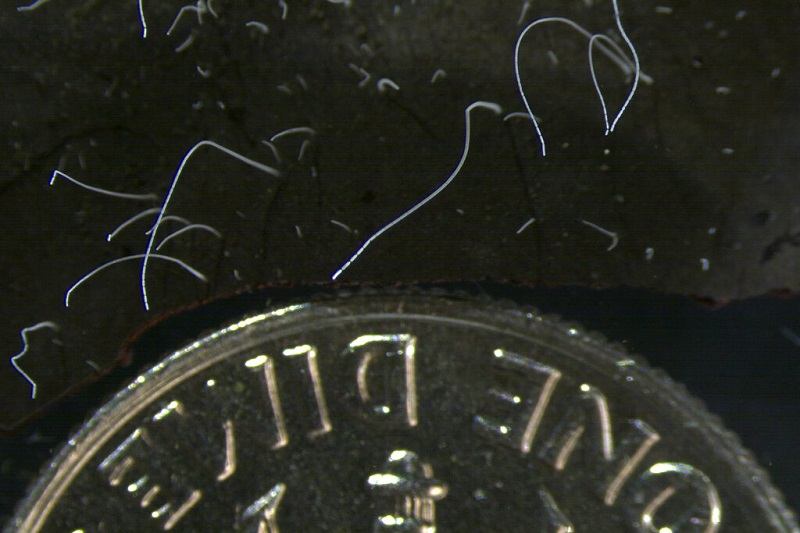
This microscope photo provided by the Lawrence Berkeley National Laboratory in June 2022 shows thin strands of Thiomargarita magnifica bacteria cells next to a U.S. dime coin.
10:21 JST, June 24, 2022
WASHINGTON (AP) — Scientists have discovered the world’s largest bacterium in a Caribbean mangrove swamp.
Most bacteria are microscopic, but this one is so big it can be seen with the naked eye.
The thin white filament, approximately the size of a human eyelash, is “by far the largest bacterium known to date,” said Jean-Marie Volland, a marine biologist at the Lawrence Berkeley National Laboratory and co-author of a paper announcing the discovery Thursday in the journal Science.
Olivier Gros, a co-author and biologist at the University of the French West Indies and Guiana, found the first example of this bacterium — named Thiomargarita magnifica, or “magnificent sulfur pearl” — clinging to sunken mangrove leaves in the archipelago of Guadeloupe in 2009.
But he didn’t immediately know it was a bacterium because of its surprisingly large size — these bacteria, on average, reach a length of a third of an inch (0.9 centimeters). Only later genetic analysis revealed the organism to be a single bacterial cell.
“It’s an amazing discovery,” said Petra Levin, a microbiologist at Washington University in St Louis, who was not involved in the study. “It opens up the question of how many of these giant bacteria are out there — and reminds us we should never, ever underestimate bacteria.”
Gros also found the bacterium attached to oyster shells, rocks and glass bottles in the swamp.
Scientists have not yet been able to grow it in lab culture, but the researchers’ say the cell has a structure that’s unusual for bacteria. One key difference: It has a large central compartment, or vacuole, that allows some cell functions to happen in that controlled environment instead of throughout the cell.
“The acquisition of this large central vacuole definitely helps a cell to bypass physical limitations … on how big a cell can be,” said Manuel Campos, a biologist at the French National Center for Scientific Research, who was not involved in the study.
The researchers said they aren’t certain why the bacterium is so large, but co-author Volland hypothesized it may be an adaptation to help it avoid being eaten by smaller organisms.









Most Read
Popular articles in the past 24 hours
-
Rising Kabuki Star Works to Ensure Deaf Audience's Enjoyment of P...
-

Lady Bess: Iroha Okuda, Mayuko Kominami Discuss Performing Elizab...
-

Japan Considering Taking Part in U.S. ‘Golden Dome’ Defense Syste...
-

Japan's TEPCO Releases Footage from Fukushima N-Plant Reactor
-
46 Evacuated from UAE, Oman on Japanese Govt-chartered Flight
-

Driver Dies in Collision with Express Train at Crossing in Mito; ...
-

Japan's Sanyo Shinkansen Suspended Again; Between Okayama, Aioi S...
-

Oil Reserve Releases: G7 Members Unite against Growing Threat
Popular articles in the past week
-

Japan Figure Skating Legend Yuzuru Hanyu Is Proud Disaster Surviv...
-

Nippon Life Insurance's U.S. Arm Sues OpenAI Over Legal Assistanc...
-
Govt to Utilize ODA for Ensuring Economic Security; Securing Ener...
-
15 Measles Patients Confirmed in Tokyo in Past 6 Days; 1 May Have...
-

Massive Sewer Pipe Found Jutting Out of Highway in Osaka
-

Japan Govt to Tighten Requirements to Receive Permanent Residency...
-

Beckoning Cats Get Makeover to Fit Modern Lifestyles with Sleek D...
-
Japan Govt Survey Finds Just 10% of Workers Want Working Hours to...
Popular articles in the past month
-

Producer Behind Pop Group XG Arrested for Cocaine Possession
-

Japan PM Takaichi’s Cabinet Resigns en Masse
-

Man Infected with Measles Reportedly Dined at Restaurant in Tokyo...
-

Videos Plagiarized, Reposted with False Subtitles Claiming ‘Ryuky...
-
Japan Figure Skating Legend Yuzuru Hanyu Is Proud Disaster Surviv...
-

iPS Treatments Pass Key Milestone, but Broader Applications Far f...
-

Sanae Takaichi Elected Prime Minister of Japan; Keeps All Cabinet...
-

Nepal Bus Crash Kills 19 People, Injures 25 Including One Japanes...
Top Articles in News Services
-
Survey Shows False Election Info Perceived as True
-

Japan’s Nikkei Stock Average Falls as US-Iran Tensions Unsettle Investors (UPDATE 1)
-
Japan’s Nikkei Stock Average Rises on Tech Rally and Takaichi’s Spending Hopes (UPDATE 1)
-

Japan to Ban Use of Power Banks on Airplanes
-

North Korea Unveils Image of Kim Jong Un’s Teenage Daughter Firing Rifle
JN ACCESS RANKING
-
Producer Behind Pop Group XG Arrested for Cocaine Possession
-
Japan PM Takaichi’s Cabinet Resigns en Masse
-
Man Infected with Measles Reportedly Dined at Restaurant in Tokyo Station
-
Videos Plagiarized, Reposted with False Subtitles Claiming ‘Ryukyu Belongs to China’; Anti-China False Information Also Posted in Japan
-
Japan Figure Skating Legend Yuzuru Hanyu Is Proud Disaster Survivor and Gold Medalist, Vows to Continue Support Efforts