
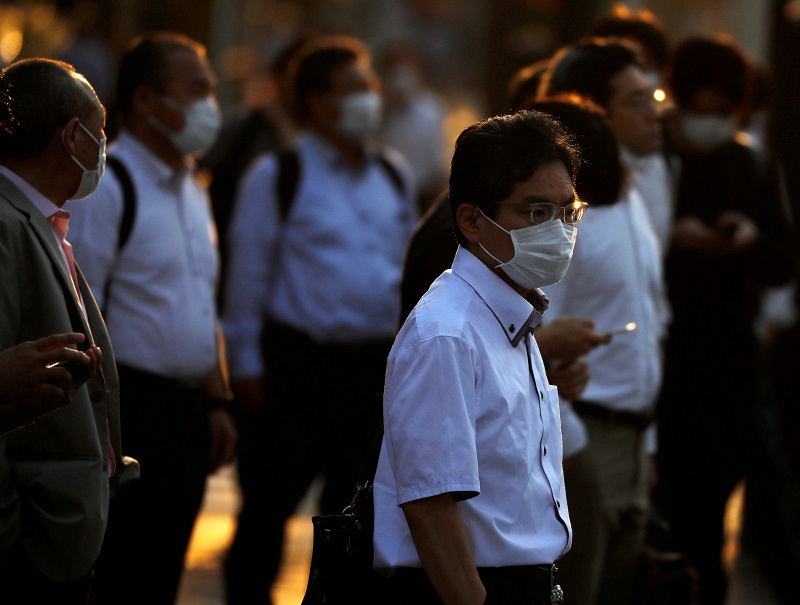
Office workers wearing protective face masks walk to head home at sunset amid the coronavirus disease (COVID-19) outbreak, in Tokyo, Japan June 9, 2020.
14:41 JST, October 8, 2021
Dear Troubleshooter:
I am a homemaker in my 40s and I’m worried about my son, who is in his mid-20s.
He works very hard, which is fine, but he also works a lot of overtime. For months he has put in a lot of hours, I think he probably accumulates 80 hours of overtime.
Recently, my son has started saying, “I’m tired,” more often. I try to support him by paying attention to his meals and telling him to not push himself too hard.
Lately, however, he doesn’t talk to the family as much anymore. He has always been quiet and a man of few words, but now he seems more exhausted. My husband says that it’s “normal to work that much overtime,” but I don’t think that’s true.
I feel like the company is going to crush my son’s mind and body. I would prefer it if he just quit. Please let me know what advice I can give to my son and what I can do to help him.
— T, Tokyo
Dear Ms. T:
I became very worried after I read your letter. This is an issue that needs to be taken seriously if he is sometimes working 80 hours of overtime a month.
Working an average of more than 80 hours of overtime a month — two to six months prior to an illness — is thought to be strongly associated with brain disorders and heart disease, among other illnesses. Working 80 hours of overtime a month is called the “overtime death line.” Overtime is generally capped at 45 hours a month or 360 hours per year.
I am also concerned by your husband’s comment that it’s “normal to work that much overtime.” It sounds like something your son’s boss would say.
I’m sure you’re aware there have been cases in which people who work long hours end up suffering from extreme physical and mental fatigue, leading to a painful and sad outcome. One of the reasons behind this is because some people still think that it is good to work, even if you’re sacrificing sleep.
The fact that your son rarely speaks to you anymore is probably a sign that he has reached his physical and mental limit and is asking for help. I would advise him to refrain from working overtime. If it is unavoidable, I think it is OK for you to recommend that he quit.
You may also want to consider discussing the situation with the local government or another labor-related authority.
— Yoko Sanuki, lawyer







Most Read
Popular articles in the past 24 hours
-

Inspection via Micro-Drones Begins at Fukushima No. 1 Nuclear Pla...
-
Japan's DPFP to Join Natl Council Considering Tax Cut Measures
-

Samurai Japan Beats Taiwan in its First World Baseball Classic Ga...
-

Excited Baseball Fans Gather at Tokyo Dome Ahead of Japan's Openi...
-

Shohei Ohtani Ignites Team Spirit for Samurai Japan's World Baseb...
-
Japan Govt Survey Finds Just 10% of Workers Want Working Hours to...
-

Heckling, Once a Fixture of Diet Debate in Japan, Abates in the F...
-

Japan Asked U.S. Not to Disadvantage Tokyo under New Tariff Rules
Popular articles in the past week
-

South Korea Tightens Rules on Foreigners Buying Homes in Seoul Me...
-

Ibaraki Pref.'s 1st Foreign Bus Driver Hired in Tsukuba
-

2 Unpublished Early Novellas by Japan's Kenzaburo Oe Discovered, ...
-

Strait of Hormuz Closure Shakes Markets; Prolonged Closure Could ...
-

Amid Strait of Hormuz Blockade, Shipping Companies Scramble to Ge...
-

Iran Situation: Japan Must Exert Diplomatic Efforts without Merel...
-

Measles Patient Visited Hospital in Bunkyo Ward, Tokyo, Metropoli...
-

North Korea Unveils Image of Kim Jong Un's Teenage Daughter Firi...
Popular articles in the past month
-

Producer Behind Pop Group XG Arrested for Cocaine Possession
-

Japan PM Takaichi’s Cabinet Resigns en Masse
-

Man Infected with Measles Reportedly Dined at Restaurant in Tokyo...
-

Videos Plagiarized, Reposted with False Subtitles Claiming ‘Ryuky...
-

Prudential Life Insurance Plans to Fully Compensate for Damages C...
-

Woman with Measles Visited Hospital in Tokyo Multiple Times Befor...
-

iPS Treatments Pass Key Milestone, but Broader Applications Far f...
-

Sanae Takaichi Elected Prime Minister of Japan; Keeps All Cabinet...
Top Articles in Features
-

Tokyo’s New Record-Breaking Fountain Named ‘Tokyo Aqua Symphony’
-

High-Hydration Bread on the Rise, Seeing Increase in Specialty Shops, Recipe Searches
-

Heirs to Kyoto Talent: Craftsman Works to Keep Tradition of ‘Kinran’ Brocade Alive Through Initiatives, New Creations
-

Maltese Pavilion’s Famous Ftira Bread Now Available in Osaka; Loaves Became Popular during 2025 Osaka-Kansai Expo
-

My Spendthrift Mother Constantly Asks Me for Money
JN ACCESS RANKING
-
Producer Behind Pop Group XG Arrested for Cocaine Possession
-
Japan PM Takaichi’s Cabinet Resigns en Masse
-
Man Infected with Measles Reportedly Dined at Restaurant in Tokyo Station
-
Videos Plagiarized, Reposted with False Subtitles Claiming ‘Ryukyu Belongs to China’; Anti-China False Information Also Posted in Japan
-
Prudential Life Insurance Plans to Fully Compensate for Damages Caused by Fraudulent Actions Without Waiting for Third-Party Committee Review