
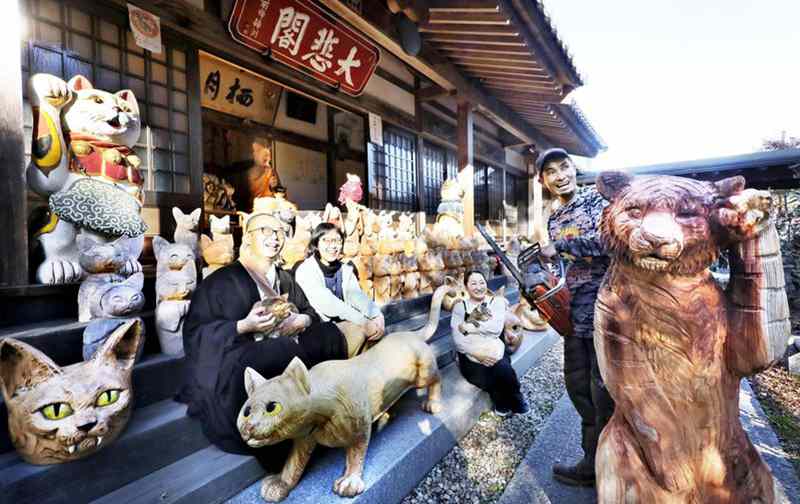
Priest Jisei Sumida, far left, chats with Takao Hayashi, far right, who created the chainsaw artwork of a beckoning tiger in front of the main hall of Unrin Temple, which is filled with cat figurines, in November 2021.
12:27 JST, January 16, 2022
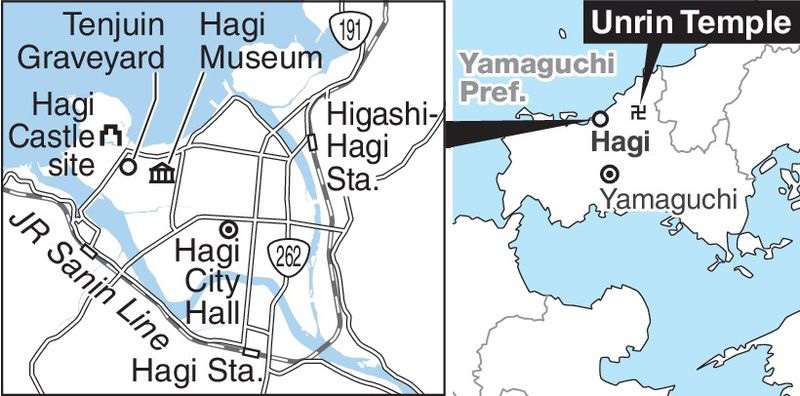
HAGI, Yamaguchi — A cat-themed temple is doing its part to help revitalize its area.
Unrin Temple in Hagi, Yamaguchi Prefecture, is putting in a bit more effort this year because of 2022 being the Chinese zodiac’s Year of the Tiger, a close cousin of the cat.
The temple’s foray into feline territory was begun by priest Jisei Sumida about 15 years ago. Sumida took inspiration from a local tale featuring a cat that is also related to the temple.
The story is set in the early 17th century, soon after Tokugawa Ieyasu established his shogunate. It follows Nagai Motofusa, whose master was the first lord of the Choshu domain, now Yamaguchi Prefecture, and founder of Hagi Castle Mori Terumoto. Motofusa had a cat and loved it very much.
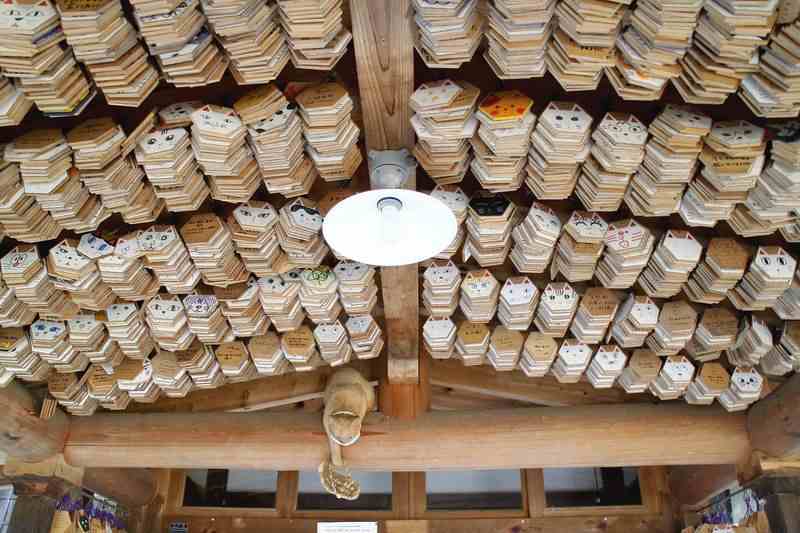
Ema wooden tablets depicting cats hang from the rafters at Unrin Temple.
When Terumoto passed away, Motofusa followed him in death and was buried at Tenjuin Temple, the now-defunct parent temple of Unrin Temple.
The cat was so saddened by its carer’s death that it never left his grave, and during a traditional memorial service held exactly 49 days after Motofusa’s death, the cat bit its own tongue and died in its spot before the grave.
This tale has been passed down in Hagi as a story showing the importance of loyalty to one’s master, which was considered virtuous in the olden days.
Using the story as inspiration, Sumida filled the temple with cat-related items and got the word out about the temple mainly via social media.
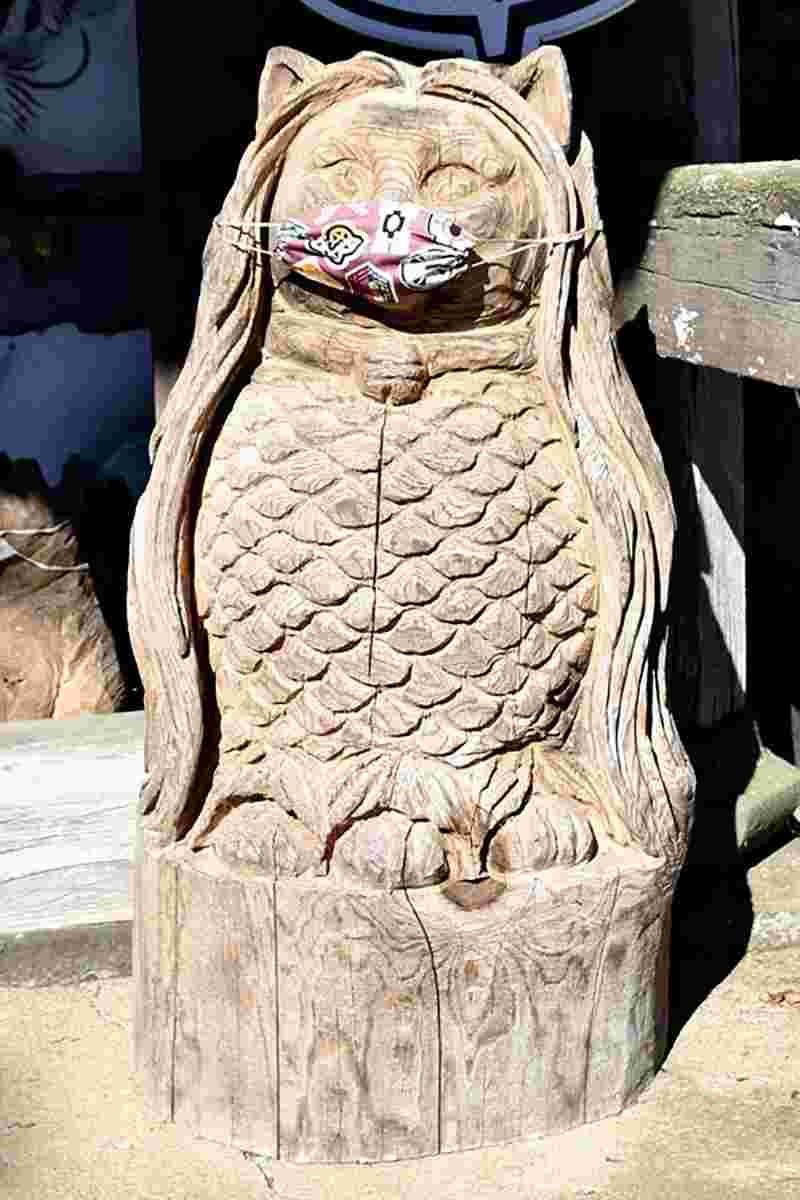
A cat sculpture modeled after imaginary creature Amabie, which is said to protect against pandemics, stands at the main gate of the temple. Nekobie, or cat Amabie, was created by Takao Hayashi.
Sumida also commissioned a manga artist friend to create a booklet of the loyal cat’s tale. Collecting various cat-theme ornaments and goods on his own, Sumida also received donations and began to offer them for sale to temple visitors. The items include cat-designed ema wooden tablets on which visitors write wishes and fortune slips that come with cat figurines.
Four real cats residing at the temple have also gained popularity, adding to the temple’s photogenic environment. In 2019, about 20,000 people visited the temple.
About 700 cat-themed figurines and other items are also on display.
As 2022 is the Year of the Tiger, a wooden tiger statue made to mimic traditional “beckoning cat” lucky charm statues seen throughout Japan was added to the feline collection in celebration.
The wooden artwork was crafted from a roughly 1.5-meter-high log by Takao Hayashi, a chainsaw artist from Yamaguchi City.
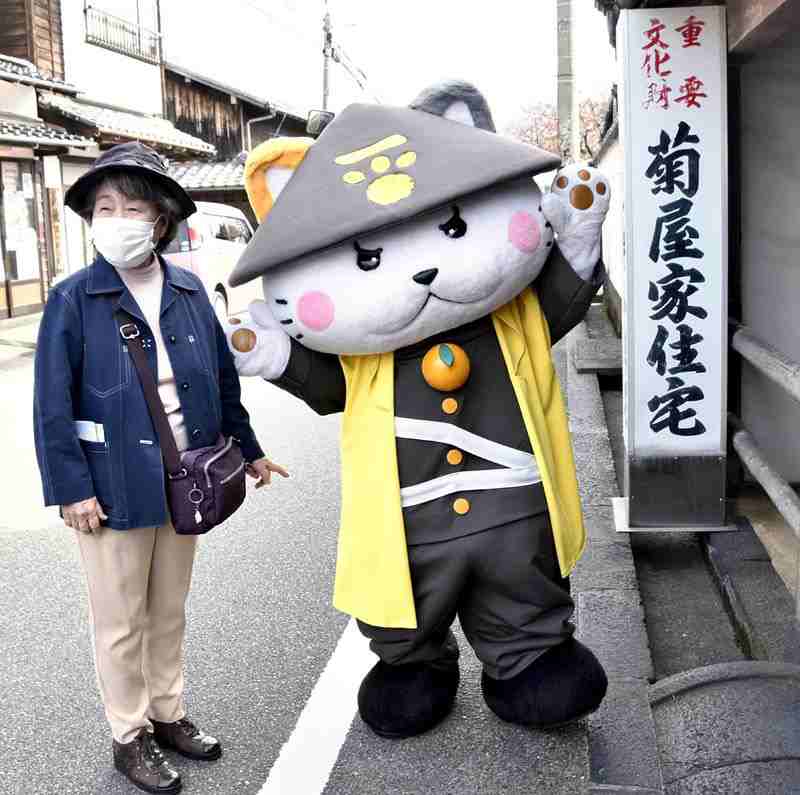
Hagi City mascot character Haginyan welcomes a tourist in the Castle Town in Hagi.
“It’d be great if the beckoning tiger could help us return to what life was like before the coronavirus,” said the 49-year-old artist, who has a brilliant track record both in Japan and abroad.
Due to said pandemic, the temple is now temporarily closed to visitors. Plans are underway to reopen the temple’s main hall once the pandemic is under control. Sumida is considering holding an exhibition of Hayashi’s works and producing new commemorative items, among other ideas.
Sumida considers this Year of the Tiger to be a roaring opportunity for the temple.
“We want to try to do something to revitalize the entire prefecture.”
Hagi’s feline history
Hagi is known for being the hometown of many who contributed to the overthrow of the Tokugawa shogunate, which led to a new government from the late 19th century on. The same town, however, is also known for its strong connection with cats.
A street called Cat Town can be found near the Hagi Museum, where Nagai Motofusa’s residence once stood.
Hagi City’s mascot character’s design is also based on Motofusa’s loyal cat. Haginyan welcomes tourists twice a month in the heart of the city, called Hagi Castle Town. Various items depicting the character are on sale.
Unfortunately, Haginyan is not well-known among tourists from outside the prefecture, as it is often mistaken for Hikonyan, the mascot for Hikone, Shiga Prefecture, one of the most famous mascots in Japan.
“This year, we want to have more activities with [Haginyan] and raise his popularity,” said a Hagi city government official.


Related Tags




Most Read
Popular articles in the past 24 hours
-

Director Naomi Kawase's New Film Explores Heart Transplants in Ja...
-

Japan’s Nikkei Stock Average Rises on Tech Rally and Takaichi's S...
-

Takaichi Expected to Express Desire for Constitutional Revision P...
-
Japanese Man Living in Iraq Suspected of Illegally Entering U.S. ...
-

Security Services Law Unconstitutional: Do Not Restrict Career Ch...
-

Milano Cortina 2026: Snowboarding Star Fukada Wins Gold in Hard-F...
-

New Leader of Japan's CRA Opposition Party Faces Challenge of For...
-

Tokyo Exhibition Featuring VR Walk Through 2025 Osaka-Kansai Expo...
Popular articles in the past week
-

Japan PM Takaichi’s Cabinet Resigns en Masse
-

Man Infected with Measles Reportedly Dined at Restaurant in Tokyo...
-

Videos Plagiarized, Reposted with False Subtitles Claiming ‘Ryuky...
-

Sanae Takaichi Elected 105th Prime Minister of Japan; Keeps All C...
-

Japan's Govt to Submit Road Map for Growth Strategy in March, PM ...
-

Milano Cortina 2026: Figure Skaters Riku Miura, Ryuichi Kihara Pa...
-

Tokyo’s New Record-Breaking Fountain Named ‘Tokyo Aqua Symphony’
-

Bus Carrying 40 Passengers Catches Fire on Chuo Expressway; All E...
Popular articles in the past month
-
Japan PM Takaichi’s Cabinet Resigns en Masse
-

Japan Institute to Use Domestic Commercial Optical Lattice Clock ...
-

Israeli Ambassador to Japan Speaks about Japan’s Role in the Reco...
-
Man Infected with Measles Reportedly Dined at Restaurant in Tokyo...
-

Man Infected with Measles May Have Come in Contact with Many Peop...
-

Prudential Life Insurance Plans to Fully Compensate for Damages C...
-
Videos Plagiarized, Reposted with False Subtitles Claiming ‘Ryuky...
-

Woman with Measles Visited Hospital in Tokyo Multiple Times Befor...
Top Articles in Features
-
Sapporo Snow Festival Opens with 210 Snow and Ice Sculptures at 3 Venues in Hokkaido, Features Huge Dogu
-
Tokyo’s New Record-Breaking Fountain Named ‘Tokyo Aqua Symphony’
-

Tourists Flock to Ice Dome Lodge at Resort in Hokkaido, Japan; Facility Invites Visitors to Sleep on Beds Made of Ice
-
High-Hydration Bread on the Rise, Seeing Increase in Specialty Shops, Recipe Searches
-
Heirs to Kyoto Talent: Craftsman Works to Keep Tradition of ‘Kinran’ Brocade Alive Through Initiatives, New Creations
JN ACCESS RANKING
-
Japan PM Takaichi’s Cabinet Resigns en Masse
-
Japan Institute to Use Domestic Commercial Optical Lattice Clock to Set Japan Standard Time
-
Israeli Ambassador to Japan Speaks about Japan’s Role in the Reconstruction of Gaza
-
Man Infected with Measles Reportedly Dined at Restaurant in Tokyo Station
-
Man Infected with Measles May Have Come in Contact with Many People in Tokyo, Went to Store, Restaurant Around When Symptoms Emerged