
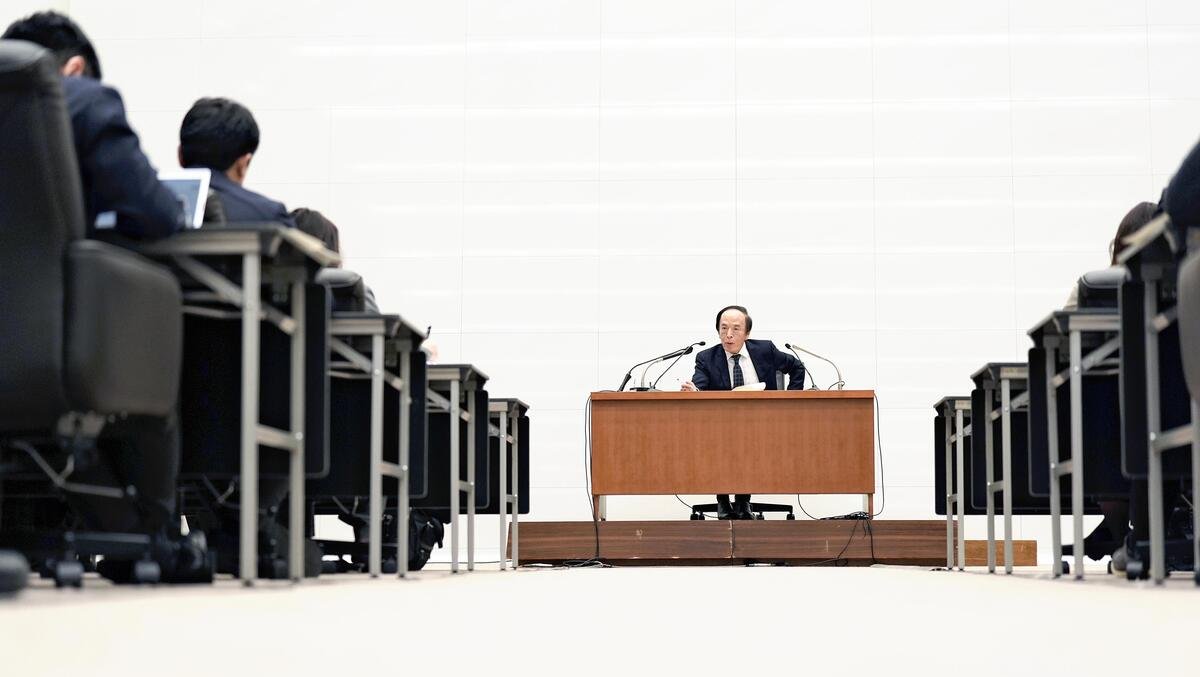
BOJ Gov. Kazuo Ueda speaks at a press conference on Friday.
12:01 JST, December 20, 2025
NEW YORK/LONDON (Reuters) — The yen weakened sharply against the dollar and other major peer currencies on Friday after the Bank of Japan raised rates to a 30-year high but did not offer clarity on future hikes.
The yen fell against the dollar after the BOJ lifted its policy rate to 0.75% from 0.5% in a move that had been well-telegraphed by policymakers, prompting traders to sell.
Losses in the Japanese currency extended after BOJ Governor Kazuo Ueda’s post-meeting press conference, where he remained vague on the exact timing and pace of future rate hikes and said only that the door was open to further tightening.
The dollar rose as high as 157.67 against the Japanese yen, its strongest level in four weeks and on track for its largest one-day rise since early October. It was last up 1.23% at 157.535 yen.
The euro hit a record high of 184.71 yen while the Swiss franc hit an all-time high of 197.23 yen CHFJPY=. Sterling rose by as much as 1.36% to its highest since 2008, at 210.96 yen.
I think most of the currencies are consolidating but the big one, of course, is the yen, said Marc Chandler, chief market strategist at Bannockburn Global Forex in New York.
The BOJ delivered a rate hike like everybody expected and indicated that they will continue to raise should the economy evolve as they expect. The yen is weaker across the board. I think many people are saying that the BOJ was not hawkish enough, Chandler added.
In Friday’s statement, the BOJ maintained its view that underlying inflation will converge around its 2% target in the latter half of its three-year projection period through fiscal 2027. It reiterated that real rates were at “significantly” low levels even after the hike, and pledged to continue tightening should the economy and inflation pan out as forecast.
But none of this was enough to halt the slide in the yen.
Traders have started to consider the chances of official intervention to support the currency once the yen crossed the 155 level against the dollar in November.
The last time Tokyo authorities stepped into the market to intervene was July 2024, when the dollar/yen rate hit 161.96, the most since the mid-1980s.
Japanese Finance Minister Satsuki Katayama warned on Friday that Tokyo would take appropriate action to deal with any excessive volatility in the foreign exchange market. “We will respond appropriately to excessive moves, including those driven by speculators,” she said.
We would fade that dovish BOJ narrative, said Elias Hadad, global head of markets strategy at BBH in an investor note. “In our view, the bar for additional BOJ rate hikes is low. First, the BOJ warned that ‘the risk of firms’ active wage-setting behavior being interrupted is low’, implying that underlying wage and inflation pressure are likely to persist. Second, BOJ Governor Ueda pointed out the policy rate is still some distance from the lower end of the neutral rate range.”








Most Read
Popular articles in the past 24 hours
-

McDonald's Japan Raises Prices; Big Mac to Cost ¥500, Double Chee...
-

Nepal Bus Crash Kills 19 People, Injures 25 Including One Japanes...
-

Japan’s Nikkei Stock Average Rises as AI-Related Stocks Shine; Co...
-

Aggression against Ukraine: Malignant Precedent Must Not Be Set t...
-

Joruri Bunraku Narrative Performed in Honor of Donald Keene by La...
-

Milano Cortina 2026: Gold Medal Olympic Figure Skaters Riku Miura...
-

Kanto's 1st Spring Wind Blows as Tokyo Sees Unseasonably High Tem...
-

How Keri Russell's Suede Coach Boots Ended up in My Closet
Popular articles in the past week
-

Producer Behind Pop Group XG Arrested for Cocaine Possession
-

Japan PM Takaichi’s Cabinet Resigns en Masse
-

Sanae Takaichi Elected Prime Minister of Japan; Keeps All Cabinet...
-

Japan's Govt to Submit Road Map for Growth Strategy in March, PM ...
-

Bus Carrying 40 Passengers Catches Fire on Chuo Expressway; All E...
-

Japan, U.S. Name 3 Inaugural Investment Projects; Reached Agreeme...
-

Riku-Ryu Pair Wins Gold Medal: Their Strong Bond Leads to Major C...
-

iPS Treatments Pass Key Milestone, but Broader Applications Far f...
Popular articles in the past month
-
Producer Behind Pop Group XG Arrested for Cocaine Possession
-
Japan PM Takaichi’s Cabinet Resigns en Masse
-

Japan Institute to Use Domestic Commercial Optical Lattice Clock ...
-

Man Infected with Measles Reportedly Dined at Restaurant in Tokyo...
-

Israeli Ambassador to Japan Speaks about Japan’s Role in the Reco...
-

Videos Plagiarized, Reposted with False Subtitles Claiming ‘Ryuky...
-

Man Infected with Measles May Have Come in Contact with Many Peop...
-

Prudential Life Insurance Plans to Fully Compensate for Damages C...
Top Articles in Business
-
Prudential Life Insurance Plans to Fully Compensate for Damages Caused by Fraudulent Actions Without Waiting for Third-Party Committee Review
-

Narita Airport, Startup in Japan Demonstrate Machine to Compress Clothes for Tourists to Prevent People from Abandoning Suitcases
-
Japan, U.S. Name 3 Inaugural Investment Projects; Reached Agreement After Considerable Difficulty
-

Toyota Motor Group Firm to Sell Clean Energy Greenhouses for Strawberries
-

SoftBank Launches AI Service for Call Centers That Converts Harsh Customer Voices into Softer Voices
JN ACCESS RANKING
-
Producer Behind Pop Group XG Arrested for Cocaine Possession
-
Japan PM Takaichi’s Cabinet Resigns en Masse
-
Man Infected with Measles Reportedly Dined at Restaurant in Tokyo Station
-
Israeli Ambassador to Japan Speaks about Japan’s Role in the Reconstruction of Gaza
-
Videos Plagiarized, Reposted with False Subtitles Claiming ‘Ryukyu Belongs to China’; Anti-China False Information Also Posted in Japan