
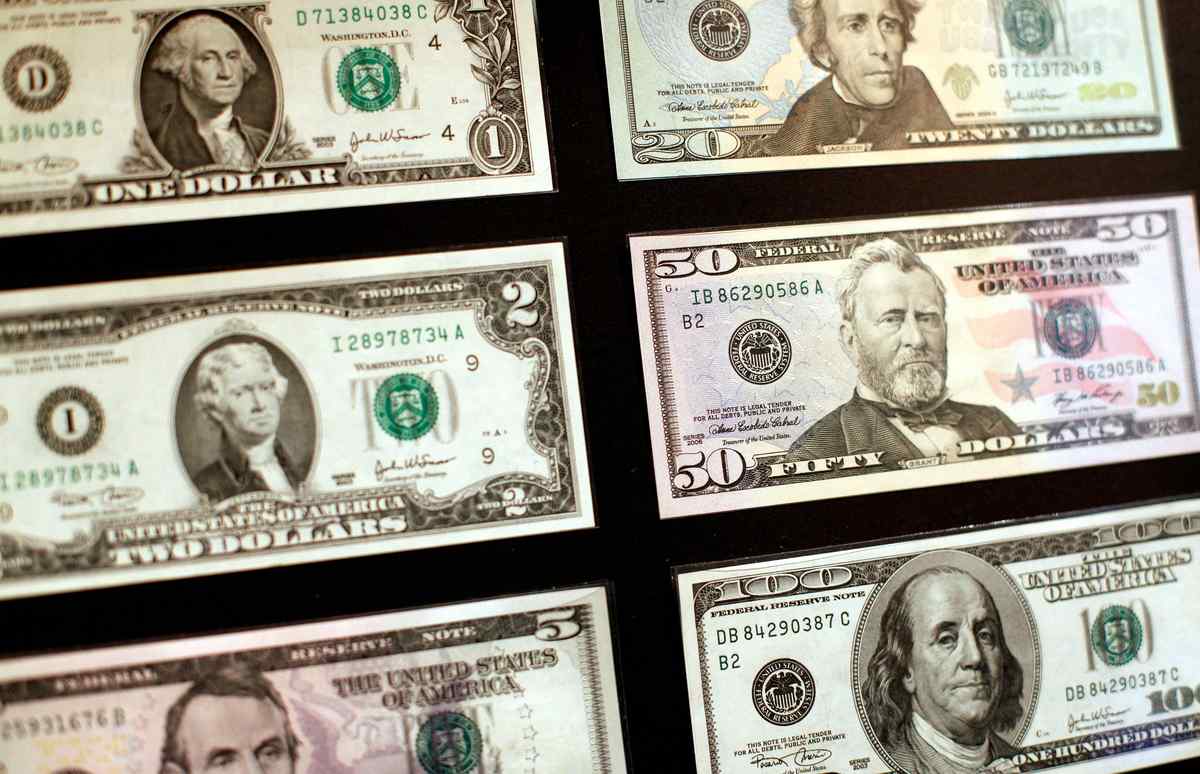
U.S. dollar banknotes
17:03 JST, September 21, 2025
Monday marks the 40th anniversary of the Plaza Accord, under which the Group of Five countries — Japan, the United States, Britan, France and then West Germany — decided to correct the excessive appreciation of the dollar through currency adjustments.
The accord was led by the United States to reduce its trade deficits. At the time, the country was suffering from both fiscal and trade deficits.
As the administration of U.S. President Donald Trump aims to cut the country’s trade deficits, Japan’s market players are wary that the United States may ask Japan to take measures to help correct the strong dollar.
Accord named after NY hotel
The agreement is named after the meeting’s venue, the Plaza Hotel in New York. Finance ministers and central bank governors gathered there on Sept. 22, 1985, and decided to jointly intervene in the currency markets to guide the dollar’s depreciation. At the time, the dollar was surging due to monetary tightening designed to curb inflation in the United States, and the country was also suffering massive trade deficits due to expanding imports.
Following the accord, the dollar depreciated, and U.S. trade deficits recovered in the early 1990s. However, due to a massive influx of low-priced foreign goods into the country following economic globalization, U.S. trade deficits have begun ballooning again. The United States’ trade deficits reached a record $1.22 trillion in 2024.
However, the yen sharply appreciated against the dollar following the accord, from the ¥240 level to the dollar to the ¥150 level in one year, dealing a blow to Japan’s export industries. This prompted Japan to take monetary easing policies to address a recession caused by the strong yen, which is believed to be one of the factors that caused the economic bubble.
Possible Mar-a-Lago Accord
The yen appreciated to ¥75.32 against the dollar on Oct. 31, 2011. Currently, the yen is trading around ¥147, continuing the trend of a weak yen and a strong dollar. Some market players speculate that the U.S. administration may attempt to correct the strong dollar to boost U.S. firms’ competitiveness in exports.
In a 2024 paper, Stephen Miran, who chairs the White House Council of Economic Advisers and recently assumed the post of Federal Reserve Governor, proposed a “Mar-a-Lago Accord,” an initiative under which countries work together to help weaken the dollar. It is also called the “Second Plaza Accord.”
After the launch of his second administration, Trump repeatedly cautioned against the strong dollar at first, but recently he has refrained from touching on the subject.
Japan and the United States said in a joint statement issued on Sept. 12 that “exchange rates should be market determined,” in line with previous agreements among the Group of Seven leading countries.
However, Trump tends to change his policies back and forth. Given this, Tomohisa Ishikawa, a researcher at the Japan Research Institute cautioned about potential risks.
“[Trump’s] interest may shift to exchange rates in case tariff measures do not help reduce the U.S. trade deficits,” Ishikawa said. “The Japanese government needs to continue careful dialogues with the United States.”







Most Read
Popular articles in the past 24 hours
-

Japan Defense Agency to Develop AI Intelligence Analysis System f...
-

Moai Statue Shows Lasting Bond Between Miyagi Pref. Town, Easter ...
-

Milano Cortina 2026: Japan’s Oguri Wins Para Snowboard Silver at ...
-
Japan's Defense Ministry: North Korea Appears to Have Fired Balli...
-

Aichi Fisheries Cooperatives Use Smart Tech to Farm Triploid Oyst...
-

Teachers Support Students’ Inquiry Learning behind the Scenes
-

National Intelligence Council: Proposed Body Must Be Utilized To ...
-
Japan's Lower House Passes Budget Proposal; Could Be Delayed in U...
Popular articles in the past week
-

Japan Figure Skating Legend Yuzuru Hanyu Is Proud Disaster Surviv...
-

Govt to Utilize ODA for Ensuring Economic Security; Securing Ener...
-
15 Measles Patients Confirmed in Tokyo in Past 6 Days; 1 May Have...
-

Massive Sewer Pipe Found Jutting Out of Highway in Osaka
-

Japan Govt to Tighten Requirements to Receive Permanent Residency...
-
JR Tokai Breaks Ground on Yamanashi Maglev Station; Will Be Part ...
-

Beckoning Cats Get Makeover to Fit Modern Lifestyles with Sleek D...
-
Power Outage Forces About 980 Passengers in Yokohama to Walk to T...
Popular articles in the past month
-

Producer Behind Pop Group XG Arrested for Cocaine Possession
-

Japan PM Takaichi’s Cabinet Resigns en Masse
-

Man Infected with Measles Reportedly Dined at Restaurant in Tokyo...
-

Videos Plagiarized, Reposted with False Subtitles Claiming ‘Ryuky...
-
Japan Figure Skating Legend Yuzuru Hanyu Is Proud Disaster Surviv...
-

iPS Treatments Pass Key Milestone, but Broader Applications Far f...
-

Sanae Takaichi Elected Prime Minister of Japan; Keeps All Cabinet...
-

Nepal Bus Crash Kills 19 People, Injures 25 Including One Japanes...
Top Articles in Business
-

Nippon Life Insurance’s U.S. Arm Sues OpenAI Over Legal Assistance Provided by ChatGPT
-

Japan, U.S. Name 3 Inaugural Investment Projects; Reached Agreement After Considerable Difficulty
-

Japan’s Major Real Estate Firms Expanding Overseas Businesses to Secure Future Growth, Focusing on Europe, U.S., Asia
-

Transport Companies See Opportunity in Narita Expansion; Airlines, Railways Prepare to Meet Expected Growth in Demand
-

Amid Strait of Hormuz Blockade, Shipping Companies Scramble to Get Japan-Linked Vessels out of Persian Gulf
JN ACCESS RANKING
-
Producer Behind Pop Group XG Arrested for Cocaine Possession
-
Japan PM Takaichi’s Cabinet Resigns en Masse
-
Man Infected with Measles Reportedly Dined at Restaurant in Tokyo Station
-
Videos Plagiarized, Reposted with False Subtitles Claiming ‘Ryukyu Belongs to China’; Anti-China False Information Also Posted in Japan
-
Japan Figure Skating Legend Yuzuru Hanyu Is Proud Disaster Survivor and Gold Medalist, Vows to Continue Support Efforts