
Japan, U.S. Name 3 Inaugural Investment Projects; Reached Agreement After Considerable Difficulty
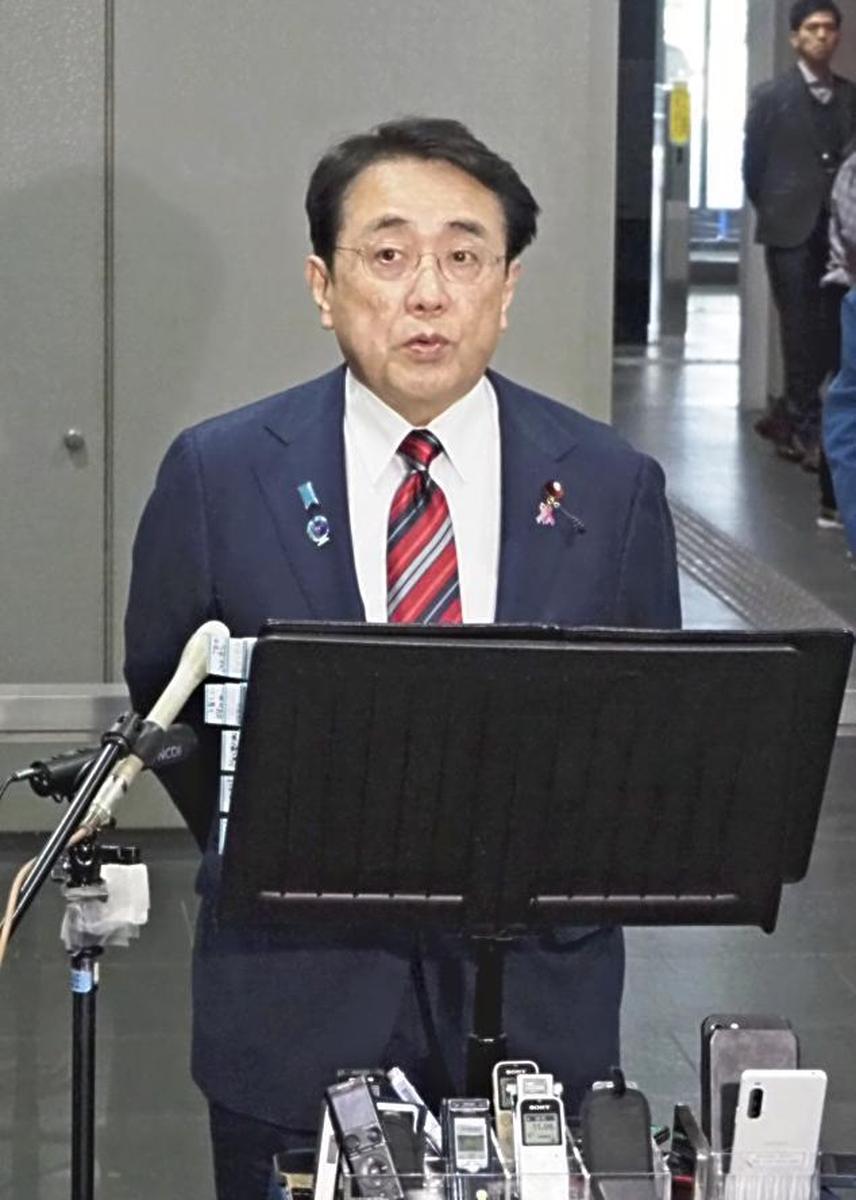
Economy, Trade and Industry Minister Ryosei Akazawa answers a question at a press conference Wednesday.
2:00 JST, February 20, 2026
Japan and the United States have chosen three inaugural projects to kick off a $550 billion (about ¥84 trillion) investment package in the United States.
The two nations agreed on the investment package in July during talks over U.S. tariff measures. The $550 billion in investments are to be made by January 2029, when U.S. President Donald Trump ‘s term of office expires.
Just over 6% of the total amount, or $36 billion, will be used in the first three projects. Both countries are hastily making preparations for the second set of projects, ahead of the Japan-U.S. summit scheduled in March, but careful consideration is required regarding profitability and other factors.
Economy, Trade and Industry Minister Ryosei Akazawa emphasized on Wednesday that the latest agreement would benefit both Japan and the United States.
“Japan and the United States will cooperate to build supply chains in sectors critical to economic security. Japanese companies can expect business expansion through equipment supply and other avenues,” Akazawa told reporters.
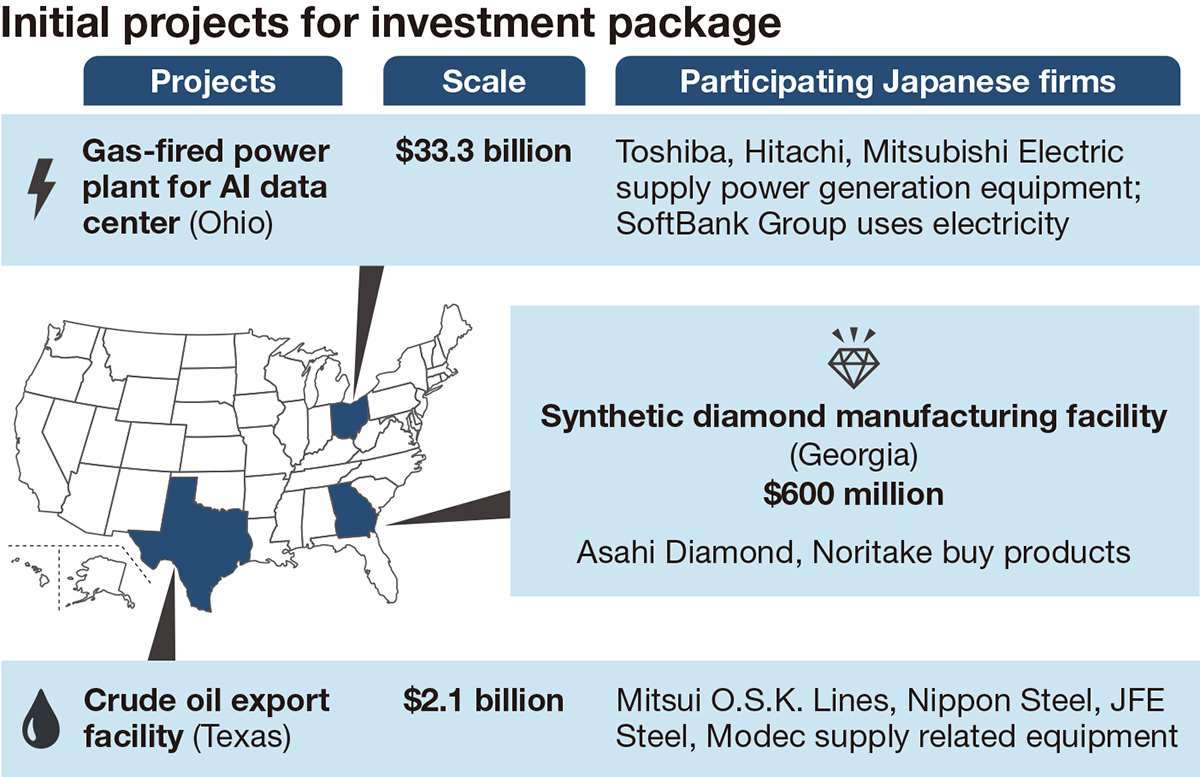
The three projects were agreed upon only after considerable difficulty.
Japan and the United States held discussions from December at a committee of senior government officials and others who worked through the year-end and New Year holidays.
According to people involved in the negotiations, the U.S. side was eager to move forward with the three projects it proposed. The United States is said to have intended to announce the projects by the end of January.
However, the negotiations ran into trouble over issues such as income and expenditure plans to minimize business risks and ensure profitability. Both sides were able to reach an agreement through talks between Akazawa and U.S. Commerce Secretary Howard Lutnick on Feb. 12.
Sources said they finally were able to do so because the U.S. side also made concessions, such as lowering interest rates and reducing business costs.
The three projects are all in areas important to economic security, such as strategic materials and energy. They involve the construction of a gas-fired power plant; the development of a facility necessary to export crude oil; and the building of a synthetic diamond manufacturing facility.
The construction of the gas-fired power plant in Ohio will be managed by SoftBank Group Corp., which is promoting the development of infrastructure such as data centers necessary for the development and operation of artificial intelligence in the United States.
Toshiba Corp. and Hitachi, Ltd. are expected to supply power generation and transmission and distribution equipment, in addition to other related equipment.
“We will work positively in the project within the scope of acceptable conditions,” Toshiba said after the latest announcement. Hitachi commented, “We are honored to be expected to contribute to the realization of the project.”
Operations at the infrastructure to be built in Texas to export crude oil will involve collecting crude onshore, transporting it offshore via pipeline and shipping it on large tankers. The project envisions exporting crude oil to Japan in emergencies.
Among the participating companies are Mitsui O.S.K. Lines, Ltd., which will handle vessel operation management, and Nippon Steel Corp., which will supply materials. “Large-scale projects generate demand for steel materials. We’ll consider supplying steel materials in a forward-looking manner,” a public relations official at Nippon Steel said.
The third project is the building of a synthetic diamond manufacturing facility in Georgia, essential for polishing and processing semiconductors and automotive parts. China dominates the global artificial diamond market.
Asahi Diamond Industrial Co., which handles tools for semiconductor components, imports 80% of its raw artificial diamond materials from China. “If we can stably procure raw materials from the United States, it would offer us significant benefits in terms of diversifying supply sources,” an Asahi Diamond official said.
To execute the three projects, Japan and the United States will establish a special purpose entity. The Japan Bank for International Cooperation will provide funding, while three major Japanese banks will extend loans with a loan guarantee from Nippon Export and Investment Insurance.
The U.S. side will contribute land and other tangible assets, while the U.S. federal government will help with construction permits and approvals.
Profits from the projects will be split 50-50 between Japan and the United States up to the amount covering Japanese loans and interest, and 90% of any profits beyond that will be received by the United States and 10% by Japan.
The Trump administration has also agreed with other parties, including the European Union and South Korea, to receive massive investments in exchange for tariff reductions. The three projects, announced ahead of other countries and regions, are likely become a model case for relevant projects.
However, one participating company expressed caution, saying; “There are concerns about who will bear the risks if things go wrong. We need to assess the risks until the details are finalized.”




Most Read
Popular articles in the past 24 hours
-

Director Naomi Kawase's New Film Explores Heart Transplants in Ja...
-
Japan’s Nikkei Stock Average Rises on Tech Rally and Takaichi's S...
-
Takaichi Expected to Express Desire for Constitutional Revision P...
-

Security Services Law Unconstitutional: Do Not Restrict Career Ch...
-
Japanese Man Living in Iraq Suspected of Illegally Entering U.S. ...
-
New Leader of Japan's CRA Opposition Party Faces Challenge of For...
-

Milano Cortina 2026: Snowboarding Star Fukada Wins Gold in Hard-F...
-
Tokyo Exhibition Featuring VR Walk Through 2025 Osaka-Kansai Expo...
Popular articles in the past week
-

Japan PM Takaichi’s Cabinet Resigns en Masse
-

Man Infected with Measles Reportedly Dined at Restaurant in Tokyo...
-

Videos Plagiarized, Reposted with False Subtitles Claiming ‘Ryuky...
-

Sanae Takaichi Elected 105th Prime Minister of Japan; Keeps All C...
-

Japan's Govt to Submit Road Map for Growth Strategy in March, PM ...
-

Milano Cortina 2026: Figure Skaters Riku Miura, Ryuichi Kihara Pa...
-
Tokyo’s New Record-Breaking Fountain Named ‘Tokyo Aqua Symphony’
-

Bus Carrying 40 Passengers Catches Fire on Chuo Expressway; All E...
Popular articles in the past month
-
Japan PM Takaichi’s Cabinet Resigns en Masse
-

Japan Institute to Use Domestic Commercial Optical Lattice Clock ...
-

Israeli Ambassador to Japan Speaks about Japan’s Role in the Reco...
-
Man Infected with Measles Reportedly Dined at Restaurant in Tokyo...
-

Man Infected with Measles May Have Come in Contact with Many Peop...
-

Prudential Life Insurance Plans to Fully Compensate for Damages C...
-
Videos Plagiarized, Reposted with False Subtitles Claiming ‘Ryuky...
-

Woman with Measles Visited Hospital in Tokyo Multiple Times Befor...
Top Articles in Business
-
Prudential Life Insurance Plans to Fully Compensate for Damages Caused by Fraudulent Actions Without Waiting for Third-Party Committee Review
-
Narita Airport, Startup in Japan Demonstrate Machine to Compress Clothes for Tourists to Prevent People from Abandoning Suitcases
-
JR Tokai, Shizuoka Pref. Agree on Water Resources for Maglev Train Construction
-
Toyota Motor Group Firm to Sell Clean Energy Greenhouses for Strawberries
-
KDDI Opens AI Data Center at Former Sharp Plant in Osaka Prefecture; Facility Will Provide Google’s Gemini AI Model for Domestic Users
JN ACCESS RANKING
-
Japan PM Takaichi’s Cabinet Resigns en Masse
-
Japan Institute to Use Domestic Commercial Optical Lattice Clock to Set Japan Standard Time
-
Israeli Ambassador to Japan Speaks about Japan’s Role in the Reconstruction of Gaza
-
Man Infected with Measles Reportedly Dined at Restaurant in Tokyo Station
-
Man Infected with Measles May Have Come in Contact with Many People in Tokyo, Went to Store, Restaurant Around When Symptoms Emerged