
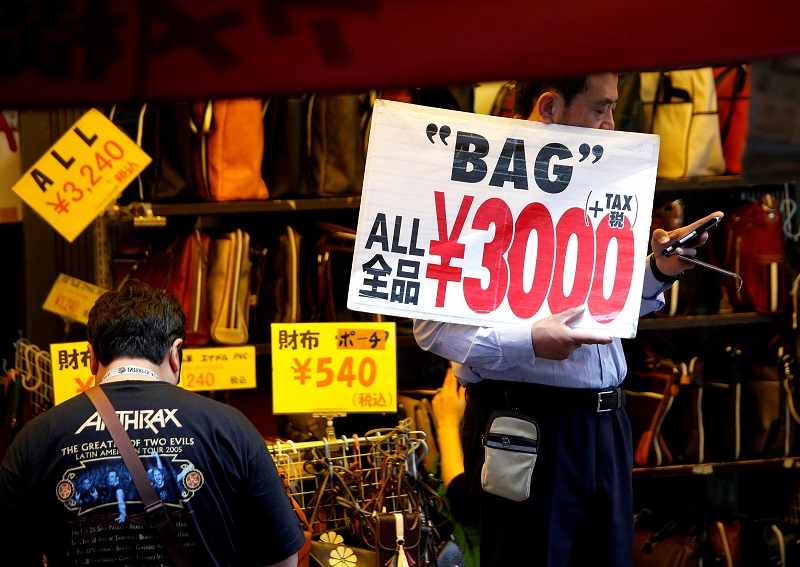
A shop employee holds a placard to attract customers in Tokyo in May 2018.
19:40 JST, November 25, 2022
TOKYO (Reuters) — Core consumer prices in Japan’s capital, a leading indicator of nationwide trends, rose at their fastest annual pace in 40 years in November and exceeded the central bank’s 2% target for a sixth straight month, signaling broadening inflationary pressure.
The increase, driven mostly by food and fuel bills but spreading to a broader range of goods, cast doubt on the view of the Bank of Japan that recent cost-push inflation will prove transitory, some analysts said.
The Tokyo core consumer price index (CPI), which excludes fresh food but includes fuel, was 3.6% higher in November than a year earlier, government data showed on Friday. The rise exceeded a median market forecast of 3.5% and the 3.4% increase seen in October.
The last time Tokyo inflation was faster was in April 1982, when the core CPI was 4.2% higher than a year before.
While the rise was driven mostly by electricity bills and food prices, companies were also charging more for durable goods as the weak yen pushed up the cost of imports, the data showed.
“Price hikes are broadening and suggests the weak yen could keep inflation elevated well into next year,” said Mari Iwashita, chief market economist at Daiwa Securities.
“Core consumer inflation may stay around the BOJ’s 2% target for much of next year, which would make it hard for the bank to keep arguing that the price rises are temporary.”
The Tokyo core-core CPI index, which excludes fuel as well as fresh food, was 2.5% higher in November than a year earlier, picking up from the 2.2% annual gain seen in October.
The BOJ has kept interest rates ultralow on the view that inflation will slow back below its target next year when the boost from fuel price gains dissipates. It has therefore remained an outlier from a wave of monetary tightening around the world aimed at combating soaring inflation.
Contrary to the experience of Western economies where wages have surged with inflation, growth in wages and services prices remain muted in Japan.
Of the components making up the Tokyo CPI data, services prices in November were up just 0.7% on a year earlier, after a 0.8% annual increase seen in October. That compared with a 7.7% spike in durable goods prices for November, which followed October’s 7.0% annual gain.






Most Read
Popular articles in the past 24 hours
-
Business Hotels Expanding into Regional Areas in Japan, Aiming to...
-

6 Injured at Naked Festival in Japan’s Okayama Prefecture; Police...
-

Fiji Defense Minister Hopes Japan Will Support Stabilization of P...
-

Space One Delays Launch of No. 3 Kairos Rocket; Company to Announ...
-

Milano Cortina 2026: Malinin Highlights Dangers of Social Media i...
-

Reciprocal Tariffs Ruled Illegal: Judiciary Would Not Tolerate Pr...
-

Japanese Film, Anymart, Wins Critics’ Award at International Film...
-

3rd Japan Pacific Islands Defense Dialogue to Begin in Tokyo on S...
Popular articles in the past week
-

Japan PM Takaichi’s Cabinet Resigns en Masse
-

Man Infected with Measles Reportedly Dined at Restaurant in Tokyo...
-

Sanae Takaichi Elected Prime Minister of Japan; Keeps All Cabinet...
-

Japan's Govt to Submit Road Map for Growth Strategy in March, PM ...
-

Bus Carrying 40 Passengers Catches Fire on Chuo Expressway; All E...
-

Milano Cortina 2026: Figure Skaters Riku Miura, Ryuichi Kihara Pa...
-

Japan, U.S. Name 3 Inaugural Investment Projects; Reached Agreeme...
-

U.S. Firm to Build Training Hub in Fukushima N-plant for Debris R...
Popular articles in the past month
-
Japan PM Takaichi’s Cabinet Resigns en Masse
-

Japan Institute to Use Domestic Commercial Optical Lattice Clock ...
-

Israeli Ambassador to Japan Speaks about Japan’s Role in the Reco...
-
Man Infected with Measles Reportedly Dined at Restaurant in Tokyo...
-

Videos Plagiarized, Reposted with False Subtitles Claiming ‘Ryuky...
-

Man Infected with Measles May Have Come in Contact with Many Peop...
-

Prudential Life Insurance Plans to Fully Compensate for Damages C...
-

Woman with Measles Visited Hospital in Tokyo Multiple Times Befor...
Top Articles in Business
-
Prudential Life Insurance Plans to Fully Compensate for Damages Caused by Fraudulent Actions Without Waiting for Third-Party Committee Review
-
Narita Airport, Startup in Japan Demonstrate Machine to Compress Clothes for Tourists to Prevent People from Abandoning Suitcases
-
Japan, U.S. Name 3 Inaugural Investment Projects; Reached Agreement After Considerable Difficulty
-

Toyota Motor Group Firm to Sell Clean Energy Greenhouses for Strawberries
-

SoftBank Launches AI Service for Call Centers That Converts Harsh Customer Voices into Softer Voices
JN ACCESS RANKING
-
Japan PM Takaichi’s Cabinet Resigns en Masse
-
Japan Institute to Use Domestic Commercial Optical Lattice Clock to Set Japan Standard Time
-
Israeli Ambassador to Japan Speaks about Japan’s Role in the Reconstruction of Gaza
-
Man Infected with Measles Reportedly Dined at Restaurant in Tokyo Station
-
Videos Plagiarized, Reposted with False Subtitles Claiming ‘Ryukyu Belongs to China’; Anti-China False Information Also Posted in Japan