
Amid Strait of Hormuz Blockade, Shipping Companies Scramble to Get Japan-Linked Vessels out of Persian Gulf
2:00 JST, March 6, 2026
Japanese shipping companies are now looking for solutions to problems arising from the recent attacks on Iran by the United States and Israel. The most pressing problem they face is determining how to get Japan-linked vessels out of the Persian Gulf, but as yet there are no clear prospects of being able to do so.
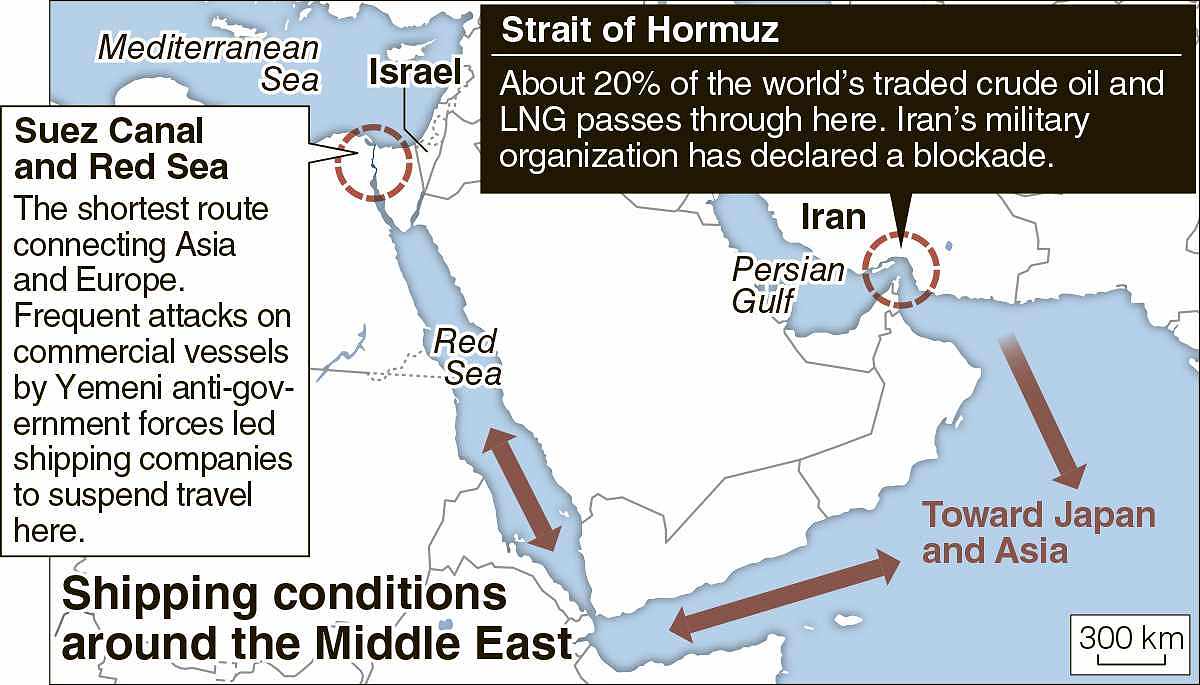
The worsening Middle East situation is impacting not only the transportation of crude oil and liquefied natural gas (LNG) via the Strait of Hormuz, but also the shipping route connecting Europe and Asia via the Suez Canal. Maritime transportation is now being restricted to a level never seen before.
44 Japan-linked vessels left in the Persian Gul
On Wednesday, the Japanese Shipowners’ Association held the first meeting of its maritime safety countermeasures headquarters.
“The situation is extremely serious,” association President Hitoshi Nagasawa, who is also the chairman of shipping company Nippon Yusen Kaisha, told reporters. “We are not optimistic about it.”
A total of 44 Japan-linked vessels were stuck inside the Persian Gulf as of Wednesday, according to the association. About half of them are crude oil tankers, but there are also vessels carrying LNG and automobiles. The safety of 24 Japanese personnel onboard these vessels has been confirmed, the association said.
At the meeting, participants affirmed their intention to ensure the safety of their seafaring personnel, vessels and cargoes and to strengthen their collaboration by sharing information.
“We will not be able to resume navigation until all details are confirmed, including the end of the fighting and the absence of mines,” Nagasawa said.
Risk insurance
The Strait of Hormuz, which links the Persian Gulf with the Indian Ocean, is a key strategic position which roughly 20% of the world’s crude oil and LNG shipments pass through. Japan depends on the Middle East for more than 90% of its crude oil imports.
Currently, Iran’s Islamic Revolutionary Guard Corps have declared the Strait of Hormuz closed following the U.S. and Israeli attacks, making it effectively impossible for vessels to navigate through the strait.
On Tuesday, U.S. President Donald Trump indicated that the U.S. Navy will begin escorting tankers through the Strait of Hormuz. Trump also said he has ordered the government-affiliated U.S. International Development Finance Corporation to provide risk insurance for all ships traveling through the Persian Gulf.
“We are paying a lot of attention [to the announcement], as our vessels cannot travel without insurance,” Nagasawa said. “We would like to gather information so we can respond [to the situation].”
Rising transportation costs
The deteriorating Middle East situation is also impacting the Suez Canal and the Red Sea, which together form the shortest sea route between Asia and Europe, one which is mainly used for transporting goods such as automobiles and food.
Japanese shipping firms have been making use of an alternative route, around Africa’s Cape of Good Hope, since Yemeni anti-government forces began making repeated attacks on commercial vessels in 2023. This has increased the amount of time required for such trips by 10 to 14 days and shipping expenses 30% to 50%.
Japan relies on imports for 90% of its energy and 60% of its food, with 99% of that trade volume managed by the shipping industry.
“We’re facing an unprecedented situation in which vessels are simultaneously unable to travel through either the Strait of Hormuz or the Red Sea,” said a senior official at a major shipping firm. “We cannot predict just how big of an impact this may have.”







Most Read
Popular articles in the past 24 hours
-

Japan Tourist Spot's Capsule Toys Made from Recycled Materials Pr...
-
Space One's No. 3 Kairos Rocket Terminates Mid-Flight
-

Former Unification Church: Proceed Steadily with Liquidation to P...
-
Japan’s Space One Kairos 3rd Flight Rocket Launched, but Mission ...
-

NTT Docomo to Discontinue 3G Service in March
-

Person Apparently Caught in Avalanche on Mt. Kamifurano in Hokkai...
-
LCC Greater Bay Airlines to Launch Regular Service on Fukuoka-Hon...
-
CARTOON OF THE DAY (March 5)
Popular articles in the past week
-
Tokyo Spends Big on Children, Wins Over Parents
-

South Korea Tightens Rules on Foreigners Buying Homes in Seoul Me...
-

Japan’s Miura, Kihara Announce Withdrawal from Figure Skating Wor...
-

2 Unpublished Early Novellas by Japan's Kenzaburo Oe Discovered, ...
-
Strait of Hormuz Closure Shakes Markets; Prolonged Closure Could ...
-
Nidec Chairman Resigns Amid Accounting Scandal at Major Japanese ...
-

Tourists Ignore Safety Barriers Near Famous Zao ‘Snow Monsters’ i...
-

Iran Situation: Japan Must Exert Diplomatic Efforts without Merel...
Popular articles in the past month
-

Producer Behind Pop Group XG Arrested for Cocaine Possession
-

Japan PM Takaichi’s Cabinet Resigns en Masse
-

Man Infected with Measles Reportedly Dined at Restaurant in Tokyo...
-

Israeli Ambassador to Japan Speaks about Japan’s Role in the Reco...
-

Videos Plagiarized, Reposted with False Subtitles Claiming ‘Ryuky...
-

Prudential Life Insurance Plans to Fully Compensate for Damages C...
-

Woman with Measles Visited Hospital in Tokyo Multiple Times Befor...
-

iPS Treatments Pass Key Milestone, but Broader Applications Far f...
Top Articles in Business
-
Prudential Life Insurance Plans to Fully Compensate for Damages Caused by Fraudulent Actions Without Waiting for Third-Party Committee Review
-

Japan, U.S. Name 3 Inaugural Investment Projects; Reached Agreement After Considerable Difficulty
-

Japan’s Major Real Estate Firms Expanding Overseas Businesses to Secure Future Growth, Focusing on Europe, U.S., Asia
-

SoftBank Launches AI Service for Call Centers That Converts Harsh Customer Voices into Softer Voices
-

Transport Companies See Opportunity in Narita Expansion; Airlines, Railways Prepare to Meet Expected Growth in Demand
JN ACCESS RANKING
-
Producer Behind Pop Group XG Arrested for Cocaine Possession
-
Japan PM Takaichi’s Cabinet Resigns en Masse
-
Man Infected with Measles Reportedly Dined at Restaurant in Tokyo Station
-
Israeli Ambassador to Japan Speaks about Japan’s Role in the Reconstruction of Gaza
-
Videos Plagiarized, Reposted with False Subtitles Claiming ‘Ryukyu Belongs to China’; Anti-China False Information Also Posted in Japan