
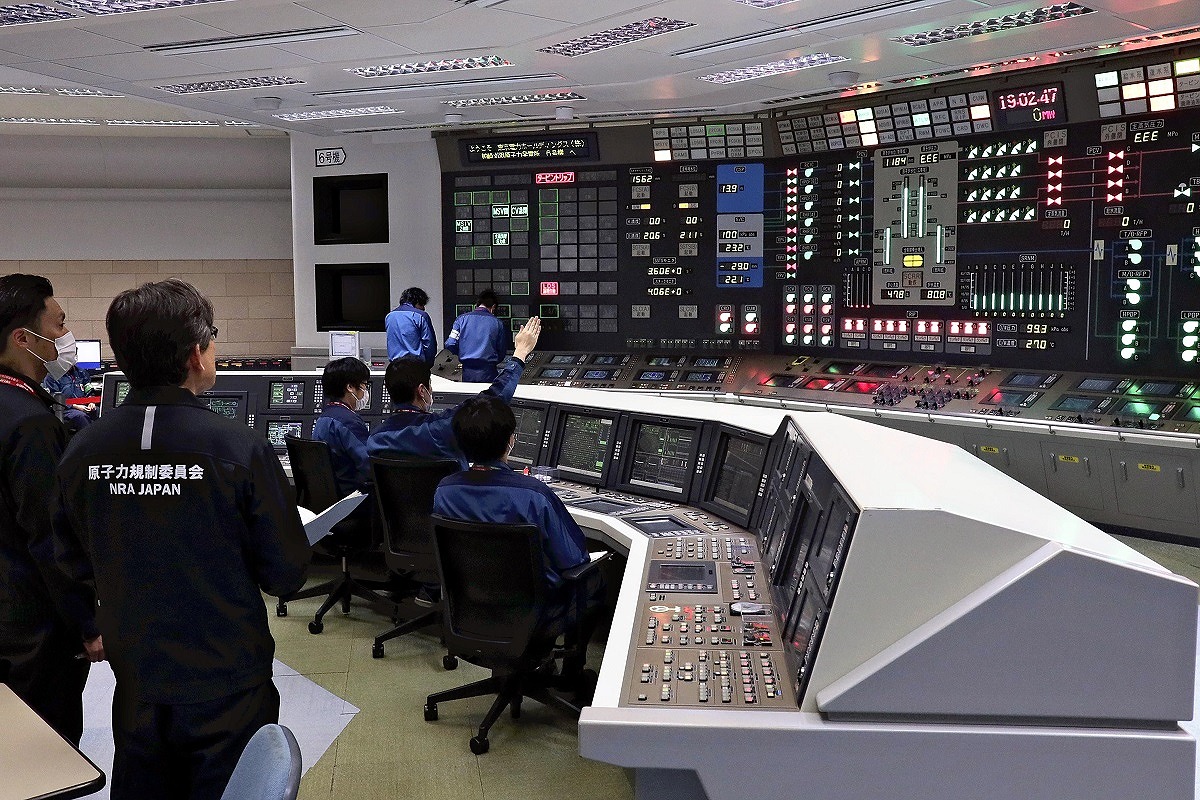
Personnel in the central control room for the Kashiwazaki-Kariwa nuclear power plant’s No. 6 reactor activate the reactor in Niigata Prefecture at 7:02 p.m. Wednesday.
17:13 JST, January 22, 2026
With the twist of a lever, the No. 6 reactor at the Kashiwazaki-Kariwa nuclear power station in Niigata Prefecture was restarted Wednesday, a significant milestone in the government’s plan to make “maximum use” of nuclear energy.
Nuclear power, a carbon-free power source that will help ensure a stable electricity supply, is crucial for people’s day-to-day lives and industrial activity, so the government plans to speed up the restart of more reactors around the nation.
At 6:52 p.m., an operator in the No. 6 reactor’s central control room received an instruction: “Turn on the reactor mode switch.” The operator turned the lever and began the process of activating the reactor, which has an output of about 1.36 million kilowatts and is among the largest in Japan.
Control rods that suppress nuclear fission inside the reactor were pulled out at 7:02 p.m., and four yellow lights on the control panel turned off. This indicated that the reactor was operating for the first time in 13 years and 10 months. The operator continued working while closely checking the meters and gauges to ensure no abnormalities occurred.
Tokyo Electric Power Company Holdings, Inc. plans to start commercial operation of the reactor as soon as Feb. 26. Electricity generated by the reactor will be supplied to the Tokyo metropolitan area. This will substantially stabilize the Tokyo area’s power supply, which had repeatedly been stretched due to high electricity demand during summer and winter.
Momentum growing in eastern Japan
The government approved a revised Strategic Energy Plan at a cabinet meeting in February 2025. The revised plan stated that nuclear power would be utilized to the “maximum” extent possible, and removed wording from the previous plan that called for the nation to “reduce dependence” on this power source. The government has set a target of having nuclear power account for 20% of Japan’s energy mix by fiscal 2040, up from the current level of less than 10%. Achieving this goal will require rebooting the majority of the nation’s 33 nuclear reactors.
However, just 15 reactors, including the Kashiwazaki-Kariwa plant’s No. 6 unit, have been brought back online. Only two of these reactors are in eastern Japan, and power bills charged by TEPCO are at least 10% higher than those issued by Kansai Electric Power Co. and Kyushu Electric Power Co., which have been able to restart more reactors.
In November, Niigata Gov. Hideyo Hanazumi officially approved the restart of the No. 6 reactor, and Hokkaido Gov. Naomichi Suzuki in December gave the green light to restarting the No. 3 reactor at Hokkaido Electric Power Co.’s Tomari nuclear power plant.
Hokkaido Electric plans to cut electricity bills for households by 11% if the Tomari reactor resumes operating.
TEPCO has set its current electricity rates based on the assumption that the Nos. 6 and 7 reactors at the Kashiwazaki-Kariwa plant will get up and running. Although the No. 6 unit has restarted, “this won’t have an immediate impact on power bills,” a TEPCO official said. However, the restart could lead to lower bills in the future.
Worldwide trend
The government’s urgency to restart nuclear reactors is motivated in part by the direct connection this issue has with Japan’s industrial competitiveness. Expanding usage of nuclear power is a global trend. In 2024, U.S. tech giant Microsoft Corp. signed a contract to purchase electricity from the Three Mile Island nuclear power plant in the northeastern United States for 20 years. U.S. companies Google LLC and Amazon.com, Inc. have also announced plans to make massive investments in next-generation reactors.
The administration of Prime Minister Sanae Takaichi has pledged to pour money into fields such as artificial intelligence and semiconductors as part of an economic growth strategy. All these fields consume vast amounts of electricity, so the nation’s demand for power will certainly increase.
Consequently, there are mounting concerns within the government about what could happen if the nation does not fully harness nuclear power. “We’ll be left behind in global competition,” a senior Economy, Trade and Industry Ministry official told The Yomiuri Shimbun.
Waseda University Prof. Noriko Endo, an expert on nuclear power, said, “Creating a stable supply of electricity will impact every industry, ranging from automobiles to defense. It’ll affect our nation’s strength.”






Most Read
Popular articles in the past 24 hours
-

Strait of Hormuz Closure Shakes Markets; Prolonged Closure Could ...
-

Iran Situation: Japan Must Exert Diplomatic Efforts without Merel...
-
Measles Patient Visited Hospital in Bunkyo Ward, Tokyo, Metropoli...
-

Milano Cortina 2026: Japanese Figure Skater Miura Returns to Home...
-

Takayama Among World's Top 10 Most Welcoming Cities for 2026; 2nd...
-
2 of Japan's Opposition Parties Submit Bill to Revise Political F...
-
Chiba Police to Arrest Japanese National in Midair; Man Accused o...
-
Former Nomura Securities Employee Given 18-year Prison Sentence f...
Popular articles in the past week
-
Milano Cortina 2026: Japanese Gold Medalist Figure Skater Miura S...
-
Tokyo Spends Big on Children, Wins Over Parents
-

Japan’s Miura, Kihara Announce Withdrawal from Figure Skating Wor...
-

Yokohama to Test Out Renewable-Powered Offshore Floating Data Cen...
-
BOJ Keeping Eye on Economy and Takaichi's ‘Proactive Fiscal Polic...
-
Tokyo Measles Patient Traveled to Fukuoka Aboard JAL Planes; Susp...
-
Japan’s Takaichi Speaks on New U.S. Tariff in Upper House, Says P...
-
Nidec Chairman Resigns Amid Accounting Scandal at Major Japanese ...
Popular articles in the past month
-

Producer Behind Pop Group XG Arrested for Cocaine Possession
-

Japan PM Takaichi’s Cabinet Resigns en Masse
-

Man Infected with Measles Reportedly Dined at Restaurant in Tokyo...
-

Israeli Ambassador to Japan Speaks about Japan’s Role in the Reco...
-

Videos Plagiarized, Reposted with False Subtitles Claiming ‘Ryuky...
-

Prudential Life Insurance Plans to Fully Compensate for Damages C...
-

Woman with Measles Visited Hospital in Tokyo Multiple Times Befor...
-

iPS Treatments Pass Key Milestone, but Broader Applications Far f...
Top Articles in Business
-
Prudential Life Insurance Plans to Fully Compensate for Damages Caused by Fraudulent Actions Without Waiting for Third-Party Committee Review
-

Japan, U.S. Name 3 Inaugural Investment Projects; Reached Agreement After Considerable Difficulty
-

Japan’s Major Real Estate Firms Expanding Overseas Businesses to Secure Future Growth, Focusing on Europe, U.S., Asia
-

SoftBank Launches AI Service for Call Centers That Converts Harsh Customer Voices into Softer Voices
-

Transport Companies See Opportunity in Narita Expansion; Airlines, Railways Prepare to Meet Expected Growth in Demand
JN ACCESS RANKING
-
Producer Behind Pop Group XG Arrested for Cocaine Possession
-
Japan PM Takaichi’s Cabinet Resigns en Masse
-
Man Infected with Measles Reportedly Dined at Restaurant in Tokyo Station
-
Israeli Ambassador to Japan Speaks about Japan’s Role in the Reconstruction of Gaza
-
Videos Plagiarized, Reposted with False Subtitles Claiming ‘Ryukyu Belongs to China’; Anti-China False Information Also Posted in Japan