
Firm Executives Participate in Discussion on Effective Supply Chains At Next-Generation Global Supply Chain Forum
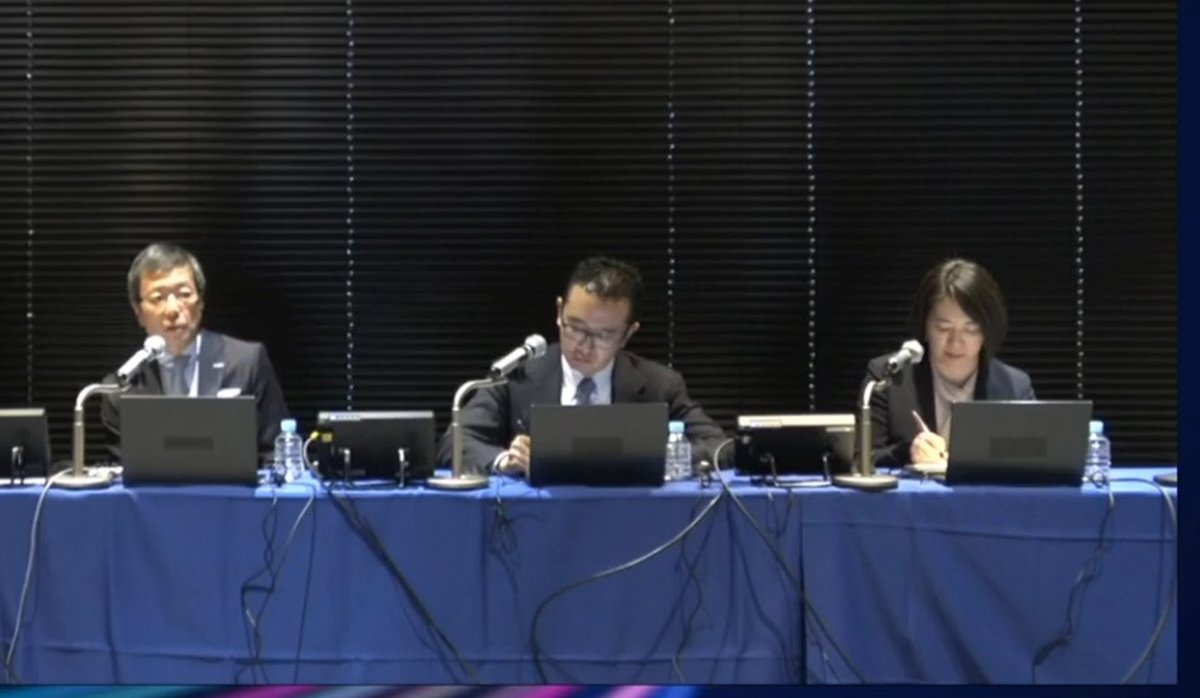
From left: Yasu Higuchi, president of Panasonic Connect Co., Tadatsugu Konoike, director and senior managing executive officer in charge of overseas business of Konoike Transport Co. and Ayako Kawai, professor of the Faculty of Economics of Gakushuin University, are seen in an image captured from video taken at the Next-Generation Global Supply Chain Forum on Friday.
12:35 JST, December 16, 2025
As tensions deepen between economic superpowers China and the United States, and growing concerns over supply chain instability, companies are intensifying efforts to secure stable supply networks. At an online forum held on Friday, corporate representatives and a researcher exchanged views on the challenges they face and discussed possible countermeasures.
While it is often said that securing supply chains is emphasized as preparation for geopolitical risks and emergencies such as large-scale disasters, at the Next-Generation Global Supply Chain Forum, Panasonic Connect Co. President Yasu Higuchi said, “Fundamentally, supply chains being managed effectively even during normal times is far more crucial.”
He pointed out that inadequate supply chain management “leads to operational inefficiencies, significantly impacting business operations,” stressing the need for corporate executives to proactively engage in improvements rather than leaving it solely to the relevant departments.
Tadatsugu Konoike, director and senior managing executive officer in charge of overseas business at Konoike Transport Co., introduced German practices. Currently stationed in Germany to understand how overseas supply chains work, he noted that advanced companies in Germany standardize product-related information such as inventory levels in warehouses and factories and efficiently manage this data using AI and other technologies. He stated, “Supply chain management must be implemented top-down.”
Regarding moves by Japanese companies to shift factories from China to Southeast Asian countries in consideration of geopolitical risks, Ayako Kawai, professor of the Faculty of Economics of Gakushuin University, expressed the view that these actions are a response to short-term challenges without a medium-to-long-term perspective. She said, “It is time to consider the overall architecture [of supply chains].”
Kawai also expressed the view that data held by logistics companies can be useful for improving supply chains, stressing the importance of these firms taking action. Konoike responded that such data also presents business opportunities for logistics companies.








Most Read
Popular articles in the past 24 hours
-
Rising Kabuki Star Works to Ensure Deaf Audience's Enjoyment of P...
-

Lady Bess: Iroha Okuda, Mayuko Kominami Discuss Performing Elizab...
-
Japan Considering Taking Part in U.S. ‘Golden Dome’ Defense Syste...
-

Japan's TEPCO Releases Footage from Fukushima N-Plant Reactor
-

Oil Reserve Releases: G7 Members Unite against Growing Threat
-
46 Evacuated from UAE, Oman on Japanese Govt-chartered Flight
-
Japan's Sanyo Shinkansen Suspended Again; Between Okayama, Aioi S...
-
Driver Dies in Collision with Express Train at Crossing in Mito; ...
Popular articles in the past week
-

Japan Figure Skating Legend Yuzuru Hanyu Is Proud Disaster Surviv...
-

Nippon Life Insurance's U.S. Arm Sues OpenAI Over Legal Assistanc...
-
Govt to Utilize ODA for Ensuring Economic Security; Securing Ener...
-
15 Measles Patients Confirmed in Tokyo in Past 6 Days; 1 May Have...
-
Massive Sewer Pipe Found Jutting Out of Highway in Osaka
-
Japan Govt to Tighten Requirements to Receive Permanent Residency...
-

Beckoning Cats Get Makeover to Fit Modern Lifestyles with Sleek D...
-
Japan Govt Survey Finds Just 10% of Workers Want Working Hours to...
Popular articles in the past month
-

Producer Behind Pop Group XG Arrested for Cocaine Possession
-

Japan PM Takaichi’s Cabinet Resigns en Masse
-

Man Infected with Measles Reportedly Dined at Restaurant in Tokyo...
-

Videos Plagiarized, Reposted with False Subtitles Claiming ‘Ryuky...
-
Japan Figure Skating Legend Yuzuru Hanyu Is Proud Disaster Surviv...
-

iPS Treatments Pass Key Milestone, but Broader Applications Far f...
-

Sanae Takaichi Elected Prime Minister of Japan; Keeps All Cabinet...
-

Nepal Bus Crash Kills 19 People, Injures 25 Including One Japanes...
Top Articles in Business
-
Nippon Life Insurance’s U.S. Arm Sues OpenAI Over Legal Assistance Provided by ChatGPT
-

Japan, U.S. Name 3 Inaugural Investment Projects; Reached Agreement After Considerable Difficulty
-

Japan’s Major Real Estate Firms Expanding Overseas Businesses to Secure Future Growth, Focusing on Europe, U.S., Asia
-

Transport Companies See Opportunity in Narita Expansion; Airlines, Railways Prepare to Meet Expected Growth in Demand
-

Amid Strait of Hormuz Blockade, Shipping Companies Scramble to Get Japan-Linked Vessels out of Persian Gulf
JN ACCESS RANKING
-
Producer Behind Pop Group XG Arrested for Cocaine Possession
-
Japan PM Takaichi’s Cabinet Resigns en Masse
-
Man Infected with Measles Reportedly Dined at Restaurant in Tokyo Station
-
Videos Plagiarized, Reposted with False Subtitles Claiming ‘Ryukyu Belongs to China’; Anti-China False Information Also Posted in Japan
-
Japan Figure Skating Legend Yuzuru Hanyu Is Proud Disaster Survivor and Gold Medalist, Vows to Continue Support Efforts