
Asahi Finally Opens Up about Extent of September’s Cyberattack; 1.91 Mil. People’s Data May Have Been Leaked
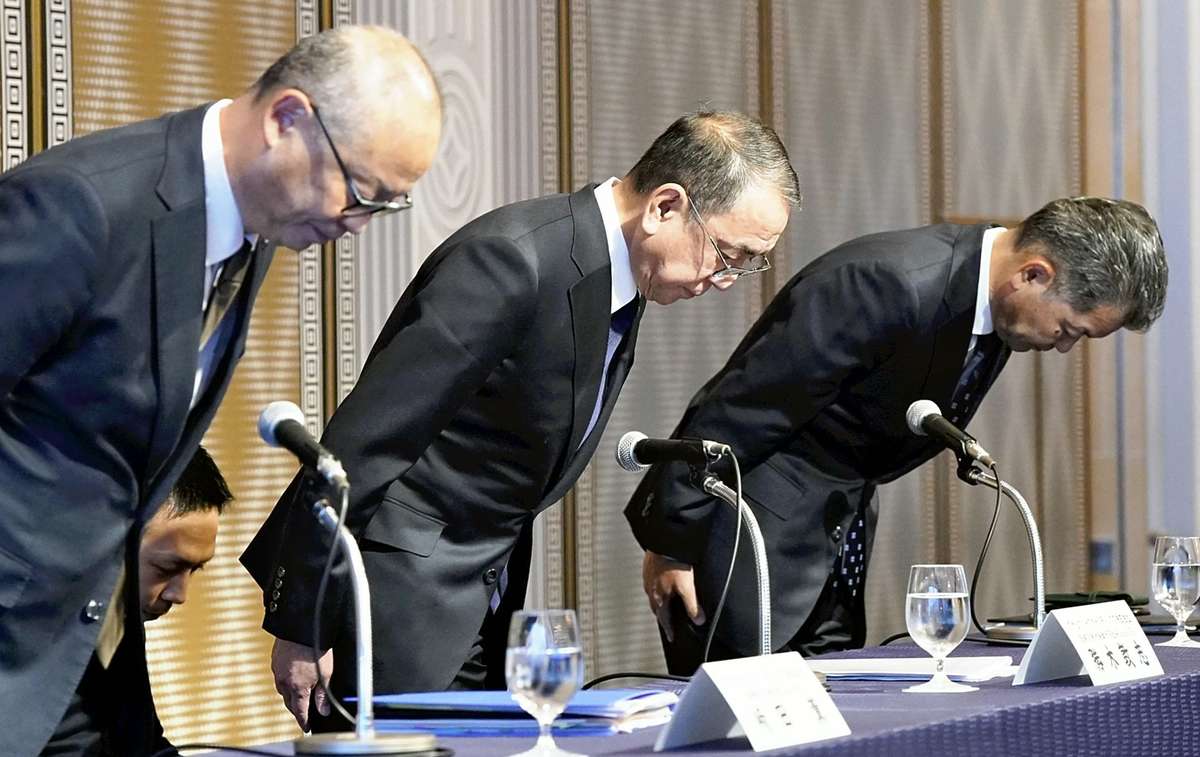
Asahi Group Holdings, Ltd. President Atsushi Katsuki, center, bows in apology at a press conference in Chiyoda Ward, Tokyo, on Thursday.
21:00 JST, November 28, 2025
The extent and severity of the damage caused by the cyberattack on Asahi Group Holdings, Ltd. in late September is finally becoming clear.
Asahi has announced that the personal information of about 1.91 million people, including customers and employees, might have been leaked as a result of the cyberattack. The major food and beverage company added that it will resume receiving orders and shipping products through its computer systems from December onward, with these operations expected to be fully normalized in February.
At the company’s first press conference since the attack, Asahi Group Holdings President Atsushi Katsuki said Thursday that the company’s computer systems had been “vulnerable,” and he acknowledged that its countermeasures had been insufficient. However, Katsuki also revealed that the “sophisticated and clever cyberattack” had been “beyond anything the company had expected.” Katsuki explained that Asahi’s systems had been redesigned since the attack.
According to a statement issued by Asahi, external attackers gained access to the data center network via the group’s internal network equipment around Sept. 19. The attackers later stole passwords and took over the system’s administrator privileges. The attackers are believed to have infiltrated multiple servers mainly outside of business hours, and repeatedly snooped around the network.
On Sept. 29, a ransomware attack disrupted the company’s systems. Asahi confirmed that data on some computers and servers connected to the network had been encrypted and rendered unusable.
Asahi’s internal investigation revealed that personal information stored on some computers provided to employees and on servers in the data center could have been exposed. The company said this information included the name, physical address, phone number and other details of customers, employees and employee family members who had contacted the customer service centers of some Asahi group companies.
VPN use halted
In October, Qilin — a hacking group believed to be based in Russia — posted an online message claiming responsibility for the cyberattack. Katsuki said the company had not received any demands for a ransom.
“We haven’t had contact with the attackers,” Katsuki said at the press conference. “We have a data backup, so even if they demanded a ransom, we felt we shouldn’t pay it.”
Asahi did not reveal in detail the route through which the hackers initially gained access, but the company has halted the use of virtual private networks, which establish a digital connection between a remote server and an organization’s internal network. A VPN encrypts communications and boosts the security of such data. However, ransomware can exploit vulnerabilities created when software has not been updated and in other situations, and has reportedly been able to penetrate computer systems in some cases.
“So many attacks exploit vulnerabilities in VPNs, so it’s possible that any company could fall victim to them,” said Naoki Bando, a fellow at the Software Association of Japan, an organization that has helped companies and hospitals recover from ransomware attacks.
Bando suggested some steps that could help repel such attacks. “It’s important to ensure your VPN devices and software are right up-to-date, and to set long, difficult-to-guess passwords,” Bando said.
Results announcement delayed
After the cyberattack disrupted its systems, Asahi had been receiving orders and arranging shipments manually, such as via telephone or fax. The computer system for receiving orders and other operations remains offline.
October sales at Asahi Breweries, Ltd., which resumed shipments of its flagship Asahi Super Dry beer and other products, were more than 90% of those recorded in the same month last year. By contrast, sales at Asahi Soft Drinks Co., which handles a wide range of products, plunged to about 60% from the level logged in the same month last year, as the company struggled with significant shipment delays.
Asahi announced at the press conference that it had decided to postpone the announcement of its financial results for the fiscal year ending on Dec. 31, 2025. The impact of the systems disruption on Asahi’s business performance in the months ahead will be closely watched.
Katsuki admitted that recovering from the cyberattack was taking a long time. “The prevention of further harm was the top priority as we carefully restored our systems,” Katsuki explained.
When asked about the top management’s future following this incident, Katsuki demurred. “We will exercise better leadership and get through this difficult time,” he said.
The company also presented a plan to prevent such a breach from happening again by beefing up its data backup systems and reviewing its business continuity plan.






Most Read
Popular articles in the past 24 hours
-

BOJ Keeping Eye on Economy and Takaichi's ‘Proactive Fiscal Polic...
-
Tokyo Measles Patient Traveled to Fukuoka Aboard JAL Planes; Susp...
-

Govt to Set Working-Level Meeting Group for Refundable Tax Credit...
-

University of Tsukuba Hospital to Introduce Working Dog Next Year...
-

Party Representatives’ Questions in Diet: Takaichi Says Consumpti...
-
Pokémon Celebrates 30 Years with Japanese Pro Baseball Collab
-

Milano Cortina 2026: News in Pictures / Feats of Japanese Athlete...
-

Nikkei Crosses 59,000 for First Time on Software Rally; Gains Shr...
Popular articles in the past week
-

Producer Behind Pop Group XG Arrested for Cocaine Possession
-

iPS Treatments Pass Key Milestone, but Broader Applications Far f...
-
Tokyo Skytree's Elevator Stops, Trapping 20 People; All Rescued (...
-

Milano Cortina 2026: Japanese Gold Medalist Figure Skater Miura S...
-

Nepal Bus Crash Kills 19 People, Injures 25 Including One Japanes...
-

Japan’s Major Real Estate Firms Expanding Overseas Businesses to ...
-

Baby Monkey Punch Captures Hearts at Chiba Pref. Zoo, on Social M...
-

Milano Cortina 2026: Japanese Figure Skater Kaori Sakamoto’...
Popular articles in the past month
-
Producer Behind Pop Group XG Arrested for Cocaine Possession
-

Japan PM Takaichi’s Cabinet Resigns en Masse
-

Japan Institute to Use Domestic Commercial Optical Lattice Clock ...
-

Man Infected with Measles Reportedly Dined at Restaurant in Tokyo...
-

Israeli Ambassador to Japan Speaks about Japan’s Role in the Reco...
-

Videos Plagiarized, Reposted with False Subtitles Claiming ‘Ryuky...
-

Man Infected with Measles May Have Come in Contact with Many Peop...
-

Prudential Life Insurance Plans to Fully Compensate for Damages C...
Top Articles in Business
-
Prudential Life Insurance Plans to Fully Compensate for Damages Caused by Fraudulent Actions Without Waiting for Third-Party Committee Review
-
Narita Airport, Startup in Japan Demonstrate Machine to Compress Clothes for Tourists to Prevent People from Abandoning Suitcases
-

Japan, U.S. Name 3 Inaugural Investment Projects; Reached Agreement After Considerable Difficulty
-

Toyota Motor Group Firm to Sell Clean Energy Greenhouses for Strawberries
-
Japan’s Major Real Estate Firms Expanding Overseas Businesses to Secure Future Growth, Focusing on Europe, U.S., Asia
JN ACCESS RANKING
-
Producer Behind Pop Group XG Arrested for Cocaine Possession
-
Japan PM Takaichi’s Cabinet Resigns en Masse
-
Man Infected with Measles Reportedly Dined at Restaurant in Tokyo Station
-
Israeli Ambassador to Japan Speaks about Japan’s Role in the Reconstruction of Gaza
-
Videos Plagiarized, Reposted with False Subtitles Claiming ‘Ryukyu Belongs to China’; Anti-China False Information Also Posted in Japan