
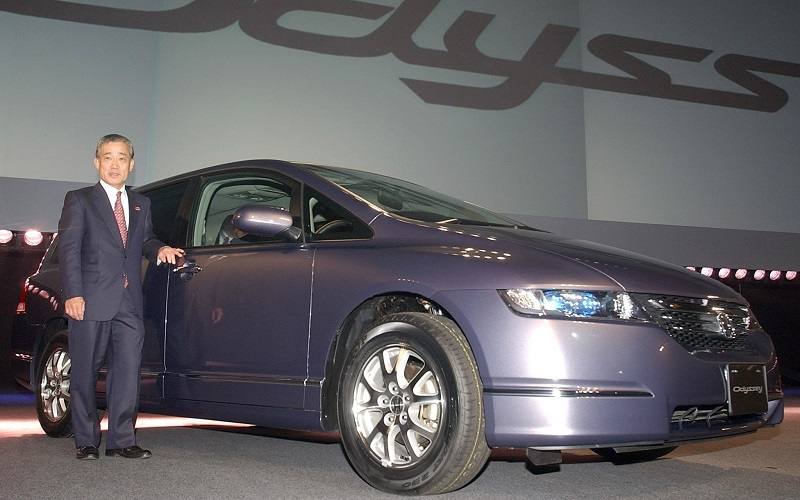
A new model of Honda’s Odyssey minivan is unveiled in October 2003.
15:49 JST, June 19, 2021
In response to both a shrinking domestic market and the accelerating shift toward electric vehicles, Japan’s automakers are reviewing their lineups and discontinuing the production of some widely beloved models.
Around the end of this year, Honda Motor Co. will end production of the Odyssey minivan, a model that has sold more than 1.2 million units since 1994.
The Odyssey became popular for its low height, which allowed it to be easily parked in multistory parking facilities, and its spacious interior with three rows of seats. It sold 120,000 units in 1995. In recent years, however, it has been competing with Toyota Motor Corp.’s Alphard minivan and other models, and sold only about 10,000 units in 2020.
Honda plans to suspend operations of its plant in Sayama, Saitama Prefecture, which produces the Odyssey, by the end of fiscal 2021 and consolidate the functions at its plant in Yorii in the prefecture. At the same time, the company will cease production of the Legend luxury sedan and the Clarity fuel cell vehicle.
Mitsubishi Motors Corp. will discontinue production of Pajero sport-utility vehicles this summer.
The Pajero has been popular both in Japan and overseas as one of the leading off-road vehicles, which was designed to overcome rugged terrain. A team driving the Pajero won in the 1985 Paris–Dakar rally. However, demand for the model has been declining in recent years due to its low fuel economy and other reasons, such as struggling to comply with increasingly strict environmental regulations.
The production of many sedans has also been discontinued. The increasing popularity of outdoor activities such as camping has created a headwind for sedans with small luggage compartments.
In March, Toyota Motor stopped production of its two sister models, the Premio and the Allion. These successors to the Corona and Carina, which were popular during the period of rapid economic growth, ended their history of more than half a century.
Nissan Motor Co. has ceased production of the Sylphy, and Subaru Corp. halted the Legacy B4 last year.
Automakers have been sinking large amounts of capital into the development of technologies for vehicle electrification and automated driving. With domestic sales shrinking mainly due to the declining birthrate and the aging of the population, many in the industry believe automakers have no choice but to continue to narrow down their lineups.
Meanwhile, a Nissan executive stressed this month that the company “will never give up” on the Skyline sedan, despite declining sales. The Skyline, one of Nissan’s most popular models, sold 150,000 units a year at its peak in the 1970s, but sold only about 3,900 units in 2020.
The handling of so many beloved models is likely to continue to trouble automakers.








Most Read
Popular articles in the past 24 hours
-

Japan Defense Agency to Develop AI Intelligence Analysis System f...
-

Moai Statue Shows Lasting Bond Between Miyagi Pref. Town, Easter ...
-

Milano Cortina 2026: Japan’s Oguri Wins Para Snowboard Silver at ...
-
Japan's Defense Ministry: North Korea Appears to Have Fired Balli...
-

Aichi Fisheries Cooperatives Use Smart Tech to Farm Triploid Oyst...
-

Teachers Support Students’ Inquiry Learning behind the Scenes
-

National Intelligence Council: Proposed Body Must Be Utilized To ...
-

Japan's Lower House Passes Budget Proposal; Could Be Delayed in U...
Popular articles in the past week
-

Japan Figure Skating Legend Yuzuru Hanyu Is Proud Disaster Surviv...
-
Govt to Utilize ODA for Ensuring Economic Security; Securing Ener...
-
15 Measles Patients Confirmed in Tokyo in Past 6 Days; 1 May Have...
-

Massive Sewer Pipe Found Jutting Out of Highway in Osaka
-

Japan Govt to Tighten Requirements to Receive Permanent Residency...
-
JR Tokai Breaks Ground on Yamanashi Maglev Station; Will Be Part ...
-

Beckoning Cats Get Makeover to Fit Modern Lifestyles with Sleek D...
-
Power Outage Forces About 980 Passengers in Yokohama to Walk to T...
Popular articles in the past month
-

Producer Behind Pop Group XG Arrested for Cocaine Possession
-

Japan PM Takaichi’s Cabinet Resigns en Masse
-

Man Infected with Measles Reportedly Dined at Restaurant in Tokyo...
-

Videos Plagiarized, Reposted with False Subtitles Claiming ‘Ryuky...
-
Japan Figure Skating Legend Yuzuru Hanyu Is Proud Disaster Surviv...
-

iPS Treatments Pass Key Milestone, but Broader Applications Far f...
-

Sanae Takaichi Elected Prime Minister of Japan; Keeps All Cabinet...
-

Nepal Bus Crash Kills 19 People, Injures 25 Including One Japanes...
Top Articles in Business
-

Nippon Life Insurance’s U.S. Arm Sues OpenAI Over Legal Assistance Provided by ChatGPT
-

Japan, U.S. Name 3 Inaugural Investment Projects; Reached Agreement After Considerable Difficulty
-

Japan’s Major Real Estate Firms Expanding Overseas Businesses to Secure Future Growth, Focusing on Europe, U.S., Asia
-

Transport Companies See Opportunity in Narita Expansion; Airlines, Railways Prepare to Meet Expected Growth in Demand
-

Amid Strait of Hormuz Blockade, Shipping Companies Scramble to Get Japan-Linked Vessels out of Persian Gulf
JN ACCESS RANKING
-
Producer Behind Pop Group XG Arrested for Cocaine Possession
-
Japan PM Takaichi’s Cabinet Resigns en Masse
-
Man Infected with Measles Reportedly Dined at Restaurant in Tokyo Station
-
Videos Plagiarized, Reposted with False Subtitles Claiming ‘Ryukyu Belongs to China’; Anti-China False Information Also Posted in Japan
-
Japan Figure Skating Legend Yuzuru Hanyu Is Proud Disaster Survivor and Gold Medalist, Vows to Continue Support Efforts