
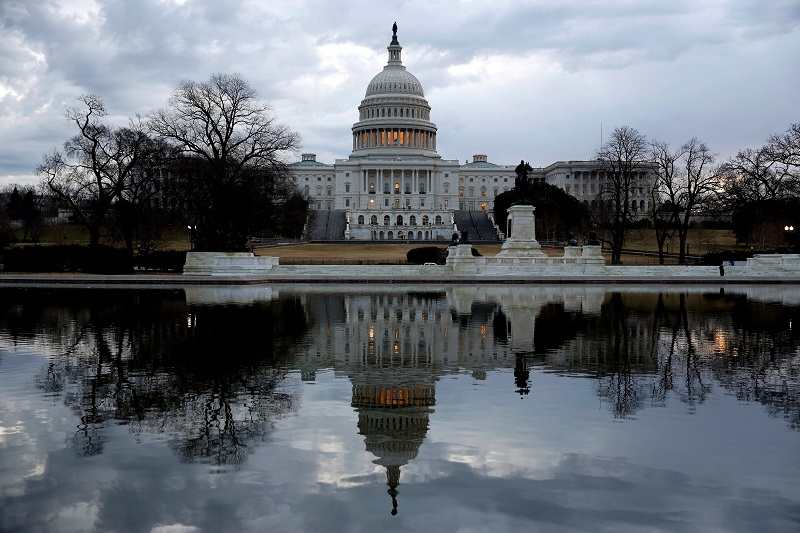
Clouds pass over the U.S. Capitol in Washington in January 2018.
10:44 JST, December 9, 2022
WASHINGTON (Reuters) — The U.S. House of Representatives backed legislation on Thursday paving the way for the defense budget to hit a record $858 billion next year, $45 billion more than proposed by President Joe Biden.
The House passed the compromise version of the National Defense Authorization Act, or NDAA, an annual must-pass bill setting policy for the Pentagon, by 350-80, far exceeding the two-thirds majority required to pass the legislation and send it for a vote in the Senate.
The fiscal 2023 NDAA authorizes $858 billion in military spending and includes a 4.6% pay increase for the troops, funding for purchases of weapons, ships and aircraft; and support for Taiwan as it faces aggression from China and Ukraine as it fights an invasion by Russia.
This bill is Congress exercising its authority to authorize and do oversight, said Representative Adam Smith, the Democratic chairman of the House Armed Services Committee, in a speech urging support for the measure.
Because it is one of the few major bills passed every year, members of Congress use the NDAA as a vehicle for a range of initiatives, some unrelated to defense.
This year’s bill — the result of months of negotiations between Democrats and Republicans in the House and Senate — needed a two-thirds majority in the House after disagreement from some House members over whether it should include an amendment on voting rights.
The fiscal 2023 NDAA includes a provision demanded by many Republicans requiring the Secretary of Defense to rescind a mandate requiring that members of the armed forces get COVID-19 vaccinations.
It provides Ukraine at least $800 million in additional security assistance next year and includes a range of provisions to strengthen Taiwan amid tensions with China.
The bill authorizes more funds to develop new weapons and purchase systems including Lockheed Martin Corp’s LMT.N F-35 fighter jets and ships made by General Dynamics GD.N.
The Senate is expected to pass the NDAA next week, sending it to the White House for President Joe Biden to sign into law.
However, the NDAA is not the final word on spending. Authorization bills create programs but Congress must pass appropriations bills to give the government legal authority to spend federal money.
Congressional leaders have not yet agreed on an appropriations bill for next year.







Most Read
Popular articles in the past 24 hours
-

McDonald's Japan Raises Prices; Big Mac to Cost ¥500, Double Chee...
-

Nepal Bus Crash Kills 19 People, Injures 25 Including One Japanes...
-

Japan’s Nikkei Stock Average Rises as AI-Related Stocks Shine; Co...
-

Aggression against Ukraine: Malignant Precedent Must Not Be Set t...
-

Joruri Bunraku Narrative Performed in Honor of Donald Keene by La...
-

Milano Cortina 2026: Gold Medal Olympic Figure Skaters Riku Miura...
-

Kanto's 1st Spring Wind Blows as Tokyo Sees Unseasonably High Tem...
-

CARTOON OF THE DAY (February 24)
Popular articles in the past week
-

Producer Behind Pop Group XG Arrested for Cocaine Possession
-

Sanae Takaichi Elected Prime Minister of Japan; Keeps All Cabinet...
-

Japan's Govt to Submit Road Map for Growth Strategy in March, PM ...
-

Bus Carrying 40 Passengers Catches Fire on Chuo Expressway; All E...
-

Japan, U.S. Name 3 Inaugural Investment Projects; Reached Agreeme...
-

iPS Treatments Pass Key Milestone, but Broader Applications Far f...
-

Riku-Ryu Pair Wins Gold Medal: Their Strong Bond Leads to Major C...
-

Tokyo Skytree's Elevator Stops, Trapping 20 People; All Rescued (...
Popular articles in the past month
-
Producer Behind Pop Group XG Arrested for Cocaine Possession
-

Japan PM Takaichi’s Cabinet Resigns en Masse
-

Japan Institute to Use Domestic Commercial Optical Lattice Clock ...
-

Man Infected with Measles Reportedly Dined at Restaurant in Tokyo...
-

Israeli Ambassador to Japan Speaks about Japan’s Role in the Reco...
-

Videos Plagiarized, Reposted with False Subtitles Claiming ‘Ryuky...
-

Man Infected with Measles May Have Come in Contact with Many Peop...
-

Prudential Life Insurance Plans to Fully Compensate for Damages C...
Top Articles in News Services
-

Survey Shows False Election Info Perceived as True
-
Hong Kong Ex-Publisher Jimmy Lai’s Sentence Raises International Outcry as China Defends It
-
Japan’s Nikkei Stock Average Touches 58,000 as Yen, Jgbs Rally on Election Fallout (UPDATE 1)
-
Japan’s Nikkei Stock Average Falls as US-Iran Tensions Unsettle Investors (UPDATE 1)
-
Trump Names Former Federal Reserve Governor Warsh as the Next Fed Chair, Replacing Powell
JN ACCESS RANKING
-
Producer Behind Pop Group XG Arrested for Cocaine Possession
-
Japan PM Takaichi’s Cabinet Resigns en Masse
-
Man Infected with Measles Reportedly Dined at Restaurant in Tokyo Station
-
Israeli Ambassador to Japan Speaks about Japan’s Role in the Reconstruction of Gaza
-
Videos Plagiarized, Reposted with False Subtitles Claiming ‘Ryukyu Belongs to China’; Anti-China False Information Also Posted in Japan