
Gunma: Student-designed satellite now in orbit to monitor radio waves from Jupiter
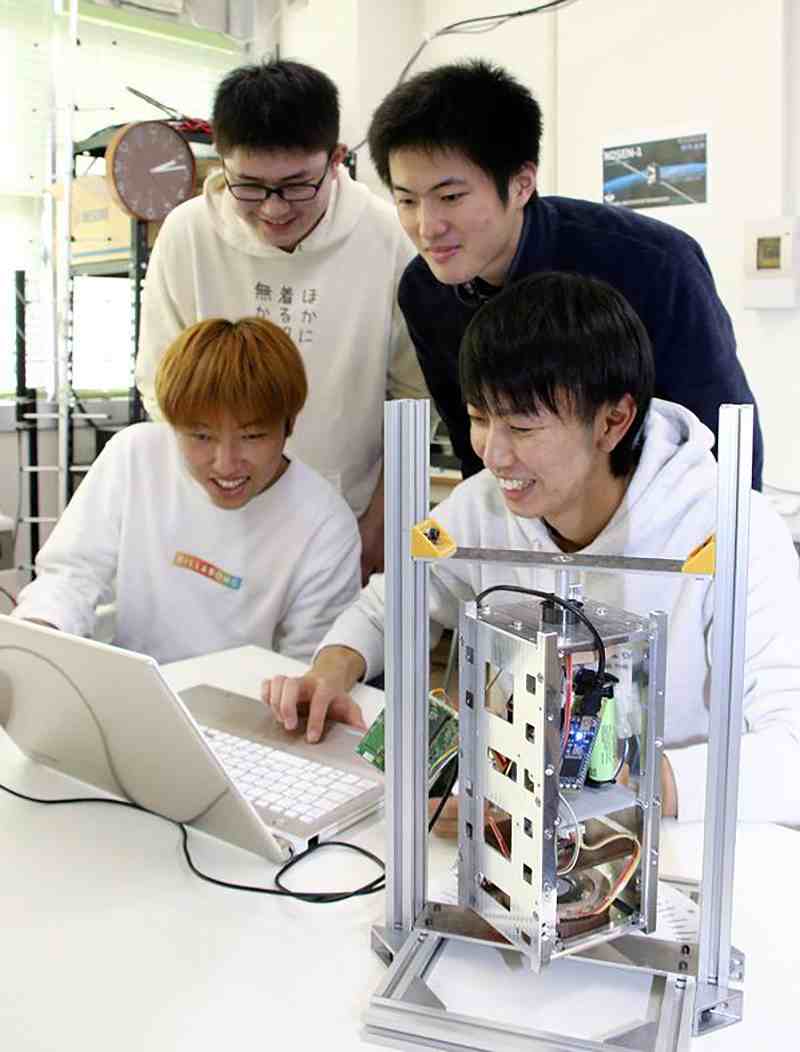
Members of the Kosen-1 project team are seen with a model of the satellite at the National Institute of Technology, Gunma College, Maebashi, on Nov. 18.
December 7, 2021
MAEBASHI — A microsatellite mainly developed by a team at the National Institute of Technology, Gunma College, Maebashi, has achieved orbit following a successful launch of the Epsilon-5 rocket that carried it into space Nov. 9.
The Kosen-1 satellite currently orbits 560 kilometers above Earth’s surface. It was designed and assembled mostly by students of the college. Kosen is shorthand for a Japanese word meaning technical college.
“A satellite can be made from scratch, even if you don’t know anything about it,” said Sota Suzuki, 21, a first-year student in the college’s advanced course. “This experience can probably lower the hurdle that many people have about space development.”
The satellite is designed to observe radio waves emitted from Jupiter. Development started in 2018 as a project with the participation of 10 colleges of the National Institute of Technology.
Eleven members who belong to Prof. Nobuto Hirakoso’s laboratory at the National Institute of Technology, Gunma College, were in charge of the satellite’s main components, such as the antenna for observing radio waves and the attitude control system.
Although the satellite is extremely small, measuring 10 centimeters in length and width and 23 centimeters in height, it has about 260 components.
On the night of the launch, an antenna on the roof of the school building received data from Kosen-1. Gathering in the laboratory, the team members were all relieved to confirm that the satellite was successfully put into orbit.
“I wonder what the radio waves are trying to tell us,” said Yusuke Ito, 21, also a first-year student in the advanced course who was already eager to analyze the data.
The team also confirmed that the satellite responded to commands sent from the ground. Kosen-1 so far is operating well. Ensuing experiments would involve deploying the satellite’s antenna and confirming its spatial direction, or attitude, based on images collected by its camera.
“I’m so excited thinking about analyzing the data that will arrive,” said Prof. Hirakoso. “With my students, I want to continue to work on this project, mulling over various possibilities.”


Related Tags


Most Read
Popular articles in the past 24 hours
-
Business Hotels Expanding into Regional Areas in Japan, Aiming to...
-
Milano Cortina 2026: Japan Sees Leap in Olympic Performance Throu...
-
6 Injured at Naked Festival in Japan’s Okayama Prefecture; Police...
-

Fiji Defense Minister Hopes Japan Will Support Stabilization of P...
-

Milano Cortina 2026: Malinin Highlights Dangers of Social Media i...
-

Space One Delays Launch of No. 3 Kairos Rocket; Company to Announ...
-

3rd Japan Pacific Islands Defense Dialogue to Begin in Tokyo on S...
-

Reciprocal Tariffs Ruled Illegal: Judiciary Would Not Tolerate Pr...
Popular articles in the past week
-

Japan PM Takaichi’s Cabinet Resigns en Masse
-

Man Infected with Measles Reportedly Dined at Restaurant in Tokyo...
-

Sanae Takaichi Elected Prime Minister of Japan; Keeps All Cabinet...
-
Japan's Govt to Submit Road Map for Growth Strategy in March, PM ...
-

Bus Carrying 40 Passengers Catches Fire on Chuo Expressway; All E...
-

Milano Cortina 2026: Figure Skaters Riku Miura, Ryuichi Kihara Pa...
-

Japan, U.S. Name 3 Inaugural Investment Projects; Reached Agreeme...
-

U.S. Firm to Build Training Hub in Fukushima N-plant for Debris R...
Popular articles in the past month
-
Japan PM Takaichi’s Cabinet Resigns en Masse
-

Japan Institute to Use Domestic Commercial Optical Lattice Clock ...
-

Israeli Ambassador to Japan Speaks about Japan’s Role in the Reco...
-
Man Infected with Measles Reportedly Dined at Restaurant in Tokyo...
-

Videos Plagiarized, Reposted with False Subtitles Claiming ‘Ryuky...
-

Man Infected with Measles May Have Come in Contact with Many Peop...
-

Prudential Life Insurance Plans to Fully Compensate for Damages C...
-
Woman with Measles Visited Hospital in Tokyo Multiple Times Befor...
Top Articles in Features
-
Tokyo’s New Record-Breaking Fountain Named ‘Tokyo Aqua Symphony’
-
Sapporo Snow Festival Opens with 210 Snow and Ice Sculptures at 3 Venues in Hokkaido, Features Huge Dogu
-

Tourists Flock to Ice Dome Lodge at Resort in Hokkaido, Japan; Facility Invites Visitors to Sleep on Beds Made of Ice
-

High-Hydration Bread on the Rise, Seeing Increase in Specialty Shops, Recipe Searches
-
Heirs to Kyoto Talent: Craftsman Works to Keep Tradition of ‘Kinran’ Brocade Alive Through Initiatives, New Creations
JN ACCESS RANKING
-
Japan PM Takaichi’s Cabinet Resigns en Masse
-
Japan Institute to Use Domestic Commercial Optical Lattice Clock to Set Japan Standard Time
-
Israeli Ambassador to Japan Speaks about Japan’s Role in the Reconstruction of Gaza
-
Man Infected with Measles Reportedly Dined at Restaurant in Tokyo Station
-
Videos Plagiarized, Reposted with False Subtitles Claiming ‘Ryukyu Belongs to China’; Anti-China False Information Also Posted in Japan