
Transport Companies See Opportunity in Narita Expansion; Airlines, Railways Prepare to Meet Expected Growth in Demand
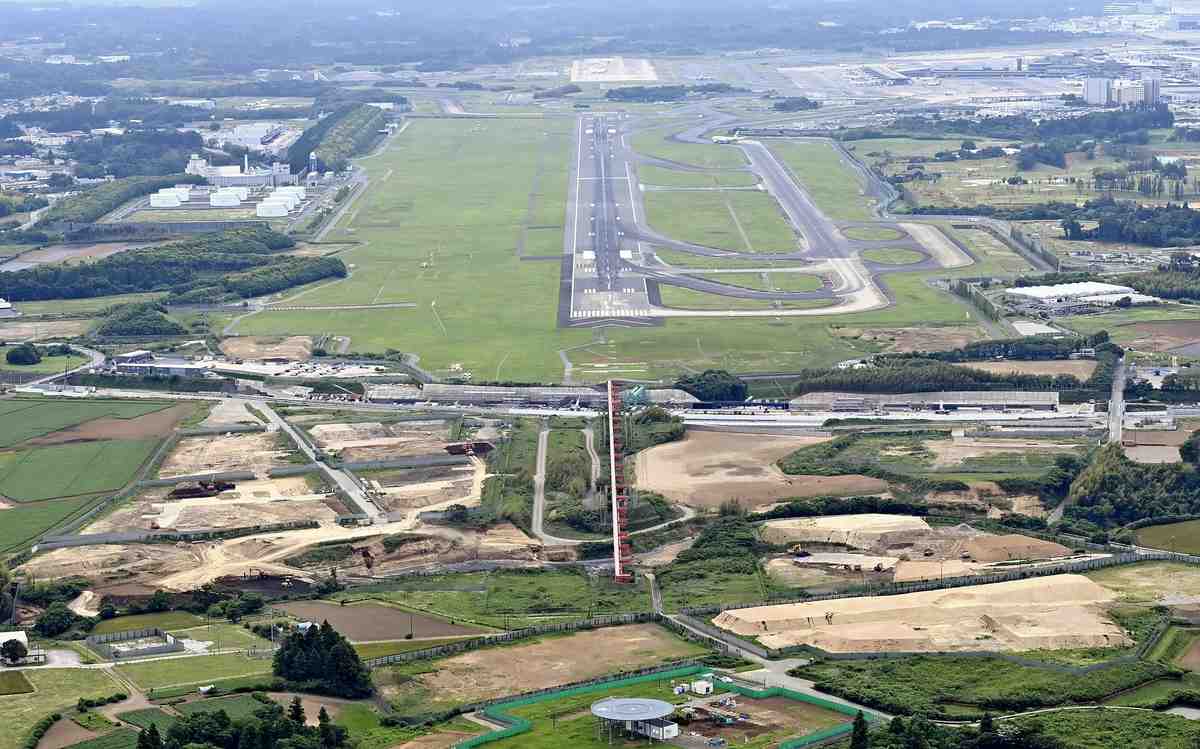
An aerial photograph, taken in May 2023, of Narita Airport’s Runway B, which is scheduled to be extended in 2029
15:55 JST, February 18, 2026
Major airline and railway companies are now hurrying to plan their responses to the 2029 expansion of Narita airport, which they view as a premier business opportunity.
The expansion is poised to spur an increase in foreign visitors to Japan and growth of global logistical networks, with annual flight slots to and from the airport set to jump from just over 300,000 to 500,000. Businesses are positioning themselves to absorb this growth in demand and translate it into higher earnings.
“We see the expansion of Narita Airport as a business opportunity, and we aim to use it as a chance to increase our short-haul routes in Asia,” Yuji Saito, executive vice president of Japan Airlines Co. (JAL), said during a press conference on financial results on Feb. 3.
On the same day, JAL announced that it will revise the shareholding structure of its Narita-based low-cost carrier (LCC) subsidiary Jetstar Japan Co., which is set to receive investment from the state-backed Development Bank of Japan Inc (DBJ).
Under the current ownership, JAL holds 50% and Australia’s Qantas Airways Ltd. 33.3% of the LCC. However, Qantas is set to exit the company by June 2027, selling its total stake to the DBJ.
The DBJ was previously involved in the restructuring of JAL and Skymark Airlines Inc. following their business failures. The bank aims to leverage this expertise to bolster the profitability of Jetstar Japan.
Under the plan for expanding Narita in 2029, a new 3,500-meter runway will be constructed to join the two existing ones, bringing the total to three. In addition to the new runway construction, one of the two existing runways will be extended from 2,500 meters to 3,500 meters.
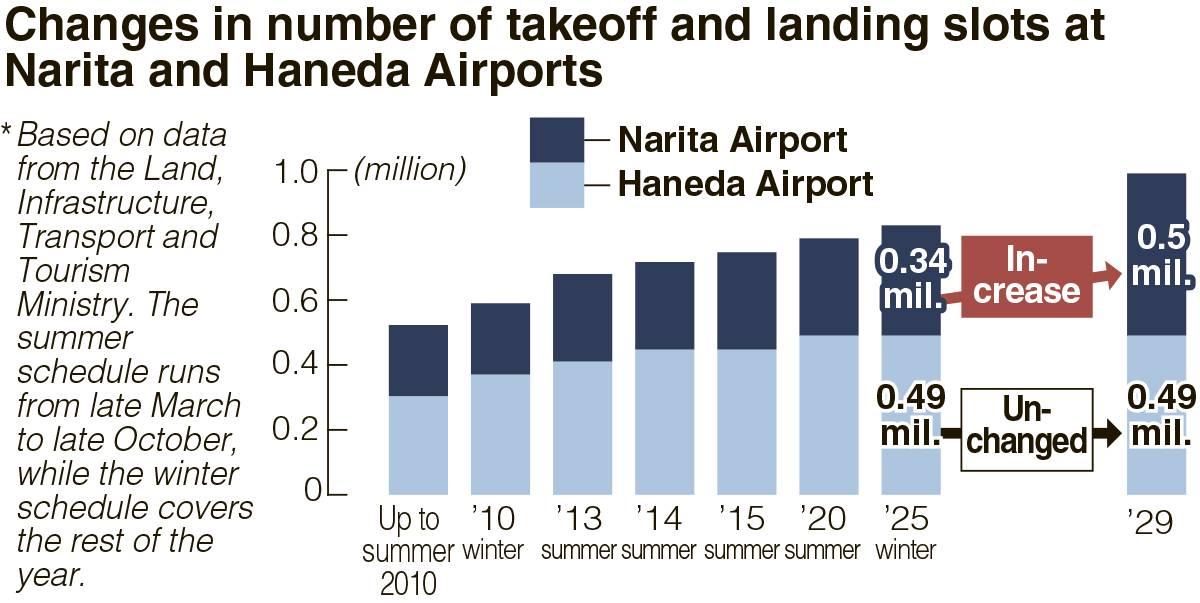
Operating hours will be extended to create more takeoff and landing slots, and the construction of a new passenger terminal and consolidation of cargo facilities are also under consideration. This transformation is being hailed as the airport’s “second opening.”
Haneda Airport can no longer add more slots to its schedule and accommodate the influx of international cargo and foreign tourists to the Tokyo metropolitan area.
Koji Shibata, president of ANA Holdings Inc., expressed high expectations for the project: “The expansion of Narita will be our biggest business opportunity over the next five years. From fiscal 2029, we will move into a stage of dramatic growth.”
On Jan. 30, ANA announced that it will seek increase the scale of its international passenger and cargo operations by 30% by fiscal 2030.
The carrier seeks to capture demand from inbound tourists and international cargo between Asia and Western countries while bolstering its highly profitable North American routes.
In autumn 2025, ANA also unveiled a plan to suspend operations by its Narita-based international brand AirJapan in March of this year. The move is intended to boost profitability by reallocating aircraft and personnel to the company’s mainstay, full-service ANA operations.
Discussions are also ongoing of expanding the capacity of the rail lines that serve Narita Airport.
Keisei Electric Railway Co. unveiled a plan on Friday to boost the frequency of its services. The project involves turning single-track sections near the airport into doubles and expanding some double-track segments to quadruple tracks.
The inability of trains to pass one another on single-track sections has been a bottleneck to boosting transport capacity.
“Narita Airport will play an even greater role as Japan moves to bolster its standing as a tourism-oriented country,” said J. F. Oberlin University Professor Hajime Tozaki.
“It is essential for the public and private sectors to cooperate in balancing the demand for passengers and cargo with transport capacity to central Tokyo,” he said.








Most Read
Popular articles in the past 24 hours
-

AI Agents Should Consult Humans, Say New Rules from Japanese Govt
-
U.S. Firm to Build Training Hub in Fukushima N-plant for Debris R...
-

Japan PM Takaichi’s Cabinet Resigns en Masse
-
TEPCO's Niigata Pref. Nuclear Power Plant Begins Transmitting Pow...
-

Milano Cortina 2026: Japan Gains Bronze in Speed Skating Women's ...
-

Bus Carrying 40 Passengers Catches Fire on Chuo Expressway; All E...
-

Milano Cortina 2026: Japan’s Ami Nakai Leads Women’s ...
-

Sanae Takaichi Elected Japan's 105th Prime Minister (UPDATE 1)
Popular articles in the past week
-

Videos Plagiarized, Reposted with False Subtitles Claiming ‘Ryuky...
-

Man Infected with Measles Reportedly Dined at Restaurant in Tokyo...
-

Tokyo’s New Record-Breaking Fountain Named ‘Tokyo Aqua Symphony’
-

Milano Cortina 2026: Figure Skaters Riku Miura, Ryuichi Kihara Pa...
-

Milano Cortina 2026: Kokomo Murase Comes Out on Top After Overcom...
-
CRA Leadership Election Will Center on Party Rebuilding; Lower Ho...
-
Crime in Japan Ticks Up for 4th Straight Year
-

Japanese Constitutional Revision Debate Expected to be Revived Af...
Popular articles in the past month
-

Japan Institute to Use Domestic Commercial Optical Lattice Clock ...
-

Israeli Ambassador to Japan Speaks about Japan’s Role in the Reco...
-

Man Infected with Measles May Have Come in Contact with Many Peop...
-

China Eyes Rare Earth Foothold in Malaysia to Maintain Dominance,...
-

Prudential Life Insurance Plans to Fully Compensate for Damages C...
-

Woman with Measles Visited Hospital in Tokyo Multiple Times Befor...
-
Australian Woman Dies After Mishap on Ski Lift in Nagano Prefectu...
-
Foreign Snowboarder in Serious Condition After Hanging in Midair ...
Top Articles in Business
-
Prudential Life Insurance Plans to Fully Compensate for Damages Caused by Fraudulent Actions Without Waiting for Third-Party Committee Review
-
Narita Airport, Startup in Japan Demonstrate Machine to Compress Clothes for Tourists to Prevent People from Abandoning Suitcases
-
JR Tokai, Shizuoka Pref. Agree on Water Resources for Maglev Train Construction
-

KDDI Opens AI Data Center at Former Sharp Plant in Osaka Prefecture; Facility Will Provide Google’s Gemini AI Model for Domestic Users
-

Toyota Motor Group Firm to Sell Clean Energy Greenhouses for Strawberries
JN ACCESS RANKING
-
Japan Institute to Use Domestic Commercial Optical Lattice Clock to Set Japan Standard Time
-
Israeli Ambassador to Japan Speaks about Japan’s Role in the Reconstruction of Gaza
-
Man Infected with Measles May Have Come in Contact with Many People in Tokyo, Went to Store, Restaurant Around When Symptoms Emerged
-
Prudential Life Insurance Plans to Fully Compensate for Damages Caused by Fraudulent Actions Without Waiting for Third-Party Committee Review
-
Woman with Measles Visited Hospital in Tokyo Multiple Times Before Being Diagnosed with Disease