
16:11 JST, February 8, 2026
Unlike the massive winter buri yellowtail, which can weigh over 10 kilograms and is difficult to buy whole, the juvenile form, known as inada, has a mild taste and is a good size for home cooking. Yellowtail is a classic example of “shusseuo,” or fish that change names as they grow.
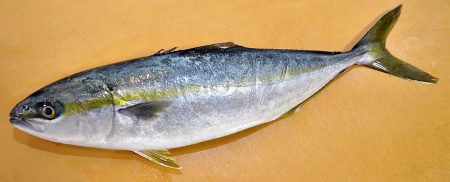
An inada juvenile yellowtail measuring about 35 centimeters, with a yellow line running from head to tail
In the Kanto region, the name changes from wakashi to inada, warasa and buri, while in the Kansai region, the sequence is tsubasu, hamachi, mejiro and buri. Other regions have their own variations. Inada measures about 40 centimeters and weighs around 1 kilogram — perfect for enjoying a variety of dishes from just one fish.
“I want people to enjoy the youthful, mild taste [of inada] that you don’t get with full-grown buri,” said Masahito Nishigata, a culinary researcher specializing in fish. “Inada starts hitting the market in autumn, but its quality remains consistent through winter.”
While inada is excellent for deep-frying or meuniere, this article features three easy-to-make dishes: sashimi, ara-ni (simmered bony parts) and kama-yaki (grilled collar). These recipes require two fish in total.
First, scrub off the hard, fine scales with a metal scourer. Slit the belly, remove the gills and internal organs, and rinse well with water. Remove the head and split it in half for ara-ni. Cut the collar section generously, starting from behind the pectoral fin.
Use the collars from one fish for kama-yaki and those from the other for ara-ni. Fillet the body into three pieces, starting from the dorsal side as is standard. Since the backbone is thick, run the knife along it slowly to ensure no meat is left on the bone.
Cut the fillets from the two fish in half lengthwise and remove the skin before slicing into sashimi. To skin a fillet, Nishigata recommends placing it skin-side down on the cutting board and making a small incision between the skin and flesh. Place the knife inside the incision with one hand, grab on to the skin with the other and tug hard while keeping the knife still, moving your hand from side to side.
“The skinned surface is white on the belly side and blue on the back side, making it visually beautiful,” Nishigata said. He recommends alternating the slices of belly and back meat when plating.
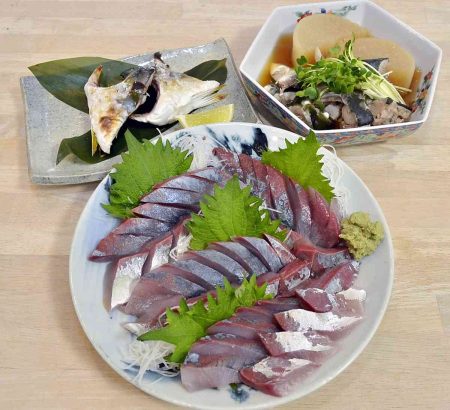
Clockwise from bottom: Sashimi, kama-yaki and ara-ni
The sashimi is tender and mild — you feel like you could endlessly eat it. “You see what I mean by its youth? Buri is rich in umami and fat, but inada is lighter. That is the charm of inada,” Nishigata said.
For the ara-ni, simmer daikon radish with kombu seaweed and soy sauce first, then remove it. Simmer the halved heads and collars in the remaining broth.
Once the fish is cooked, put the daikon back in and simmer on low hewat for about 30 minutes to let it absorb the flavor of the inada.
It has a deep, nourishing flavor that makes you crave rice.
The kama-yaki, sprinkled with salt and grilled, has a firm texture, and you sense the umami with every bite. It is also fun to eat by digging out the meat with chopsticks.
Inada hits the shelves at this time of year for about ¥1,000 per fish.
“While it is sold as fillets, a whole fish is a better deal,” Nishigata said. “Relatively easy to find and mild-flavored, it is more versatile than fatty buri. I hope people give it a try.”
Catches shift north
While yellowtail is indispensable for the New Year, particularly in western Japan, its main production areas are moving north.
According to the Statistical Survey on Marine Fishery Production, the yellowtail catch, including inada, was 66,345 tons in 2004, with areas in western Japan such as Shimane and Nagasaki topping the list.
The 2024 catch totaled 81,400 tons, with Hokkaido topping the list at 16,200 tons. This figure was about 5,000 tons higher than second-place Nagasaki, and rising seawater temperatures due to climate change are believed to be a factor.
Yellowtail farming is thriving, boasting the highest production volume among farmed fish. In 2024, farmed yellowtail totaled 132,100 tons, exceeding the wild catch.







Most Read
Popular articles in the past 24 hours
-

Schools Should Stress Role of Newspapers in Democracy, Says Japan...
-
Magnitude 4.1 Earthquake Jolts Areas near Mt. Fuji; No Tsunami Ex...
-
High Chocolate Prices Shake Up Valentine's Lineup at Japan's Depa...
-

SoftBank Launches AI Service for Call Centers That Converts Harsh...
-

Tokyo, Many Regions across Japan Hit with Heavy Snow
-

Milano Cortina 2026: Japan’s Maruyama Wins Bronze Medal in Women’...
-

Milano Cortina 2026: Japan's Kimura, Kimata Dazzle in Big Air To ...
-

6 Injured, Taken to Hospital After Snow-related Car Collisions in...
Popular articles in the past week
-

Man Infected with Measles May Have Come in Contact with Many Peop...
-

BTS to Hold Comeback Concert in Seoul on March 21; Popular Boy Ba...
-

Israeli Ambassador to Japan Speaks about Japan’s Role in the Reco...
-
Rising Prices in Japan Squeeze Household Finances; Major Parties ...
-
Tokyo Had 65,000 More People Move In Than Out In 2025; Osaka Area...
-

Milano Cortina 2026: Japan’s Athletes Arrive in Italy for Milano ...
-
Green Tea Exports Hit Record High in 2025 Amid Growing Demand, Li...
-

Sapporo Snow Festival Opens with 210 Snow and Ice Sculptures at 3...
Popular articles in the past month
-
Univ. in Japan, Tokyo-Based Startup to Develop Satellite for Disa...
-

Japan Institute to Use Domestic Commercial Optical Lattice Clock ...
-
JAL, ANA Cancel Flights During 3-day Holiday Weekend due to Blizz...
-

China Eyes Rare Earth Foothold in Malaysia to Maintain Dominance,...
-
Man Infected with Measles May Have Come in Contact with Many Peop...
-

Japan, Qatar Ministers Agree on Need for Stable Energy Supplies; ...
-

Australian Woman Dies After Mishap on Ski Lift in Nagano Prefectu...
-

Japan, Italy to Boost LNG Cooperation; Aimed at Diversifying Japa...
Top Articles in Features
-
Pangasius Catfish Increasingly Featured on Japanese Restaurant Menus, Home Dining Tables Due to Affordability, Mild Flavor
-
Sapporo Snow Festival Opens with 210 Snow and Ice Sculptures at 3 Venues in Hokkaido, Features Huge Dogu
-

Tourists Flock to Ice Dome Lodge at Resort in Hokkaido, Japan; Facility Invites Visitors to Sleep on Beds Made of Ice
-
Traditional Umbrellas Illuminated in Gifu City, Projection Mapping Lights Up Park Near Gifu Castle
-
Venison from Culled Deer Made into Prepackaged Curry in Mie Pref. City, Creator Hopes to Inspire Young People to Hunt
JN ACCESS RANKING
-
Japan Institute to Use Domestic Commercial Optical Lattice Clock to Set Japan Standard Time
-
JAL, ANA Cancel Flights During 3-day Holiday Weekend due to Blizzard
-
China Eyes Rare Earth Foothold in Malaysia to Maintain Dominance, Counter Japan, U.S.
-
Man Infected with Measles May Have Come in Contact with Many People in Tokyo, Went to Store, Restaurant Around When Symptoms Emerged
-
Japan, Qatar Ministers Agree on Need for Stable Energy Supplies; Motegi, Qatari Prime Minister Al-Thani Affirm Commitment to Cooperation