
Japanese, Chinese Automakers Roll Out Electric Kei Car Models as Key Strategy to Boost EV Sales in Japan
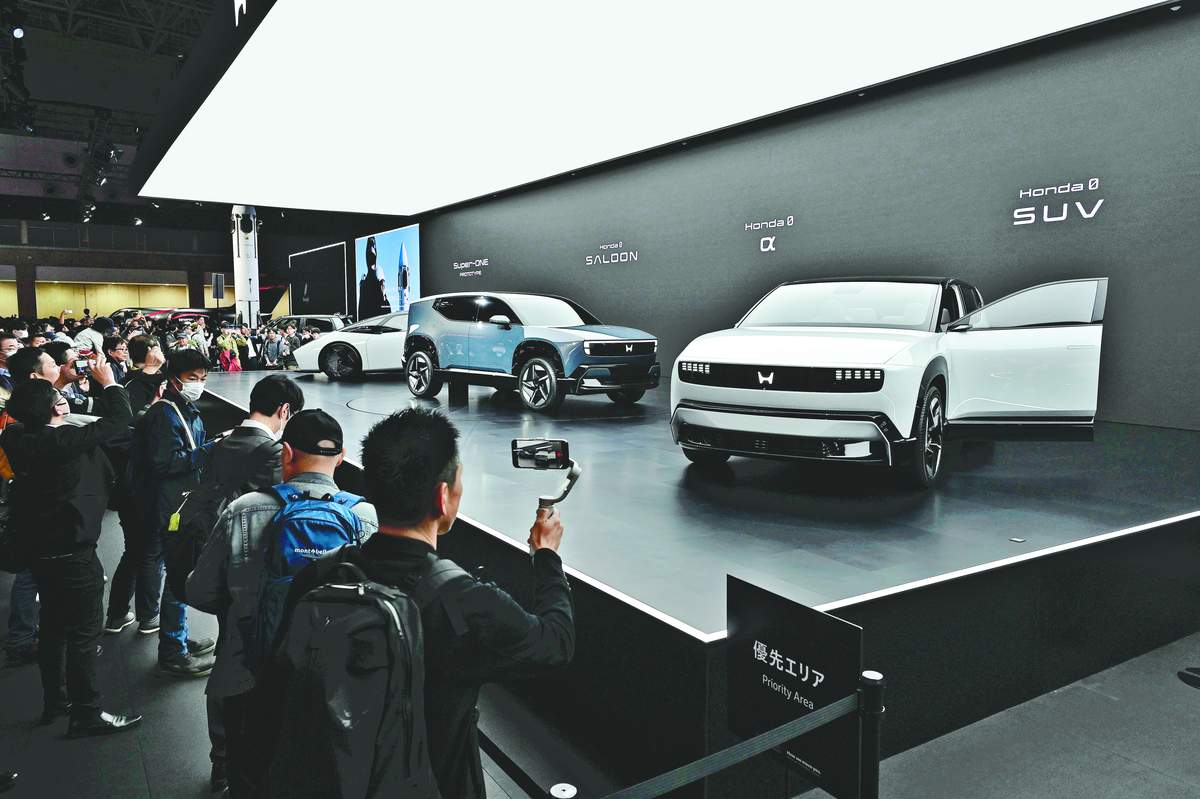
People watch various EVs exhibited in the Japan Mobility Show in Koto Ward, Tokyo, in November.
12:28 JST, February 5, 2026
Japanese and Chinese automakers are strengthening their lineups of lightweight EVs.
Suzuki Motor Corp. and BYD Auto Japan Inc., a subsidiary of the major Chinese EV maker, are scheduled to release new electric kei cars by the end of fiscal 2026.
A shortage of charging facilities, a perceived disadvantage of EVs, is less of an obstacle for electric kei cars, as they are typically used for shorter journeys. The impact of these kei cars on overall EV sales in Japan will be closely watched.
Over 300 km driving range
At the Tokyo Auto Salon, a custom car exhibition held in Chiba in January, BYD announced that the maximum range of its Racco electric kei car, scheduled for release in Japan this summer, will be extended beyond 300 kilometers.
The ranges of popular electric kei cars currently sold in Japan are 180 kilometers for Nissan Motor Co.’s Sakura and Mitsubishi Motors Corp.’s eK X EV, and 295 kilometers for Honda Motor Co.’s N-One e:.
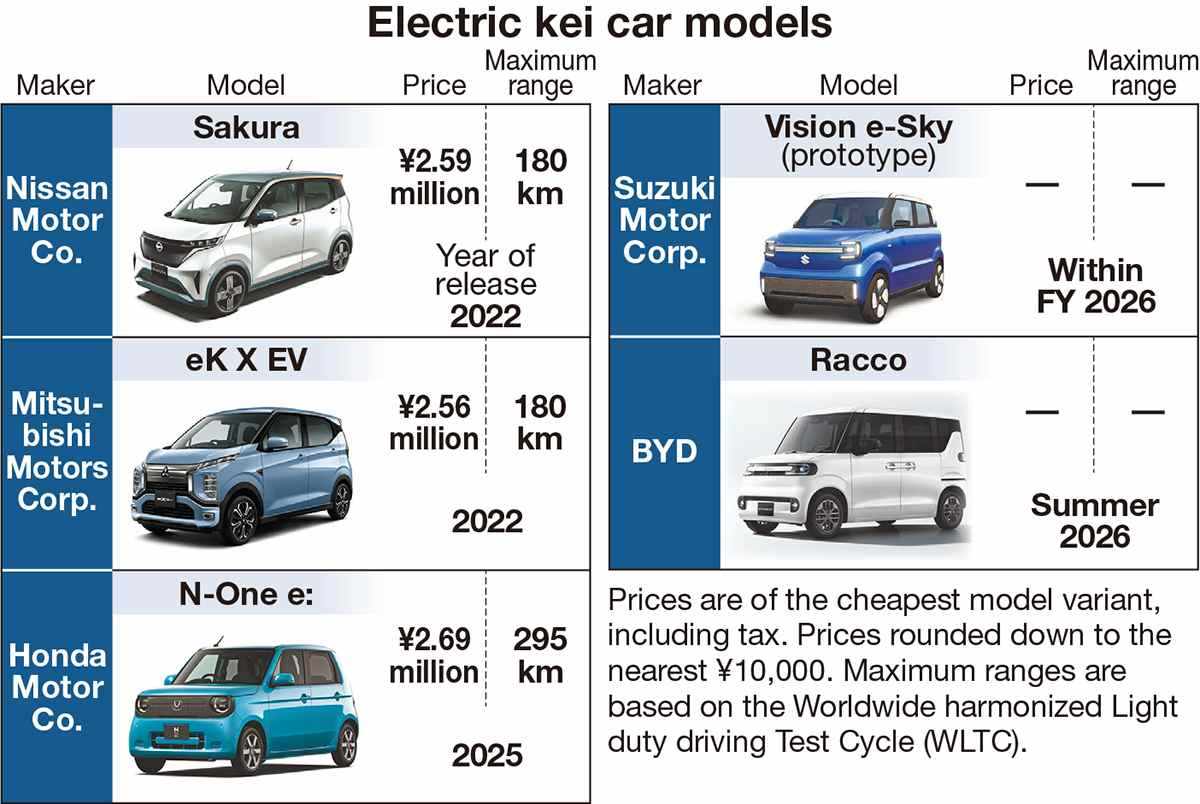
Though the price of the Racco has yet to be announced, it will likely be a strong rival for its Japanese counterparts. BYD also plans to release a model with a maximum range of over 200 kilometers. Thus, its lineup may be a powerhouse in the Japanese market.
Atsuki Tofukuji, president of BYD Auto Japan, said, “We will release vehicles reflecting BYD’s high-level technological capabilities and further accelerate the expansion of our business in the Japanese market.”
Suzuki, which topped the 2025 sales rankings for kei cars, plans to unveil a new electric model by the end of fiscal 2026.
The company has showcased the Vision e-Sky, a prototype electric kei car, and said that its maximum range will be at least 270 kilometers.
Toyota Motor Corp., Suzuki and Daihatsu Motor Co. are scheduled to release an electric kei van jointly developed by the three companies, under their respective names, by March.
Potential for regional demand
Sales of new kei cars in 2025 totaled 1,667,360 units, up 7% from the previous year. But that of electric kei cars fell 19% to around 20,000 units.
Sales of the Honda N-One e:, first released in September, totaled about 5,000 by the end of December. But sales of the Nissan Sakura, first released in 2022, fell about 40% from the previous year to 14,093 units, pushing down the overall figure.
The lack of recharging facilities in Japan, and thus the fear one’s battery running out, is a major hurdle for the spread of EVs. However, kei cars are usually used for short journeys for everyday purposes, such as shopping and commuting. Therefore, this particular issue has less impact on those driving electric kei cars.
The central and local governments have also implemented measures such as subsidies for the purchase of electric kei cars, and thus automakers expect the market will continue to grow.
Sanshiro Fukao, a research fellow at Itochu Research Institute Inc. who is an expert in the automobile industry, said: “The number of gas stations has been on the decline in regional areas, generating demand for electric kei cars. If reasonably priced models increase, it is possible that the consumer shift to EVs will accelerate.”





Most Read
Popular articles in the past 24 hours
-
Seeking Nuclear Waste Site, Japan Eyes Remote Island of Minami-To...
-

Japan’s Govt Says No Immediate Impact on Oil Supply; No Releases ...
-

Japan Ministry Asks to Conduct Nuclear Waste Disposal-related Sur...
-

Total Lunar Eclipse Visible for Some in Japan, While Clouds Block...
-
Artisans from Disaster-Hit Areas Work Together to Keep Memories o...
-
Tokyo High Court Upholds Unification Church Dissolution Order; Li...
-

Milano Cortina 2026: Ceremony for Winter Paralympic Torch Relay T...
-
Japan Tourist Spot's Capsule Toys Made from Recycled Materials Pr...
Popular articles in the past week
-
Tokyo Spends Big on Children, Wins Over Parents
-

South Korea Tightens Rules on Foreigners Buying Homes in Seoul Me...
-
Japan’s Miura, Kihara Announce Withdrawal from Figure Skating Wor...
-
BOJ Keeping Eye on Economy and Takaichi's ‘Proactive Fiscal Polic...
-
Tokyo Measles Patient Traveled to Fukuoka Aboard JAL Planes; Susp...
-
Nidec Chairman Resigns Amid Accounting Scandal at Major Japanese ...
-

Strait of Hormuz Closure Shakes Markets; Prolonged Closure Could ...
-

Tourists Ignore Safety Barriers Near Famous Zao ‘Snow Monsters’ i...
Popular articles in the past month
-

Producer Behind Pop Group XG Arrested for Cocaine Possession
-

Japan PM Takaichi’s Cabinet Resigns en Masse
-

Man Infected with Measles Reportedly Dined at Restaurant in Tokyo...
-

Israeli Ambassador to Japan Speaks about Japan’s Role in the Reco...
-

Videos Plagiarized, Reposted with False Subtitles Claiming ‘Ryuky...
-

Prudential Life Insurance Plans to Fully Compensate for Damages C...
-

Woman with Measles Visited Hospital in Tokyo Multiple Times Befor...
-

iPS Treatments Pass Key Milestone, but Broader Applications Far f...
Top Articles in Business
-
Prudential Life Insurance Plans to Fully Compensate for Damages Caused by Fraudulent Actions Without Waiting for Third-Party Committee Review
-

Japan, U.S. Name 3 Inaugural Investment Projects; Reached Agreement After Considerable Difficulty
-

Japan’s Major Real Estate Firms Expanding Overseas Businesses to Secure Future Growth, Focusing on Europe, U.S., Asia
-

SoftBank Launches AI Service for Call Centers That Converts Harsh Customer Voices into Softer Voices
-

Transport Companies See Opportunity in Narita Expansion; Airlines, Railways Prepare to Meet Expected Growth in Demand
JN ACCESS RANKING
-
Producer Behind Pop Group XG Arrested for Cocaine Possession
-
Japan PM Takaichi’s Cabinet Resigns en Masse
-
Man Infected with Measles Reportedly Dined at Restaurant in Tokyo Station
-
Israeli Ambassador to Japan Speaks about Japan’s Role in the Reconstruction of Gaza
-
Videos Plagiarized, Reposted with False Subtitles Claiming ‘Ryukyu Belongs to China’; Anti-China False Information Also Posted in Japan