
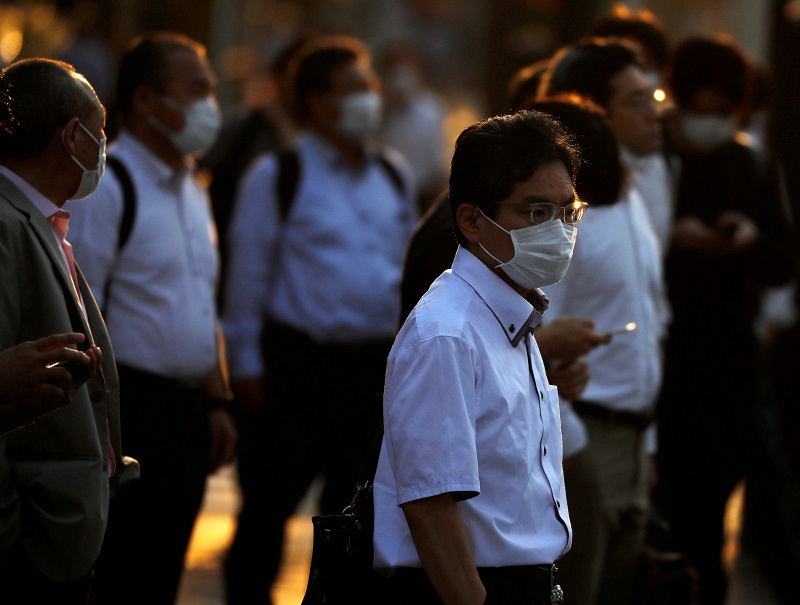
Office workers wearing protective face masks walk to head home at sunset amid the coronavirus disease (COVID-19) outbreak, in Tokyo, Japan June 9, 2020.
14:41 JST, October 8, 2021
Dear Troubleshooter:
I am a homemaker in my 40s and I’m worried about my son, who is in his mid-20s.
He works very hard, which is fine, but he also works a lot of overtime. For months he has put in a lot of hours, I think he probably accumulates 80 hours of overtime.
Recently, my son has started saying, “I’m tired,” more often. I try to support him by paying attention to his meals and telling him to not push himself too hard.
Lately, however, he doesn’t talk to the family as much anymore. He has always been quiet and a man of few words, but now he seems more exhausted. My husband says that it’s “normal to work that much overtime,” but I don’t think that’s true.
I feel like the company is going to crush my son’s mind and body. I would prefer it if he just quit. Please let me know what advice I can give to my son and what I can do to help him.
— T, Tokyo
Dear Ms. T:
I became very worried after I read your letter. This is an issue that needs to be taken seriously if he is sometimes working 80 hours of overtime a month.
Working an average of more than 80 hours of overtime a month — two to six months prior to an illness — is thought to be strongly associated with brain disorders and heart disease, among other illnesses. Working 80 hours of overtime a month is called the “overtime death line.” Overtime is generally capped at 45 hours a month or 360 hours per year.
I am also concerned by your husband’s comment that it’s “normal to work that much overtime.” It sounds like something your son’s boss would say.
I’m sure you’re aware there have been cases in which people who work long hours end up suffering from extreme physical and mental fatigue, leading to a painful and sad outcome. One of the reasons behind this is because some people still think that it is good to work, even if you’re sacrificing sleep.
The fact that your son rarely speaks to you anymore is probably a sign that he has reached his physical and mental limit and is asking for help. I would advise him to refrain from working overtime. If it is unavoidable, I think it is OK for you to recommend that he quit.
You may also want to consider discussing the situation with the local government or another labor-related authority.
— Yoko Sanuki, lawyer









Most Read
Popular articles in the past 24 hours
-

Japan, U.S. Fail to Make Final Decision on $550 Bil. Investment P...
-

Council Submits Proposals for Revising Retrial System; Some Legal...
-

Milano Cortina 2026: Japan’s Totsuka Wins Gold, Yamada Takes Bron...
-
Heirs to Kyoto Talent: Craftsman Works to Keep Tradition of ‘Kinr...
-

2026 Has Seen a Grim Dawn in Iran; What Will the Rest of the Year...
-

Milano Cortina 2026: Japan Take Silver and Bronze in Bittersweet ...
-

Exit of Opposition Veterans Brings Breath of Generational Change
-

New CRA Leader: Ogawa Should Quickly Present Party’s Vision for F...
Popular articles in the past week
-

Woman with Measles Visited Hospital in Tokyo Multiple Times Befor...
-

Prudential Life Insurance Plans to Fully Compensate for Damages C...
-

Woman with No Overseas Travel History Infected with Measles in Na...
-

LDP Wins Historic Landslide Victory
-

Measles Patient Flew Between Tokyo, Hokkaido in Late January; Lik...
-

LDP Wins Landslide Victory, Secures Single-party Majority; Ruling...
-

Milano Cortina 2026: Kokomo Murase Comes Out on Top After Overcom...
-

Tokyo, Many Regions across Japan Hit with Heavy Snow
Popular articles in the past month
-

Japan Institute to Use Domestic Commercial Optical Lattice Clock ...
-

Israeli Ambassador to Japan Speaks about Japan’s Role in the Reco...
-

Man Infected with Measles May Have Come in Contact with Many Peop...
-

China Eyes Rare Earth Foothold in Malaysia to Maintain Dominance,...
-

Australian Woman Dies After Mishap on Ski Lift in Nagano Prefectu...
-
Woman with Measles Visited Hospital in Tokyo Multiple Times Befor...
-
Prudential Life Insurance Plans to Fully Compensate for Damages C...
-

Foreign Snowboarder in Serious Condition After Hanging in Midair ...
Top Articles in Features
-

Sapporo Snow Festival Opens with 210 Snow and Ice Sculptures at 3 Venues in Hokkaido, Features Huge Dogu
-

Pangasius Catfish Increasingly Featured on Japanese Restaurant Menus, Home Dining Tables Due to Affordability, Mild Flavor
-

Tourists Flock to Ice Dome Lodge at Resort in Hokkaido, Japan; Facility Invites Visitors to Sleep on Beds Made of Ice
-

Venison from Culled Deer Made into Prepackaged Curry in Mie Pref. City, Creator Hopes to Inspire Young People to Hunt
-

Maltese Pavilion’s Famous Ftira Bread Now Available in Osaka; Loaves Became Popular during 2025 Osaka-Kansai Expo
JN ACCESS RANKING
-
Japan Institute to Use Domestic Commercial Optical Lattice Clock to Set Japan Standard Time
-
Israeli Ambassador to Japan Speaks about Japan’s Role in the Reconstruction of Gaza
-
Man Infected with Measles May Have Come in Contact with Many People in Tokyo, Went to Store, Restaurant Around When Symptoms Emerged
-
China Eyes Rare Earth Foothold in Malaysia to Maintain Dominance, Counter Japan, U.S.
-
Australian Woman Dies After Mishap on Ski Lift in Nagano Prefecture