
Japan Tourism / Morioka Bakery Fukudapan Sells 10,000 Koppepan Rolls Daily
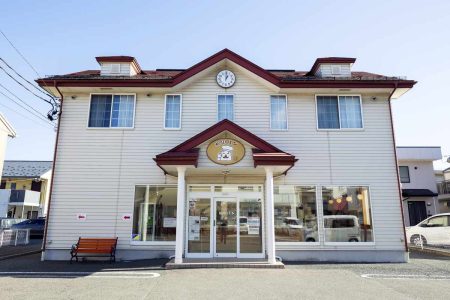
Fukudapan’s main store in the Nagata building evokes the appearance of a school building.
12:35 JST, January 27, 2026

MORIOKA — When it comes to the cuisine of Morioka, the capital of Iwate Prefecture, its three famous noodle dishes — wanko soba, reimen and jajamen — are well-known, but the koppepan from Fukudapan is also a cherished local favorite recognized by every citizen.
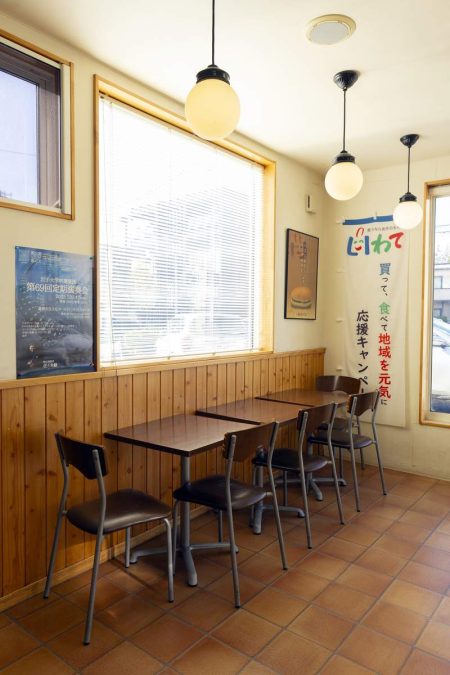
The main shop’s eat-in corner
Founder Tomekichi Fukuda was born in Hanamaki in the prefecture. He studied under Kenji Miyazawa, later known as a poet and fairy tale author, at an agricultural school and then, applying his knowledge of yeast research, founded the bakery in Morioka in 1948. Soon after opening, he began selling bread at his alma mater, Iwate University. Amidst the postwar scarcity of goods, he focused on the koppepan, which looks like a hot dog bun, with the idea of “providing students with something cheap that fills them up.”
It quickly became popular because one roll provided calories equivalent to two bowls of rice and a bottle of milk. Creating numerous menu items by varying the fillings was an ingenious solution in an era when bread varieties were limited. The bakery has supplied bread for school lunch programs since they began in elementary schools across the prefecture and has offered mobile koppepan sales at high schools in the city since the 1970s.
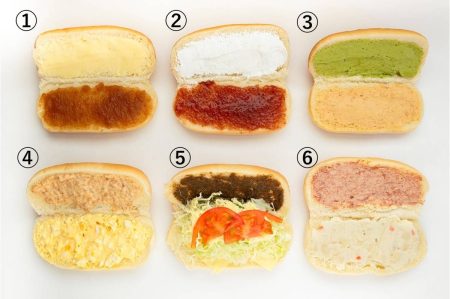
Selected varieties of koppepan 1. Grated apple jam and butter (¥185), 2. Jam and whipped cream (¥195), 3. Matcha and whole peanuts (¥210), 4. Chicken and egg (¥366), 5. Vegetable and jajamiso (¥531), and 6. Corned beef with potato (¥366)
Visiting its main store in Nagata reveals an extensive menu, with about 50 different fillings lined up behind the counter. Sweet fillings can be paired, with options like “Mix” with different fillings on the top and bottom, or “Half-and-Half” where the two flavors are divided. For savory fillings, customers can fill their bread with their preferred ingredients, resulting in over 2,000 possible flavor combinations.
The most popular combination is red bean paste with butter. “It was born around the 1970s,” said Kiyoshi Fukuda, the third-generation owner. “My mother, who worked at the shop, was asked to make one koppepan with red bean paste and one with butter. However, she accidentally spread them both on one roll.”
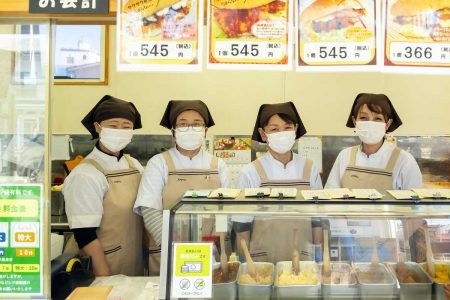
Staff quickly respond to orders.
Watching the staff scoop generous amounts of filling from tubs and spread it perfectly to the edges of the bread at lightning speed is mesmerizing. The koppepan handed to customers are large, about the size of an adult’s face. The soft, spongy bread combines perfectly with the richly spread salty-sweet filling of red bean paste and butter-infused margarine.
The bread’s texture comes from the “nakadane method,” a two-stage dough kneading process used since the shop’s founding. For savory fillings, the original vegetable sandwich topped with jajamiso, a meat-based miso paste that is a signature of Morioka, is recommended. The fresh vegetables and rich meat miso make a great accent to each other.

Freshly baked koppepan
There are three directly managed stores in the city, including one inside the Morioka Bus Center, and one attached to its factory in neighboring Yahaba. Some products are also available at major supermarkets and convenience stores within the prefecture. They sell about 10,000 koppepan daily, and during peak seasons, that number can reach about 20,000.
“We bake them at night and ship them out in the morning, so they’re served almost as if they were freshly baked,” said Kiyoshi. Learning the secrets behind this beloved local food, I decided I will visit again.
***
Japan Tourism is presented in collaboration with Ryoko Yomiuri Publication, which publishes Ryoko Yomiuri, a monthly travel magazine. If you are interested in stories click here. .





Most Read
Popular articles in the past 24 hours
-

Japan Defense Agency to Develop AI Intelligence Analysis System f...
-
Moai Statue Shows Lasting Bond Between Miyagi Pref. Town, Easter ...
-

Milano Cortina 2026: Japan’s Oguri Wins Para Snowboard Silver at ...
-
Japan's Defense Ministry: North Korea Appears to Have Fired Balli...
-

Aichi Fisheries Cooperatives Use Smart Tech to Farm Triploid Oyst...
-
Teachers Support Students’ Inquiry Learning behind the Scenes
-
Japan's Lower House Passes Budget Proposal; Could Be Delayed in U...
-

National Intelligence Council: Proposed Body Must Be Utilized To ...
Popular articles in the past week
-
Japan Figure Skating Legend Yuzuru Hanyu Is Proud Disaster Surviv...
-
Govt to Utilize ODA for Ensuring Economic Security; Securing Ener...
-
15 Measles Patients Confirmed in Tokyo in Past 6 Days; 1 May Have...
-
Massive Sewer Pipe Found Jutting Out of Highway in Osaka
-

Japan Govt to Tighten Requirements to Receive Permanent Residency...
-
JR Tokai Breaks Ground on Yamanashi Maglev Station; Will Be Part ...
-
Beckoning Cats Get Makeover to Fit Modern Lifestyles with Sleek D...
-
Power Outage Forces About 980 Passengers in Yokohama to Walk to T...
Popular articles in the past month
-

Producer Behind Pop Group XG Arrested for Cocaine Possession
-

Japan PM Takaichi’s Cabinet Resigns en Masse
-

Man Infected with Measles Reportedly Dined at Restaurant in Tokyo...
-

Videos Plagiarized, Reposted with False Subtitles Claiming ‘Ryuky...
-
Japan Figure Skating Legend Yuzuru Hanyu Is Proud Disaster Surviv...
-

iPS Treatments Pass Key Milestone, but Broader Applications Far f...
-

Sanae Takaichi Elected Prime Minister of Japan; Keeps All Cabinet...
-

Nepal Bus Crash Kills 19 People, Injures 25 Including One Japanes...
Top Articles in Features
-

Tokyo’s New Record-Breaking Fountain Named ‘Tokyo Aqua Symphony’
-
High-Hydration Bread on the Rise, Seeing Increase in Specialty Shops, Recipe Searches
-
Japanese Students Use Traditional Pickle to Create Novel Wagashi Confectionery
-

My Spendthrift Mother Constantly Asks Me for Money
-
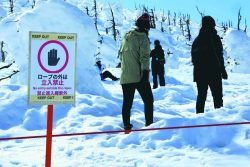
Tourists Ignore Safety Barriers Near Famous Zao ‘Snow Monsters’ in Japan
JN ACCESS RANKING
-
Producer Behind Pop Group XG Arrested for Cocaine Possession
-
Japan PM Takaichi’s Cabinet Resigns en Masse
-
Man Infected with Measles Reportedly Dined at Restaurant in Tokyo Station
-
Videos Plagiarized, Reposted with False Subtitles Claiming ‘Ryukyu Belongs to China’; Anti-China False Information Also Posted in Japan
-
Japan Figure Skating Legend Yuzuru Hanyu Is Proud Disaster Survivor and Gold Medalist, Vows to Continue Support Efforts