
Former Japanese Prime Minister Shinzo Abe’s Shooter Appears Emotionless in Court during Sentencing
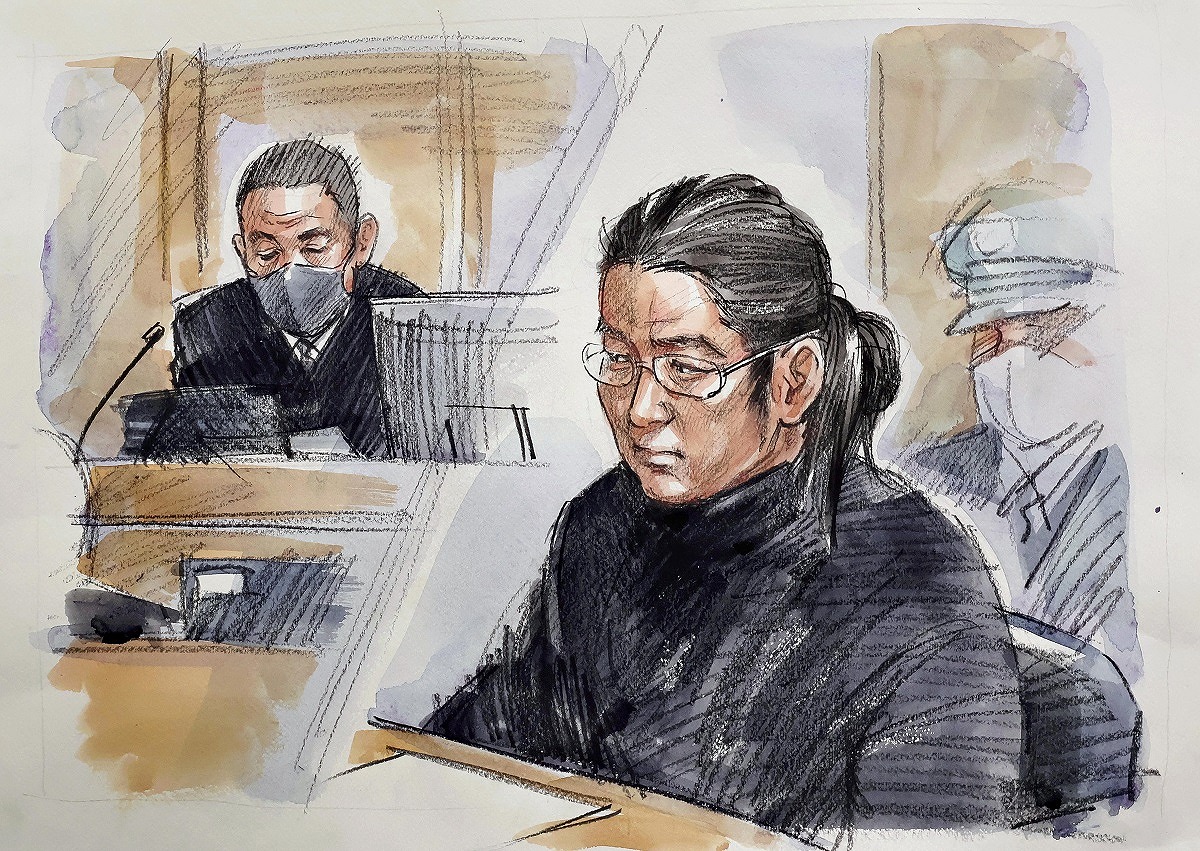
Defendant Tetsuya Yamagami listens to the reasons for the life sentence at the Nara District Court on Wednesday.
14:52 JST, January 22, 2026
Tetsuya Yamagami did not seem to show any emotion as the Nara District Court on Wednesday sentenced him to life in prison for fatally shooting former Prime Minister Shinzo Abe in 2022.
Three and a half years after the incident in which Abe, then 67, was shot in front of a crowd, the court handed down a life sentence to Yamagami, 45, for murder and other charges, in line with prosecutors’ demands.
Yamagami, who had spoken about his pent-up feelings toward the Family Federation for World Peace and Unification, formerly known as the Unification Church, during the trial, left the courtroom quietly on Wednesday. His expression did not seem to change while in the room.
Eyes down
At 1:30 p.m. in Courtroom No. 101, the largest at the Nara District Court, Yamagami, with his long hair tied back, sat in the witness stand after bowing. He remained motionless with his eyes cast downward, even as the sentence was handed down.
During the trial, he spoke dispassionately about his troubled upbringing and the events leading up to the crime, including his mother making massive donations to the religious group, his family falling apart and his brother’s suicide.
The reading of the sentencing lasted 75 minutes. Yamagami appeared to show no emotion during that time. After the court adjourned, he left the courtroom with his eyes down, never looking up at other people.
According to his defense team, he appeared calm during a meeting after the sentencing.
Court cites Akie’s suffering
Abe’s wife, Akie, 63, did not appear in court on Wednesday but released a statement through her lawyer.
“I feel that the long period of days since my husband’s sudden death has come to a close of sorts,” it read.
After expressing her gratitude to the police, prosecutors, judges and lay judges, she concluded by saying, “I will continue to stay positive, carry on my husband’s will and cherish each day.”
As one of the reasons for the life sentence, the court cited that Akie “suffers a great sense of loss over her husband’s death,” noting that her feelings are understandable.
Hiroyuki Omae, deputy chief prosecutor of the Nara District Public Prosecutors’ Office, welcomed the outcome, saying, “We believe that our arguments regarding both the facts and sentencing were accepted.”
Considering an appeal
Yamagami’s defense team said at a press conference that it is considering an appeal.
“It is disappointing that our argument that his upbringing was directly linked to the crime was not accepted,” said Yamagami’s lawyer Kohei Matsumoto. “We made every effort to prove the psychological state of a child of a [religious group] follower, but it was not enough.”


Related Tags






Most Read
Popular articles in the past 24 hours
-

Voters Using AI to Choose Candidates in Japan's Upcoming General ...
-

Japan's Snow-Clad Beauty: Camellia Flowers Seen in Winter Bloom a...
-

Monkey Strikes Junior High School Girl from Behind in Japan's Yam...
-

Genichiro Inokuma's Mural in Ueno Station That Gave Hope in Postw...
-

Senior Japanese Citizens Return to University to Gain Knowledge, ...
-

Heavy Snow Linked to 30 Deaths across Japan since Late Jan.; JMA ...
-

Foreign and Security Policy: Political Parties Must Discuss How T...
-

Tokyo Police Arrest Head of Resignation Assistance Firm
Popular articles in the past week
-

Japan Institute to Use Domestic Commercial Optical Lattice Clock ...
-
Australian Woman Dies After Mishap on Ski Lift in Nagano Prefectu...
-
Foreign Snowboarder in Serious Condition After Hanging in Midair ...
-

Chinese Embassy in Japan Reiterates Call for Chinese People to Re...
-

Narita Airport, Startup in Japan Demonstrate Machine to Compress ...
-

Toyota Motor Group Firm to Sell Clean Energy Greenhouses for Stra...
-

Sakie Yokota, Last Surviving Parent of a North Korea Abductee, Ur...
-

Beer Yeast Helps Save Labor, Water Use in Growing Rice; Govt Hope...
Popular articles in the past month
-

Univ. in Japan, Tokyo-Based Startup to Develop Satellite for Disa...
-

JAL, ANA Cancel Flights During 3-day Holiday Weekend due to Blizz...
-
China Confirmed to Be Operating Drilling Vessel Near Japan-China ...
-

China Eyes Rare Earth Foothold in Malaysia to Maintain Dominance,...
-
M6.2 Earthquake Hits Japan's Tottori, Shimane Prefectures; No Tsu...
-
Japan Institute to Use Domestic Commercial Optical Lattice Clock ...
-

Japan, Qatar Ministers Agree on Need for Stable Energy Supplies; ...
-

Japan, Italy to Boost LNG Cooperation; Aimed at Diversifying Japa...
Top Articles in Society
-
JAL, ANA Cancel Flights During 3-day Holiday Weekend due to Blizzard
-
Record-Breaking Snow Cripples Public Transport in Hokkaido; 7,000 People Stay Overnight at New Chitose Airport
-
Australian Woman Dies After Mishap on Ski Lift in Nagano Prefecture
-
Foreign Snowboarder in Serious Condition After Hanging in Midair from Chairlift in Nagano Prefecture
-
Train Services in Tokyo Resume Following Power Outage That Suspended Yamanote, Keihin-Tohoku Lines (Update 4)
JN ACCESS RANKING
-
Univ. in Japan, Tokyo-Based Startup to Develop Satellite for Disaster Prevention Measures, Bears
-
JAL, ANA Cancel Flights During 3-day Holiday Weekend due to Blizzard
-
China Confirmed to Be Operating Drilling Vessel Near Japan-China Median Line
-
China Eyes Rare Earth Foothold in Malaysia to Maintain Dominance, Counter Japan, U.S.
-
Japan Institute to Use Domestic Commercial Optical Lattice Clock to Set Japan Standard Time