
Head of U.S. Delegation: China Wants More Productive Conversation, Following Meeting in Beijing

U.S. Congressman Adam Smith speaks to The Yomiuri Shimbun on Friday.
19:30 JST, October 8, 2025
WASHINGTON — China has requested “more productive conversation” with the United States, the head of a bipartisan delegation from the U.S. House of Representatives that visited China late last month told The Yomiuri Shimbun on Friday.
Rep. Adam Smith, a Democrat, held talks with Chinese Premier Li Qiang, among others, in Beijing.
The visit could be seen as a sign that Beijing is trying to enhance contact with Washington in an effort to improve their multifaceted relationship.
Smith is the highest-ranking Democrat member of the House Armed Services Committee. He takes the stance of advocating peaceful coexistence with China even amid Congress leaning toward a bipartisan hardline stance.
It was the first time since 2019 for a delegation from the House to visit China. In addition to Li, the delegation also held talks with Defense Minister Dong Jun and Vice Premier He Lifeng, China’s top negotiator in U.S.-China tariff talks.
Smith said China was “less aggressive” at the September meeting.
“I saw a willingness on behalf of all of the Chinese leadership that we met with, and certainly the Chinese ambassador to the U.S., to say, ‘Hey, can we have a more productive conversation?’ I think that was the biggest message that they were trying to get across,” Smith said.
When Smith dined with Chinese Ambassador to the U.S. Xie Feng this spring, he was urged to visit China. This proposal from the Chinese side led to the delegation’s visit to China.
U.S. President Donald Trump and Chinese President Xi Jinping are scheduled to hold face-to-face talks in South Korea late this month, coinciding with the Asia-Pacific Economic Cooperation summit. Smith said the main focus of the talks would be economics, but “I’m trying to help broaden that conversation to engage in the military-to-military concerns.”
During the series of talks, the U.S. side requested enhanced military dialogue, including the resumption of U.S.-China nuclear dialogue.
Taiwan was also on the agenda during the September visit. China called U.S. arms sales to Taiwan “provocative,” expressing its wariness toward the administration of Taiwanese President Lai Ching-te of the ruling Democratic Progressive Party.
Smith said that he told Chinese officials that circling around Taiwan “with massive armadas, and what sure looks like a preparation for an invasion, [is] also escalatory.”





Popular Articles
Popular articles in the past 24 hours
-
Teen in Japan Arrested Over Cyberattack on Internet Cafe Operator...
-

Tokyo Metropolitan Government to Hold Its First International Art...
-
Japan Govt to Soon Submit Lower House Seat Reduction Bill That Co...
-
Kamakura City to Suspend ‘Slam Dunk’ Manga License Plates as Meas...
-

University Hospitals: Work to Maintain Functions through Stable M...
-

Abe Shooting Defendant Yamagami Apologizes to Slain PM's Family f...
-

World's Top Fashion Brands Make Strides in Sustainability; Paris ...
-

CARTOON OF THE DAY (December 4)
Popular articles in the past week
-

8 Japanese Nationals Stranded on Indonesia's Sumatra Island
-
Violations of Subcontract Law: Major Automakers Must Eliminate Ol...
-

Trains with Large Spaces for Baby Strollers, Wheelchairs on the R...
-
Local Governments’ Tax Revenues: Devise Ways to Correct Imbalance...
-

Big Leap in Quest to Get to Bottom of Climate Ice Mystery
-
Van Cleef & Arpels Dazzles with Art Deco Artisanry at Tokyo Exhib...
-

Yoshinobu Yamamoto Cheered by Los Angeles Lakers Fans at NBA Game
-
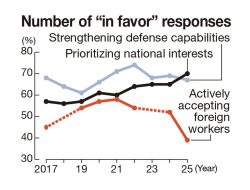
Survey Finds 59% of Japanese Opposed to Actively Accepting Foreig...
Popular articles in the past month
-

Govt Plans to Urge Municipalities to Help Residents Cope with Ris...
-

Japan Resumes Scallop Exports to China
-
Japan Prime Minister Takaichi Vows to Have Country Exit Deflation...
-

Japan to Charge Foreigners More for Residence Permits, Looking to...
-

JR East Suica's Penguin to Retire at End of FY2026; Baton to be P...
-

Japan GDP Down Annualized 1.8% in July-Sept.
-
Tokyo's Off Limit Areas Becoming Popular for Tours
-
Corporate Interim Earnings: Companies Must Devise Ways to Overcom...
"World" POPULAR ARTICLE
-
China Urges Citizens to Refrain from Visiting Japan, Citing Surge of Crimes Against Chinese
-

Mozambican Cooking Class Held in Matsuyama, Ehime Pref.; Participants Don Aprons, Bandanas Made from Traditional Mozambique Fabric
-
South Korean Military Band Backs Out of Japan’s Self-Defense Forces Festival to Be Held in Tokyo
-
8 Japanese Nationals Stranded on Indonesia’s Sumatra Island
-

China Steps Up ‘Wolf Warrior’ Diplomacy Against Japan, Hurling Accusation About Plutonium Stockpile
JN ACCESS RANKING
-
Govt Plans to Urge Municipalities to Help Residents Cope with Rising Prices
-
Japan Resumes Scallop Exports to China
-
Japan Prime Minister Takaichi Vows to Have Country Exit Deflation, Closely Monitor Economic Indicators
-
Japan to Charge Foreigners More for Residence Permits, Looking to Align with Western Countries
-
JR East Suica’s Penguin to Retire at End of FY2026; Baton to be Passed to New Character