
Japanese Nationals Lured to Scam Bases with False Promises, Controlled Through Violence
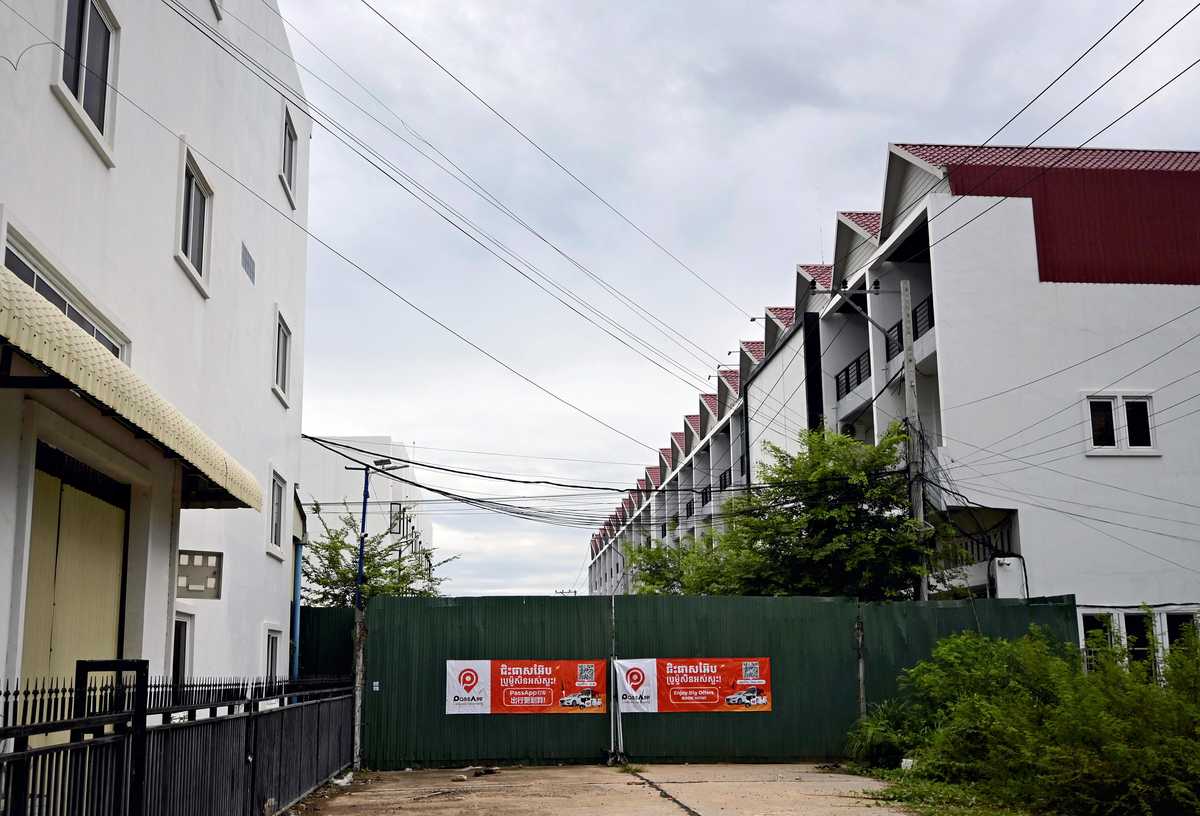
A housing complex in Poipet in northwestern Cambodia is seen on June 26. The complex is believed to have housed Japanese nationals who were involved in phone scams.
20:00 JST, September 28, 2025
Several Japanese nationals have been arrested after traveling to Southeast Asian countries and joining special fraud groups. They were lured by enticing phrases such as “high income” and “earn tons of money” but ended up being forced to carry out phone scams under strict surveillance. Police investigations have revealed the reality of overseas scam bases controlled by violence.
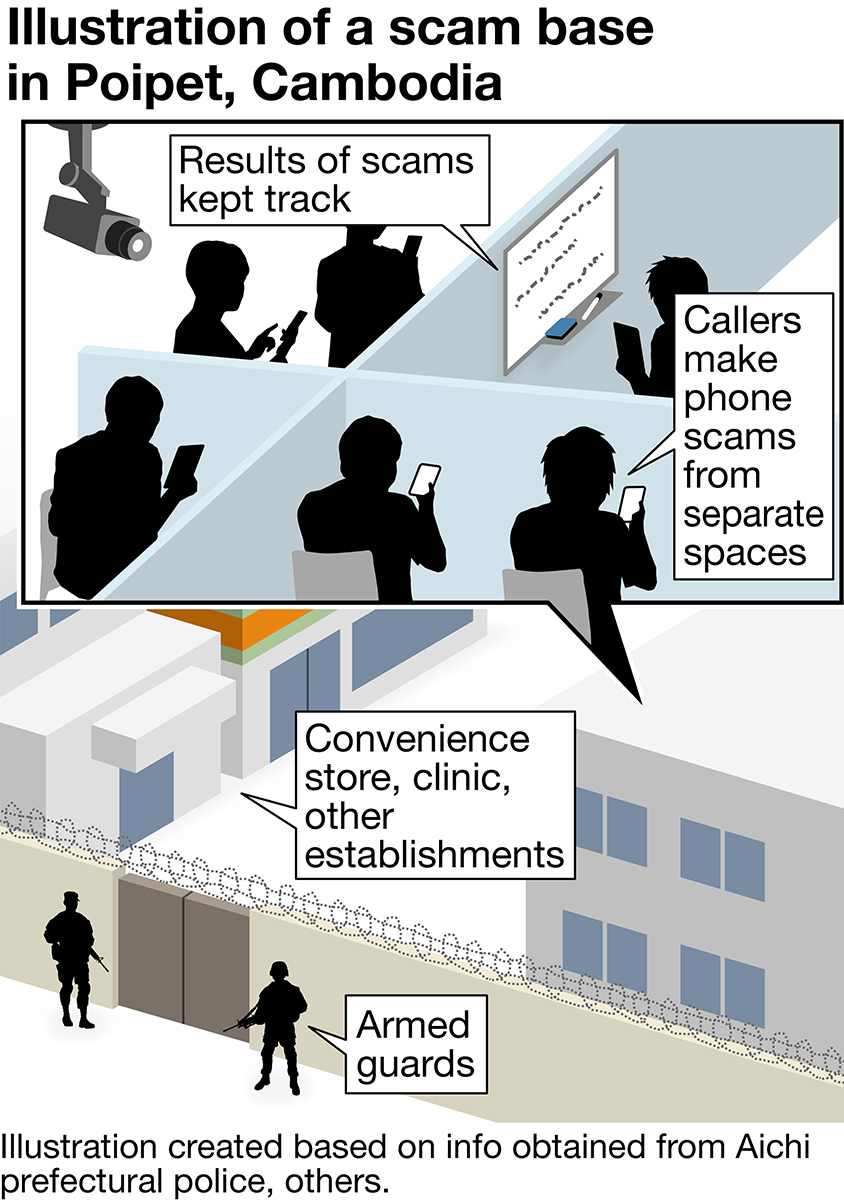
Convenience store, clinic
“More than 20 Japanese nationals live in a facility at a scam base surrounded by walls. They carry out phone scams at an office,” a man explained to Aichi prefectural police. He had returned to Japan in January from a scam base in Poipet in northwestern Cambodia.
This statement led to the repatriation of 29 men and women to Japan in August, who were believed to have been callers who carried out phone scams. They were arrested by the prefectural police on suspicion of attempted fraud.
According to the police, the 29 are said to have lived in a housing complex at the base. It had facilities including a convenience store, a clinic, a barbershop and a nail salon that provided a comfortable living environment.
However, they were not allowed to leave the base without permission and armed guards were stationed at the gate. Some suspects reportedly told investigators that they had seen lions, tigers and crocodiles being kept at the base.
There was an established system to methodically make phone scams under the surveillance of multiple Chinese nationals. The 29 Japanese people posed as telecommunications company employees and police officers, among other professions, in spaces separated for small groups. They made the calls from morning to night using devices including smartphones.
For meals during work, they could sometimes order Japanese, Chinese or fast food to be delivered.
Wake-up times and bedtimes were fixed and the results of the scams were recorded on a whiteboard. Surveillance cameras recorded the workers, who were fined if they were late for work.
Newcomers were required to memorize manuals. At the end of the day, there was a review meeting among the callers in which they listened to each other’s recorded calls and discussed things such as effective lines to deceive people.
Burned with turbo lighter
The suspects were beaten and kicked if they were not successful in their scams or if they said they wanted to leave. Some had their eardrums burned with a high-powered flame lighter while others had their fingernails ripped off. One suspect is quoted by the prefectural police as saying, “The environment was harsher than I expected.”
Many of the 29 suspects allegedly traveled to Cambodia to pay off their debts and the police have confirmed cases in which they were lured by the idea that they could earn money.
They were solicited on social media, but some were recruited face-to-face, leading the prefectural police to believe that there were recruiters in Japan and people who guided them in Cambodia.
The suspects are believed to have received a small cut of the money obtained through the scams as a reward, with higher rewards if they played the role of a police officer because of its “high difficulty.”
Many of the suspects spent their money at a store related to sex service in the base while others used the money to pay off their debts. At the time of repatriation, most of the suspects did not have any cash on them. Those that did have money had at the most about ¥2,700.
Another case in Myanmar
There was another case in Myanmar’s eastern border region in which Japanese nationals were forced to make phone scams while being beaten. It is believed that if they failed to meet their quota, they would not paid and a stun gun would be used against them. The base was surrounded by barbed wire with stationed armed guards, like the Cambodian base.
Two people, who were arrested by the prefectural police in April on suspicion of fraud, reportedly told others that they had applied for a well-paying part-time job. They are believed to have used the reward money for living expenses at the base and both had less than ¥10,000 on them at the time of their arrests.
A senior prefectural police officer investigating the Cambodia and Myanmar cases said: “In order to live, people needed to use money in the base. It is a system in which the rewards callers obtain through the scams are returned to the operators of the bases.”







Most Read
Popular articles in the past 24 hours
-

Japan's Snow-Clad Beauty: Camellia Flowers Seen in Winter Bloom a...
-

Monkey Strikes Junior High School Girl from Behind in Japan's Yam...
-

Foreign and Security Policy: Political Parties Must Discuss How T...
-
Senior Japanese Citizens Return to University to Gain Knowledge, ...
-
Genichiro Inokuma's Mural in Ueno Station That Gave Hope in Postw...
-
Heavy Snow Linked to 30 Deaths across Japan since Late Jan.; JMA ...
-

Tokyo Police Arrest Head of Resignation Assistance Firm
-

Japan’s Nikkei Stock Average Jumps near 4%, Closes at Record High...
Popular articles in the past week
-

Japan Institute to Use Domestic Commercial Optical Lattice Clock ...
-
Australian Woman Dies After Mishap on Ski Lift in Nagano Prefectu...
-
Foreign Snowboarder in Serious Condition After Hanging in Midair ...
-

Chinese Embassy in Japan Reiterates Call for Chinese People to Re...
-
Narita Airport, Startup in Japan Demonstrate Machine to Compress ...
-

Toyota Motor Group Firm to Sell Clean Energy Greenhouses for Stra...
-

Sakie Yokota, Last Surviving Parent of a North Korea Abductee, Ur...
-

Beer Yeast Helps Save Labor, Water Use in Growing Rice; Govt Hope...
Popular articles in the past month
-

Univ. in Japan, Tokyo-Based Startup to Develop Satellite for Disa...
-
JAL, ANA Cancel Flights During 3-day Holiday Weekend due to Blizz...
-

China Confirmed to Be Operating Drilling Vessel Near Japan-China ...
-

China Eyes Rare Earth Foothold in Malaysia to Maintain Dominance,...
-
Japan Institute to Use Domestic Commercial Optical Lattice Clock ...
-
M6.2 Earthquake Hits Japan's Tottori, Shimane Prefectures; No Tsu...
-

Japan, Qatar Ministers Agree on Need for Stable Energy Supplies; ...
-

Japan, Italy to Boost LNG Cooperation; Aimed at Diversifying Japa...
Top Articles in Society
-
JAL, ANA Cancel Flights During 3-day Holiday Weekend due to Blizzard
-
Record-Breaking Snow Cripples Public Transport in Hokkaido; 7,000 People Stay Overnight at New Chitose Airport
-
Australian Woman Dies After Mishap on Ski Lift in Nagano Prefecture
-
Foreign Snowboarder in Serious Condition After Hanging in Midair from Chairlift in Nagano Prefecture
-
Train Services in Tokyo Resume Following Power Outage That Suspended Yamanote, Keihin-Tohoku Lines (Update 4)
JN ACCESS RANKING
-
Univ. in Japan, Tokyo-Based Startup to Develop Satellite for Disaster Prevention Measures, Bears
-
JAL, ANA Cancel Flights During 3-day Holiday Weekend due to Blizzard
-
China Confirmed to Be Operating Drilling Vessel Near Japan-China Median Line
-
China Eyes Rare Earth Foothold in Malaysia to Maintain Dominance, Counter Japan, U.S.
-
Japan Institute to Use Domestic Commercial Optical Lattice Clock to Set Japan Standard Time