
Tight Surveillance of Yakuza Group Yamaguchi-Gumi Continues Despite Decrease in No. of Incidents
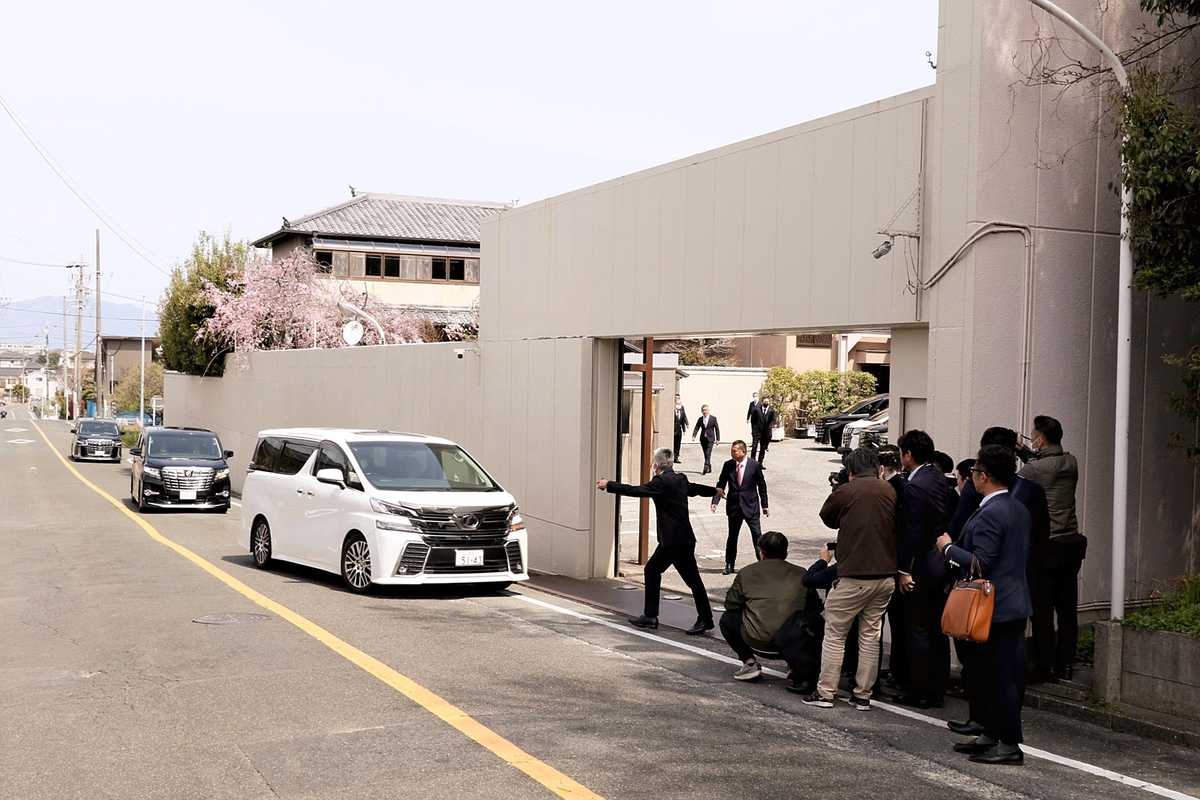
Vehicles believed to belong to the Yamaguchi-gumi enter the crime syndicate’s office in Toyohashi, Aichi Prefecture, in April.
1:00 JST, September 19, 2025
Ten years have passed since the Yamaguchi-gumi, the largest yakuza group in Japan, split into smaller groups. Thanks to increased police crackdowns and growing momentum for eliminating yakuza groups, conflicts between the Yamaguchi-gumi and the Kobe Yamaguchi-gumi (formed by a Yamaguchi-gumi splinter group) have largely subsided. Many yakuza offices have also been closed.
However, shooting incidents have continued to occur in recent years, prompting police authorities to remain on high alert regarding organized crime syndicates.
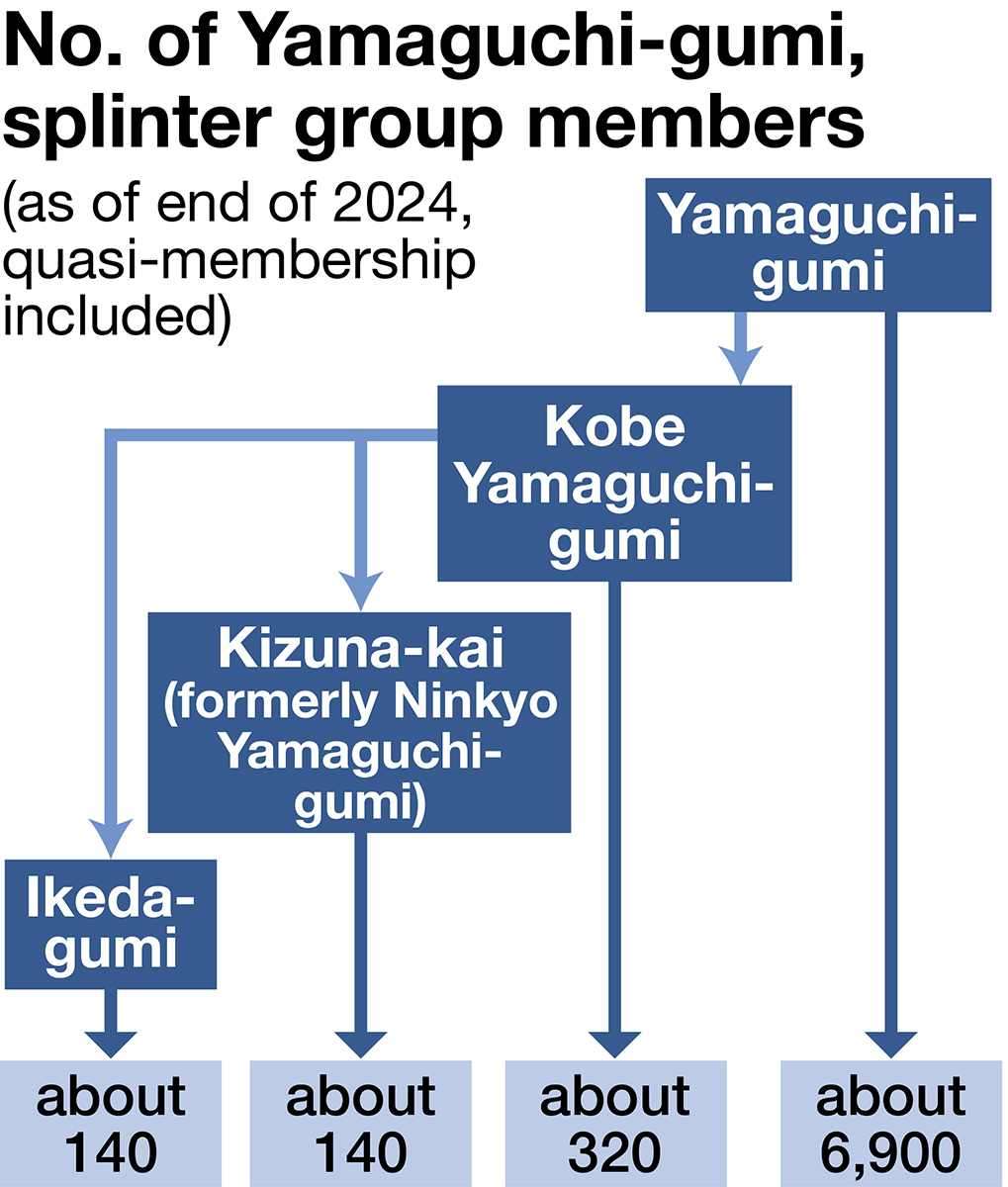
Yamaguchi-gumi, based in Nada Ward, Kobe, split on Aug. 27, 2015, and Kobe Yamaguchi-gumi was established by former members of the Yamaguchi-gumi in Inami, Hyogo Prefecture. Then, the Kizuna-kai, formerly the Ninkyo Yamaguchi-gumi, and the Ikeda-gumi were formed by former members of the Kobe Yamaguchi-gumi.
The Ninkyo Yamaguchi-gumi is based in Neyagawa, Osaka Prefecture, and the Ikeda-gumi in Okayama City.
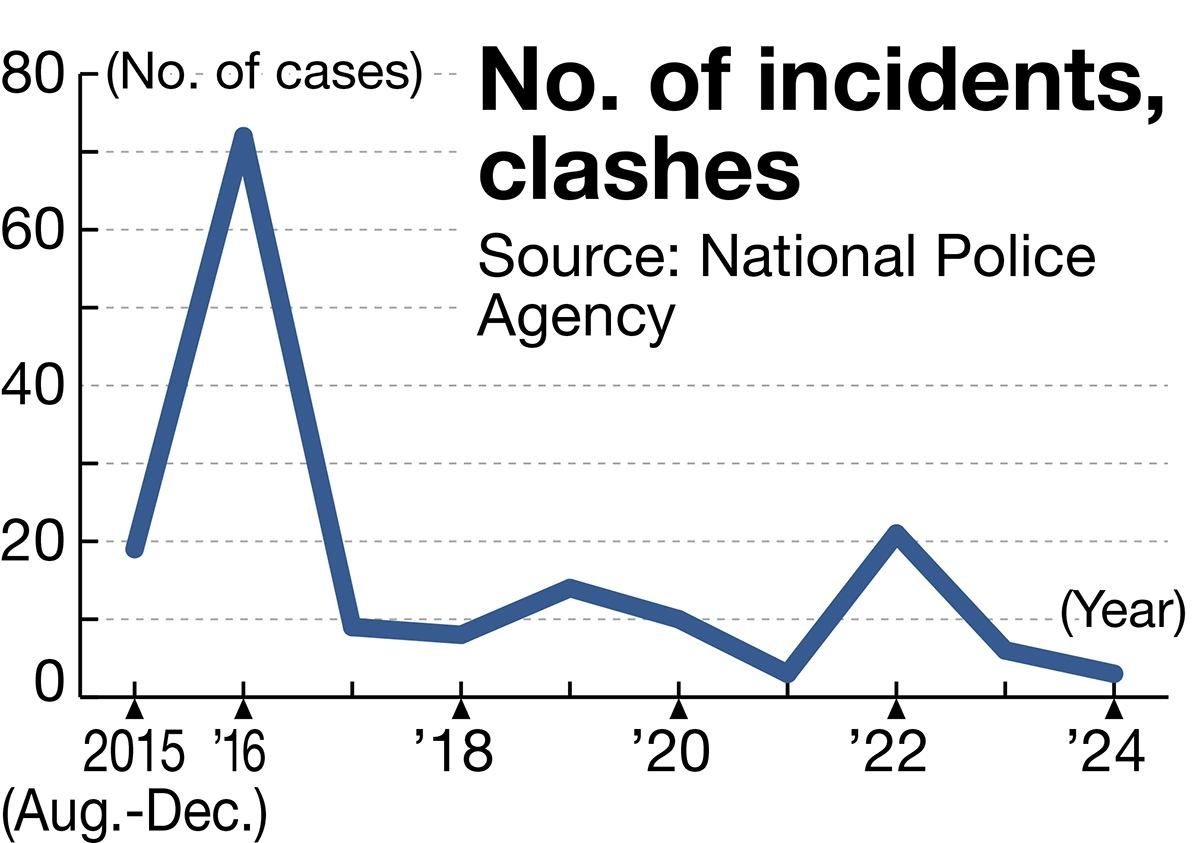
According to the National Police Agency, since the split of the Yamaguchi-gumi, 165 incidents related to the rivalry involving these four groups occurred by the end of 2024. In 2019, a series of clashes took place in which gang members were killed in shootings.
Starting in 2020, the NPA designated yakuza groups, including the Yamaguchi-gumi and the Kobe Yamaguchi-gumi, as “organized crime groups engaged in specified conflicts” under the anti-gang law. This designation prohibited them from being engaged in such acts as gathering in groups of five or more members, or entering gang offices within designated areas.
In 2017, the Hyogo Prefectural Center for the Elimination of Boryokudan (criminal organizations) filed a provisional injunction on behalf of local residents under the proxy lawsuit system, seeking a ban on the use of the Kobe Yamaguchi-gumi headquarters office, which was then located in Awaji in the prefecture. The injunction was approved and the office was eventually sold.
Thanks to similar anti-gang campaigns led by local residents, the number of criminal syndicate offices dropped to zero in September 2022 from eight in 2013 in Amagasaki, Hyogo Prefecture. “Some residents used to say that they were unable to let their children go out because they were afraid of gang violence. We want to keep the neighborhood free from such worries,” said a man who joined the anti-gang campaign in Amagasaki.
There used to be more than ten incidents involving gangs every year, but that number dropped to three in 2024. As of the end of 2015, the Yamaguchi-gumi had 14,100 members and the Kobe Yamaguchi-gumi had 6,100. Each group included quasi-members who have close relationships with the crime groups and support their operations.
However, due in part to the splintering and merging of affiliated groups, the number of Yamaguchi-gumi members decreased to 6,900, while the number of Kobe Yamaguchi-gumi members dwindled to 320 by the end of 2024.
In recent years, however, there have been incidents involving firearms. In 2023, the owner of a ramen restaurant in Nagata Ward, Kobe, who was also a leader of a yakuza group affiliated with the Yamaguchi-gumi, was shot dead. There is a view within the police that, while the Kobe Yamaguchi-gumi is weakening, it is hard to predict what yakuza members will do as they become more desperate.
In April, senior and other Yamaguchi-gumi members visited the Hyogo prefectural police headquarters and submitted a written oath promising to end conflicts with other gang organizations and cause no further trouble. But prefectural police chief Yasuhiro Konishi called for continued vigilance at a meeting of police station chiefs on April 18. “There are no signs that the yakuza power struggle is ending,” Konishi said.
A senior official of the prefectural police said the crime organization may have made the pledge in order to be delisted as a designated organized crime group. “The written oath was nothing more than their unilateral declaration that they had ended their conflicts with other gang groups,” the official said.
Even after the power struggle between the Yamaguchi-gumi and the Ichiwa-kai (a splinter group of the Yamaguchi-gumi) ended in the 1980s, clashes between yakuza groups continued. “We cannot rule out the possibility of another fierce rivalry among gang groups. We will carefully monitor developments,” the senior official said.
‘Tokuryu’ crime groups
Although the number of organized crime syndicates has declined in recent years, police authorities believe that former members of these syndicates continue to engage in criminal activities by joining “tokuryu” groups. These groups are anonymous and fluid, with members repeatedly coming together and dispersing via social media.
Ordinances to eliminate criminal syndicates, which were put into force in all 47 prefectures by 2011, ban citizens and businesses from providing bank accounts and cell phones to gang members. Police crackdowns on yakuza groups intensified further after the Yamaguchi-gumi split, prompting crime syndicate members to leave their groups.
However, of the about 5,000 people who left crime syndicates with the support of police and others between 2015 and 2024, only 264 found jobs after receiving social reintegration assistance.
Police authorities have confirmed cases in which former yakuza members joined tokuryu groups involved in special fraud and other crimes, suspecting that some of the money generated through these acts were given to organized crime syndicates.
“It is necessary for police to share and analyze all available information across section boundaries to clarify the actual status of crime groups,” said Noboru Hirosue, a commissioned researcher at Ryukoku Corrections and Rehabilitation Center at Ryukoku University.


Related Tags




Most Read
Most read in the last 24 hours
-

Trump Extends the Ceasefire with Iran but Keeps the Blockade
-

China, South Korea Object to Japanese PM Takaichi's Ritual Offeri...
-

Florida Launches Criminal Probe into OpenAI and ChatGPT over Dead...
-

Trump Opposes United–American Merger, Signals Support for Spirit
-

Trump Picks a University of Minnesota Professor to Lead His Econo...
-

Japan's ANA to Introduce Fuel Surcharges to Domestic Flights from...
-

Taiwan President Cancels Africa Trip Blaming Chinese Pressure
-

Fired Former UK Official Says He Felt Political Pressure to Appro...
Most read in the last 7 days
-
Earthquake Hits Japan's Tohoku Region; 3-meter Tsunami Warning Is...
-
Trump Extends the Ceasefire with Iran but Keeps the Blockade
-

Olympic Gold Medal-Winning Figure Skaters Riku-Ryu Announce Retir...
-
China, South Korea Object to Japanese PM Takaichi's Ritual Offeri...
-

Japan to Ban Use of Portable Chargers on Airplanes from April 24,...
-

New Challenges Await as Miura-Kihara Retires; Blade Maker, Ex-Coa...
-
Florida Launches Criminal Probe into OpenAI and ChatGPT over Dead...
-
Trump Opposes United–American Merger, Signals Support for Spirit
Most read in the last 30 days
-
Earthquake Hits Japan's Tohoku Region; 3-meter Tsunami Warning Is...
-
Police Find Child's Shoe During Search for Missing Boy in Nantan,...
-
Body Found in Nantan, Kyoto Prefecture, During Search for 11-Year...
-
Cherry Blossoms, Rapeseed Flowers Perform Colorful ‘Duet’ in Niig...
-
Trump Extends the Ceasefire with Iran but Keeps the Blockade
-
Olympic Gold Medal-Winning Figure Skaters Riku-Ryu Announce Retir...
-
Nori Prices Surge in Japan Due to Poor Seaweed Production Amid Ri...
-

Japanese Prime Minister Takaichi Speaks to Pakistani Prime Minist...
Top Articles in Society
-
Earthquake Hits Japan’s Tohoku Region; 3-meter Tsunami Warning Issued (Update 1)
-
Police Find Child’s Shoe During Search for Missing Boy in Nantan, Kyoto Prefecture
-
Body Found in Nantan, Kyoto Prefecture, During Search for 11-Year-Old Boy in Area (Update 1)
-
Cherry Blossoms, Rapeseed Flowers Perform Colorful ‘Duet’ in Niigata
-

Two Women in Osaka Found Lying on Floor Bleeding, Later Pronounced Dead
JN ACCESS RANKING
-
Earthquake Hits Japan’s Tohoku Region; 3-meter Tsunami Warning Issued (Update 1)
-
Police Find Child’s Shoe During Search for Missing Boy in Nantan, Kyoto Prefecture
-
Body Found in Nantan, Kyoto Prefecture, During Search for 11-Year-Old Boy in Area (Update 1)
-
Cherry Blossoms, Rapeseed Flowers Perform Colorful ‘Duet’ in Niigata
-
Trump Extends the Ceasefire with Iran but Keeps the Blockade
Most read in the last 24 hours
-
Trump Extends the Ceasefire with Iran but Keeps the Blockade
-
China, South Korea Object to Japanese PM Takaichi's Ritual Offeri...
-
Florida Launches Criminal Probe into OpenAI and ChatGPT over Dead...
-
Trump Opposes United–American Merger, Signals Support for Spirit
-
Trump Picks a University of Minnesota Professor to Lead His Econo...
Most read in the last 7 days
-
Earthquake Hits Japan's Tohoku Region; 3-meter Tsunami Warning Is...
-
Trump Extends the Ceasefire with Iran but Keeps the Blockade
-
Olympic Gold Medal-Winning Figure Skaters Riku-Ryu Announce Retir...
-
China, South Korea Object to Japanese PM Takaichi's Ritual Offeri...
-
Japan to Ban Use of Portable Chargers on Airplanes from April 24,...
Most read in the last 30 days
-
Earthquake Hits Japan's Tohoku Region; 3-meter Tsunami Warning Is...
-
Police Find Child's Shoe During Search for Missing Boy in Nantan,...
-
Body Found in Nantan, Kyoto Prefecture, During Search for 11-Year...
-
Cherry Blossoms, Rapeseed Flowers Perform Colorful ‘Duet’ in Niig...
-
Trump Extends the Ceasefire with Iran but Keeps the Blockade