
Suga, Koizumi Urged Ishiba to Step Down Amid Risk of Split; Prime Minister Considered Various Desperate Measures to Stay On
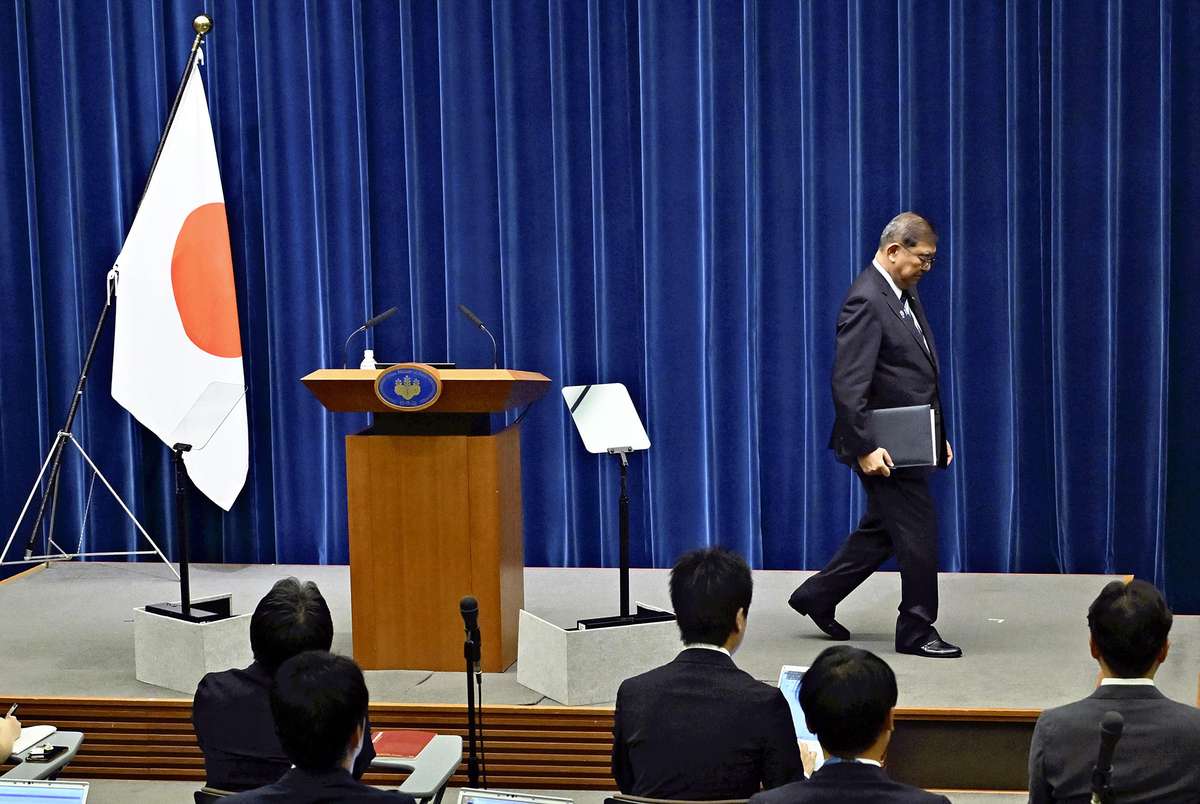
Prime Minister Shigeru Ishiba leaves a press conference at the Prime Minister’s Office on Sunday.
16:37 JST, September 8, 2025
“We must avoid a split within the LDP at all costs.”
So said Liberal Democratic Party Vice President Yoshihide Suga on Saturday, as he met with Prime Minister Shigeru Ishiba at the Prime Minister’s Residence. Drawing on his own experience of stepping down from the 2021 LDP leadership race, after criticism of his response to the COVID-19 pandemic, Suga was sympathetic to the pain felt by a cornered leader while also encouraging Ishiba to voluntarily announce his resignation.
Beside them sat Agriculture, Forestry and Fisheries Minister Shinjiro Koizumi, who had worked on reforming rice policy under the Ishiba Cabinet. Knowing the deep trust between Koizumi and Ishiba, Suga had asked Koizumi to accompany him.
If Ishiba did not announce his resignation, lawmakers were scheduled to begin submitting written requests at 10 a.m. Monday for an extraordinary party leadership election. “It would be disastrous,” Koizumi warned. “We can’t let it begin.”
Because the names of lawmakers seeking a special election would be made public, many in the LDP believed that irreparable rifts would be created regardless of the outcome. That sense of crisis spurred both Suga and Koizumi, who until then had kept their distance from the efforts to oust Ishiba.
Suga supported Koizumi in the first round of voting in last year’s party leadership race, and in the runoff he and most of Koizumi’s camp switched to supporting Ishiba.
“If you hadn’t supported me, I wouldn’t be prime minister today,” Ishiba told Suga on Saturday. Koizumi stayed nearly an hour and a half after Suga left, listening to Ishiba’s lingering thoughts on policy challenges. As the meeting ended, Ishiba appeared to be firming his resolve to step down.
The hardliners
On Sunday afternoon, Ishiba was visited by a handful of loyal allies at the Prime Minister’s Residence. Hurrying in through the back entrance were Foreign Minister Takeshi Iwaya, economic revitalization minister Ryosei Akazawa, Internal Affairs and Communications Minister Seiichiro Murakami, and Deputy Chief Cabinet Secretary Kazuhiko Aoki.
All had held secret meetings with Ishiba at the Akasaka lawmakers’ residence in Tokyo and consistently backed his staying in office. As news of Sunday’s gathering spread within the party, speculation mounted that they were trying to change the prime minister’s mind again after Suga urged him to resign.
Ishiba’s ultimate announcement that he would resign defied his aides’ hopes. After the disastrous upper house election, Ishiba initially hardened his resolve to quit before reversing course and strengthening his desire to continue.
Now, however, he looked exhausted. Murakami apologized, saying, “I’m sorry we couldn’t protect you,” marking the end of the isolated Ishiba group’s resistance.
Wishful thinking
Until Sunday, the hardliners had refused to face political reality. They avoided responsibility for the crushing election loss and kept exploring countermeasures.
At first, they shared the optimistic view that the requirements for an extraordinary leadership election — a majority of the total number of party lawmakers and prefectural federation representatives is required — would never be fulfilled, especially since the names of lawmakers requesting such an election would be disclosed.
But as support for his resignation grew daily and the deterioration of the situation became undeniable, Akazawa and others began advocating a dissolution of the lower house. Ishiba also leaned toward dissolution.
He began telling aides, “There is a gap between public opinion and perceptions within the party.” On Wednesday, in a private conversation with Special Advisor to the Prime Minister Akihisa Nagashima, who had been urging him to step down, Ishiba declared, “If it comes to an extraordinary leadership election, then I’ll dissolve the lower house.”
He even showed documents summarizing opinion polls that seemed to favor his staying in office, hinting at confidence in a general election. When Nagashima cautioned, “You’ll be criticized for calling an election without just cause,” Ishiba insisted, “It would be a dissolution for political realignment.”
Before leaving for Washington on Thursday for Japan-U.S. ministerial talks, Akazawa asked a senior party official whether a dissolution of the lower house was possible during the parliamentary recess. While technically possible, the answer he received was negative.
Even Tetsuo Saito, leader of the LDP’s coalition partner Komeito and who had shown some understanding for Ishiba’s staying on, told the prime minister bluntly, “We can never accept dissolution.”
Within the LDP, opposition to the unreasonable dissolution plan spread rapidly. A veteran lawmaker even said, “If the prime minister dissolves the Diet just to block a proper leadership election, we’ll expel him from the party.”
Dissolution would have required Cabinet approval. A senior government official also said that “with many ministers opposed, it would require mass dismissals and is impossible.”
Desperate gambits
Even after realizing that dissolution was impossible, Ishiba and his aides considered various desperate measures. These included a separation of roles plan, in which he would resign as party president but remain prime minister, and a plan for him to resign as president under Article 6, Clause 2 of party rules and then run again in the ensuing leadership election. Party executives, however, flatly rejected both ideas.
Having run out of ways to resist, Ishiba faced Sunday’s press conference with visible frustration. By postponing the decision on his political future — something only he could determine — and having deepened the rifts and turmoil within the party, Ishiba said, “I don’t hold a large [support] base within the party. I have tried sincerely to pursue harmony. I still wonder, ‘What could I have done better?’”


Related Tags

Most Read
Popular articles in the past 24 hours
-

Director Naomi Kawase's New Film Explores Heart Transplants in Ja...
-

Japan’s Nikkei Stock Average Rises on Tech Rally and Takaichi's S...
-
Takaichi Expected to Express Desire for Constitutional Revision P...
-
Japanese Man Living in Iraq Suspected of Illegally Entering U.S. ...
-

Security Services Law Unconstitutional: Do Not Restrict Career Ch...
-

Milano Cortina 2026: Snowboarding Star Fukada Wins Gold in Hard-F...
-
New Leader of Japan's CRA Opposition Party Faces Challenge of For...
-

Tokyo Exhibition Featuring VR Walk Through 2025 Osaka-Kansai Expo...
Popular articles in the past week
-

Japan PM Takaichi’s Cabinet Resigns en Masse
-

Man Infected with Measles Reportedly Dined at Restaurant in Tokyo...
-

Videos Plagiarized, Reposted with False Subtitles Claiming ‘Ryuky...
-

Sanae Takaichi Elected 105th Prime Minister of Japan; Keeps All C...
-

Japan's Govt to Submit Road Map for Growth Strategy in March, PM ...
-

Milano Cortina 2026: Figure Skaters Riku Miura, Ryuichi Kihara Pa...
-

Tokyo’s New Record-Breaking Fountain Named ‘Tokyo Aqua Symphony’
-

Bus Carrying 40 Passengers Catches Fire on Chuo Expressway; All E...
Popular articles in the past month
-
Japan PM Takaichi’s Cabinet Resigns en Masse
-

Japan Institute to Use Domestic Commercial Optical Lattice Clock ...
-

Israeli Ambassador to Japan Speaks about Japan’s Role in the Reco...
-
Man Infected with Measles Reportedly Dined at Restaurant in Tokyo...
-

Man Infected with Measles May Have Come in Contact with Many Peop...
-

Prudential Life Insurance Plans to Fully Compensate for Damages C...
-
Videos Plagiarized, Reposted with False Subtitles Claiming ‘Ryuky...
-

Woman with Measles Visited Hospital in Tokyo Multiple Times Befor...
Top Articles in Politics
-
Japan PM Takaichi’s Cabinet Resigns en Masse
-
Sanae Takaichi Elected 105th Prime Minister of Japan; Keeps All Cabinet Appointees from Previous Term
-
Japan’s Govt to Submit Road Map for Growth Strategy in March, PM Takaichi to Announce in Upcoming Policy Speech
-

LDP Wins Historic Landslide Victory
-

LDP Wins Landslide Victory, Secures Single-party Majority; Ruling Coalition with JIP Poised to Secure Over 300 seats (UPDATE 1)
JN ACCESS RANKING
-
Japan PM Takaichi’s Cabinet Resigns en Masse
-
Japan Institute to Use Domestic Commercial Optical Lattice Clock to Set Japan Standard Time
-
Israeli Ambassador to Japan Speaks about Japan’s Role in the Reconstruction of Gaza
-
Man Infected with Measles Reportedly Dined at Restaurant in Tokyo Station
-
Man Infected with Measles May Have Come in Contact with Many People in Tokyo, Went to Store, Restaurant Around When Symptoms Emerged