
Texas Students Learn about Japanese Agriculture in Niigata Pref. as Part of Exchange Initiative for Studying Climate Change
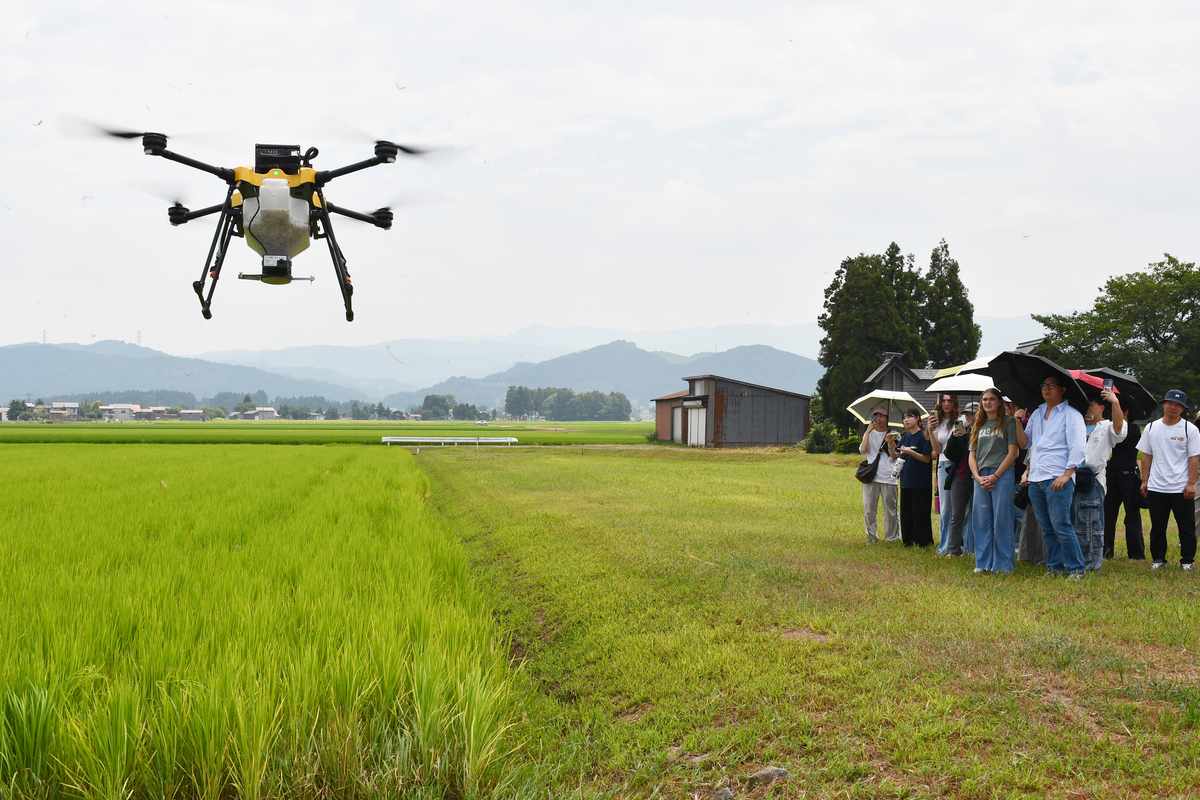
Students from the United States and Niigata Prefecture watch a drone spread fertilizer over a rice field in Joetsu, Niigata Prefecture, on Aug. 5.
11:19 JST, September 3, 2025
JOETSU / NIIGATA — Texas A&M University students majoring in agriculture-related studies visited Niigata Prefecture, an area known for rice production, from Aug. 4 to Aug. 9 as part of an initiative to learn about local agricultural practices and the impact of climate change in Japan and the United States.
The visit was part of the U.S.-Japan Council-Japan’s TOMODACHI Tanaka Sangyo Agricultural Exchange Initiative program, which aims to promote exchanges and mutual learning between Japanese and U.S. students on the themes of climate change and agriculture.
Eight students from Texas A&M and 10 university students from Niigata Prefecture participated in the program, which started last year. The Japanese students visited Texas in March and took part in study tours, touring Houston and other areas to learn about efforts to adapt to climate change and visit an automated precision phenotyping facility.
Tanaka Sangyo, or Tanaka Industry Co., which collaborates with the program, is a construction company in Joetsu in the prefecture, but has also purchased land from farmers who had to quit rice farming. The firm is now engaged in large-scale rice cultivation on a total of about 340 hectares of land. The company became involved in the program through its business connection with the U.S. Embassy in Japan.
Using drones over rice fields
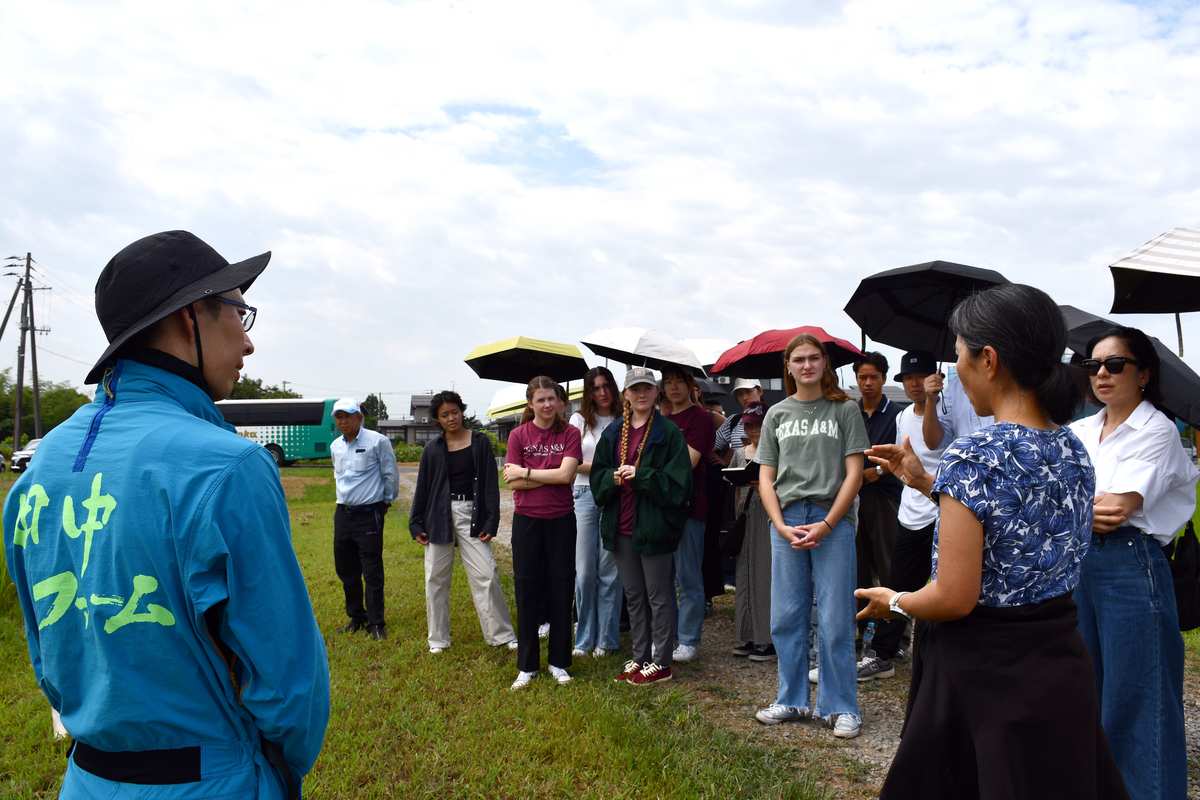
Students listen to explanation by a worker at a rice field in Joetsu on Aug. 5
On Aug. 5, the students visited rice paddies in Joetsu, where severe heat and record-low rainfall have raised a serious concern over the water shortages for agricultural use. Part of the leaves of rice plants had a yellowish hue, indicating damage from hot weather. With the rice plants nearing the heading stage, there is concern that the water shortage could have a severe impact on the harvest. Here, the students gained firsthand experience of the impact of climate change on agriculture in Japan.
A worker demonstrated a drone spreading granular fertilizers over the paddies.
“The drone’s route is already set on the machine, so it automatically flies along that route,” he said.
Since the students specialize in agriculture, they posed questions that were often technical and specific, such as, “Are they worried about nutrient treatment?” and “Is there any R&D company [working to create] rice that requires less water?”
“It is nice to see agriculture that shows us more traditional old practices, plus new technologies like drones,” said Daniel Kim Kwong, one of the U.S. students.
Experimental cultivation methods are being adopted at the part of rice paddies. One involves directly sowing the seeds in the dry soil, followed by cultivating the rice with a minimum amount of water. According to an employee of Tanaka Sangyo, which manages the rice field, this method could require less labor.
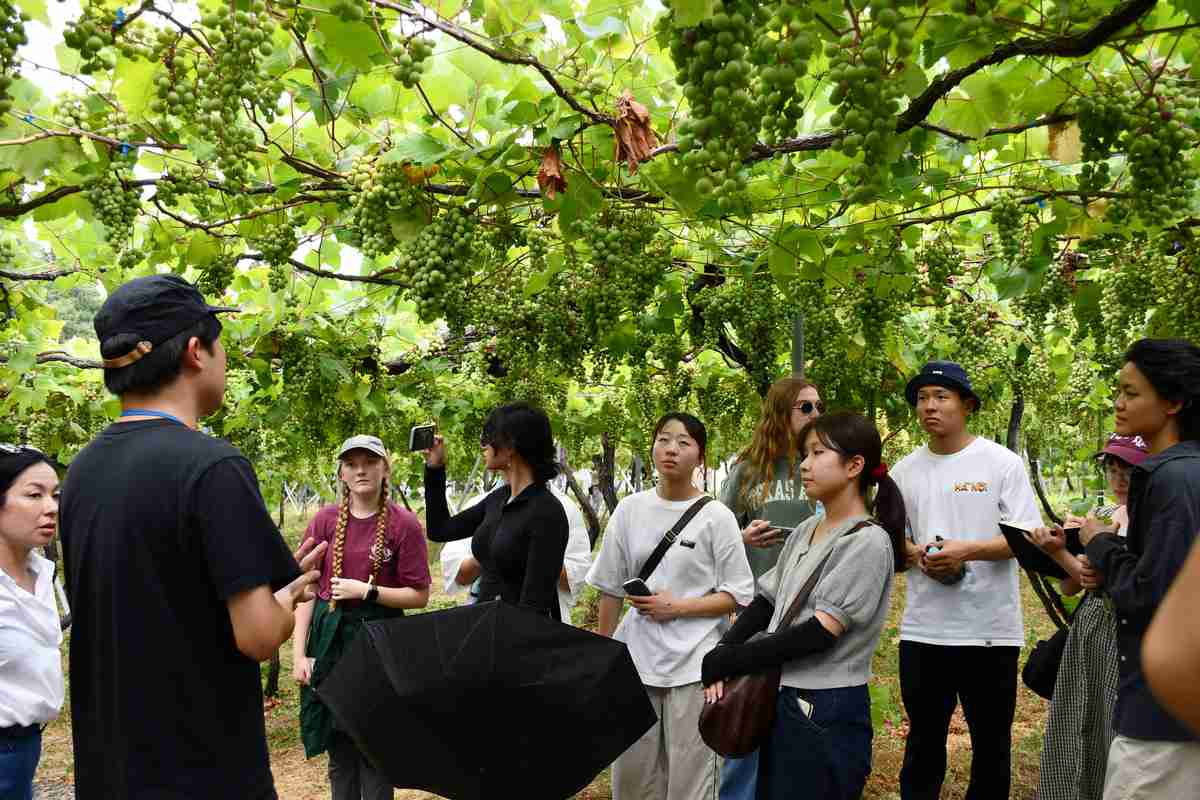
Students listen to an explanation given by an employee at Iwanohara Vineyard in Joetsu on Aug. 5.
Afterward, the students visited Iwanohara Vineyard, which has a long history of wine-making in the area. As winery staff explained methods adapted for the snowy climate of Niigata Prefecture, such as raising grapevines high above the ground, the students listened while taking notes.
Sakiko Okumoto, an associate professor in plant science at Texas A&M who accompanied the group, explained that one of the “major differences in agriculture between Japan and U.S. is the scale of land, hence the different way of management or equipment used.” She expressed hope that the students would learn a wide range of aspects stemming from these differences.
Group presentations
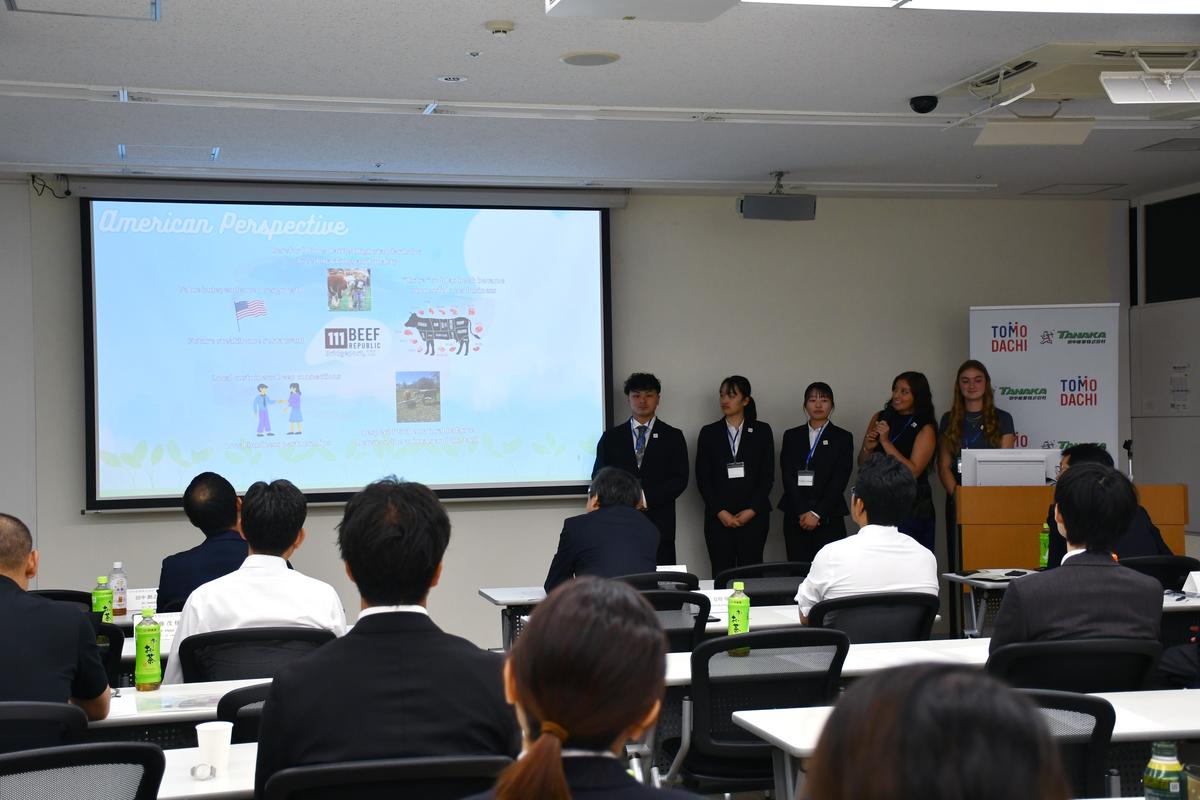
A group of students gives a presentation about their research in Niigata City on Aug. 8.
During their six-day stay in Niigata Prefecture, the students visited traditional terraced rice fields as well as a JA facility that handles shipments of vegetables brought by farmers, and a rice cracker factory among others, where they learned not only about agriculture, but also related industries and their marketing strategies.
Upon wrapping up their stay in Niigata, the students shared what they had learned through group presentations for the finale of the program.
Under four themes — such as sustainable agriculture and how climate change is affecting agriculture — the students did much work together, including conducting interviews with various people in agriculture sectors such as vegetable and livestock farmers. As part of the project, they also held online discussions with their counterparts overseas.
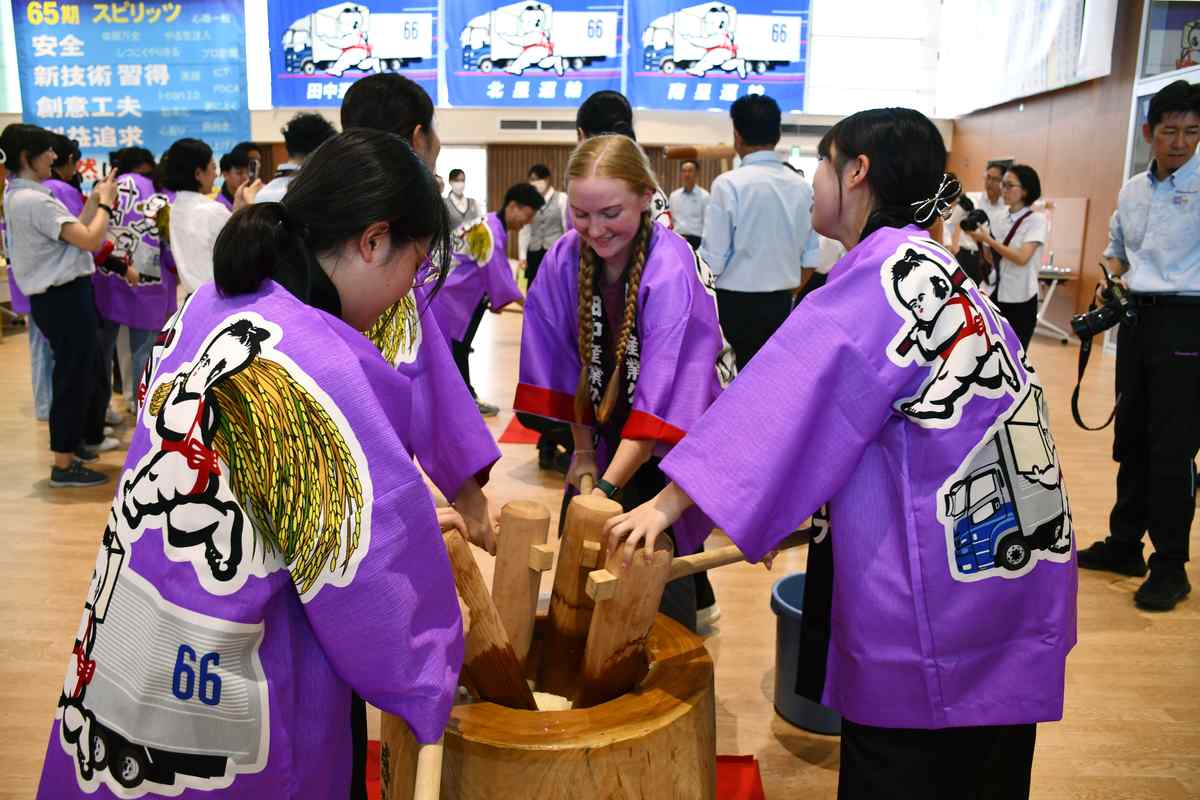
Students pound mochi the traditional way at Tanaka Sangyo in Joetsu on Aug. 5.
Emilia Gaona, who is studying genetic editing of rice plants with aims such as developing rice varieties that require less water, said that visiting rice fields in Joetsu was one of the most valuable experiences for her studies.
“Seeing how drought has been really impacting Japanese rice farmers … it helped me see the value of my research … and understand why we are doing [the research] and how we should continue,” she said.
Ryuki Nagashima, a student from Niigata Prefecture, said participating in the program gave him the opportunity to reevaluate the value of Japanese agriculture and the Niigata region itself. Recalling the moment when the Texas A&M students praised the traditional rice terraces and abundant nature in Niigata Prefecture, he said, “I felt the significance of Japanese agriculture that runs through thousands of years.”
***
Global warming damages crops
Record-breaking heat has been the norm this summer. Tanba, Hyogo Prefecture, recorded the highest — ever temperature in Japan on July 30 at 41.2 C. However, this record was soon surpassed on Aug. 5 when the mercury hit 41.8 C in Isesaki, Gunma Prefecture.
According to the Japan Meteorological Agency, a maximum temperature of at least 35 C was recorded at 4,565 locations in July, nearly double the number in 2023.
The Paris Agreement, an international framework to combat climate change, set out goals to reduce greenhouse gas emissions and limit the global temperature increase to 1.5 C above pre-industrial levels.
However, the World Meteorological Organization notes that the global average temperature in 2024 was 1.55 C higher than before the Industrial Revolution. This makes achieving the goals of the Paris Agreement more challenging, although the long-term data still needs to be verified.
The U.N. Food and Agriculture Organization estimates that global warming over the past 30 years has incurred $3.8 trillion (about ¥570 trillion) worth of damage to global crops and livestock. To mitigate these effects, the United Nations is promoting the introduction of heat-resistant crops and other measures for adaptation.


Related Tags


Most Read
Most read in the last 24 hours
-

India's Arms Indigenization Quest for Self-Reliance / Desert Dril...
-

26-year-old U.S. National Falls While Climbing Mt. Fuji; Accompan...
-
Japan Passport Fees Going Down to ¥9,000 in July
-

Japanese Side Machida Zelvia Faces Ah-Ahli in Asian Champions Lea...
-

Transfer of Defense Equipment: Increase the Number of Like-minded...
-
Japan Eyes Trialing Dual-Use Tech Developed by Startups to Promot...
-

Charm of Meiji-Era Poet Takuboku Examined from Viewpoint of Donal...
-

Cherry Blossoms in Full Bloom in Hokkaido's Hakodate; Tourists Fl...
Most read in the last 7 days
-
Earthquake Hits Japan's Tohoku Region; 3-meter Tsunami Warning Is...
-

Trump Extends the Ceasefire with Iran but Keeps the Blockade
-

China, South Korea Object to Japanese PM Takaichi's Ritual Offeri...
-

India's Arms Indigenization Quest for Self-Reliance / New Delhi S...
-
Japan to Ban Use of Portable Chargers on Airplanes from April 24,...
-

¥1,000 Coins to Be Issued to Mark Anniversary of Beginning of Jap...
-

Most Serious Cyberattacks against the UK Now from Russia, Iran an...
-
New Challenges Await as Miura-Kihara Retires; Blade Maker, Ex-Coa...
Most read in the last 30 days
-
Earthquake Hits Japan's Tohoku Region; 3-meter Tsunami Warning Is...
-
Police Find Child's Shoe During Search for Missing Boy in Nantan,...
-
Body Found in Nantan, Kyoto Prefecture, During Search for 11-Year...
-
Cherry Blossoms, Rapeseed Flowers Perform Colorful ‘Duet’ in Niig...
-
Trump Extends the Ceasefire with Iran but Keeps the Blockade
-

Olympic Gold Medal-Winning Figure Skaters Riku-Ryu Announce Retir...
-
Nori Prices Surge in Japan Due to Poor Seaweed Production Amid Ri...
-
China, South Korea Object to Japanese PM Takaichi's Ritual Offeri...
Top Articles in JN Specialities
-
How to Prepare for Power Outages Caused by Natural Disasters
-
Tokyo Wards Train Volunteer Tour Guides for Locals Passionate About Their Area’s Charms
-

Tateyama Soup Curry in Chiba Challenges Its Sapporo Roots, Cafe Owner Looks to Local Area for Best Ingredients
-

Personal History Helps You Look Back, Move Forward; Editor Gives Advice to Those Writing Their Story
-
Japan May Build ‘Rescue City’ in Noto Region to Train Disaster Experts
JN ACCESS RANKING
-
Earthquake Hits Japan’s Tohoku Region; 3-meter Tsunami Warning Issued (Update 1)
-
Police Find Child’s Shoe During Search for Missing Boy in Nantan, Kyoto Prefecture
-
Body Found in Nantan, Kyoto Prefecture, During Search for 11-Year-Old Boy in Area (Update 1)
-
Cherry Blossoms, Rapeseed Flowers Perform Colorful ‘Duet’ in Niigata
-
Trump Extends the Ceasefire with Iran but Keeps the Blockade
Most read in the last 24 hours
-
India's Arms Indigenization Quest for Self-Reliance / Desert Dril...
-
26-year-old U.S. National Falls While Climbing Mt. Fuji; Accompan...
-
Japan Passport Fees Going Down to ¥9,000 in July
-
Japanese Side Machida Zelvia Faces Ah-Ahli in Asian Champions Lea...
-
Transfer of Defense Equipment: Increase the Number of Like-minded...
Most read in the last 7 days
-
Earthquake Hits Japan's Tohoku Region; 3-meter Tsunami Warning Is...
-
Trump Extends the Ceasefire with Iran but Keeps the Blockade
-
China, South Korea Object to Japanese PM Takaichi's Ritual Offeri...
-
India's Arms Indigenization Quest for Self-Reliance / New Delhi S...
-
Japan to Ban Use of Portable Chargers on Airplanes from April 24,...
Most read in the last 30 days
-
Earthquake Hits Japan's Tohoku Region; 3-meter Tsunami Warning Is...
-
Police Find Child's Shoe During Search for Missing Boy in Nantan,...
-
Body Found in Nantan, Kyoto Prefecture, During Search for 11-Year...
-
Cherry Blossoms, Rapeseed Flowers Perform Colorful ‘Duet’ in Niig...
-
Trump Extends the Ceasefire with Iran but Keeps the Blockade