
Upper House Election: Ishiba Vows to Stay on Despite Ruling Bloc’s Loss in Upper House Election; ‘Stagnation Must Not Be Allowed’
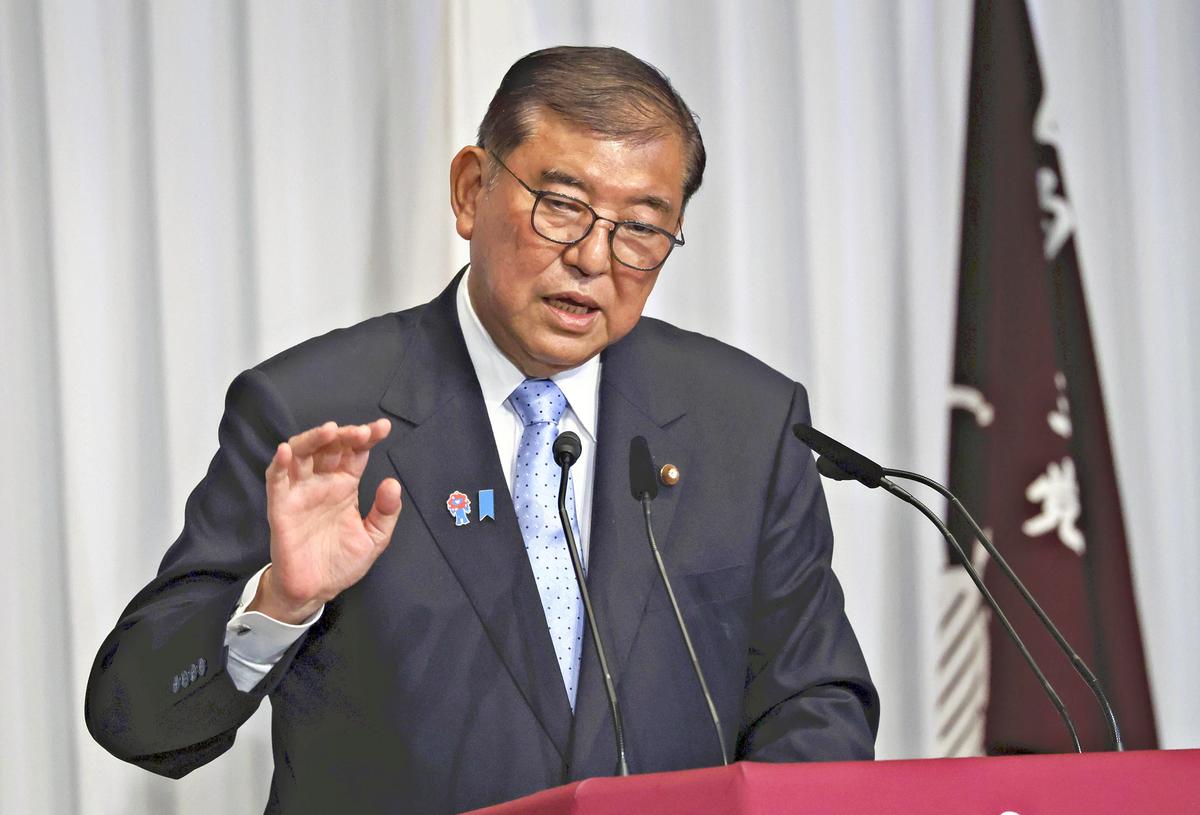
Prime Minister Shigeru Ishiba speaks at a press conference at the Liberal Democratic Party’s headquarters in Tokyo on Monday.
20:00 JST, July 21, 2025
Prime Minister Shigeru Ishiba on Monday vowed to stay in office a day after the ruling coalition of the Liberal Democratic Party and Komeito failed to secure a majority of seats in the House of Councillors election.
“In the election, the results for the LDP were grave,” Ishiba, who is also LDP president, said at a press conference. “It is regrettable that many LDP and Komeito members could not win seats.”
However, Ishiba expressed his intention to stay on given the pressing challenges facing Japan, such as U.S. tariffs, rising prices, possible major natural disasters and the complex security environment.
“Under such severe circumstances, the most crucial thing for now is not to bring about stagnation in politics. Even one moment of stagnation cannot be allowed,” Ishiba said. “We must fulfill our responsibility as the largest party, while also being keenly aware of our own responsibility for the election results.”
Regarding the management of government, given that the ruling coalition has now fallen to a minority in both chambers of the Diet, the prime minister said: “The road ahead of us is truly a thorny one. We will deepen our discussions with other parties more earnestly and carefully. We will sincerely work on national politics.”
Since becoming prime minister in October, Ishiba has suffered three consecutive defeats in major elections, following the House of Representatives and the Tokyo Metropolitan Assembly races.
Asked about the possibility of expanding the coalition framework to stabilize his administration, Ishiba said at the press conference, “At this moment, I am not thinking about an expansion.”
Seeking tangible tariff results
At the press conference, Ishiba also vowed to protect Japan’s national interests in tariff negotiations with the United States. Before the “reciprocal tariff” of 25% on Japan takes effect on Aug. 1, he said his government will be making “utmost efforts.”
“We are making various efforts to gain understanding by stressing investment rather than tariffs,” he said. “We will aim to reach an agreement that is beneficial to both Japan and the United States.”
Ryosei Akazawa, economic revitalization minister and Japan’s chief tariff negotiator, left for the United States on Monday for a new round of talks. Ishiba expressed his willingness to have direct talks with U.S. President Donald Trump at an early date to produce “tangible results.”
Ahead of the press conference, Ishiba discussed future moves with his secretaries and others at the Prime Minister’s official residence on Monday morning, based on the election results and other factors. After that, he attended an extraordinary meeting of the LDP’s board at the party’s headquarters.
Early Monday morning, Komeito leader Tetsuo Saito indicated his support for Ishiba’s intention to remain prime minister. “The LDP and Komeito must play a pivotal role in moving national politics forward,” he said.
The first extraordinary Diet session since Sunday’s upper house election is expected to be convened in early August, during which the chamber’s president and vice president will be elected. As long as Ishiba does not resign from the premiership, a prime ministerial election will not be held.
Ishiba’s term as LDP president will end in September 2027, but the LDP Constitution stipulates that a presidential election can be moved up if a majority of its Diet members and representatives of party prefectural chapters demand it.
“If he does not resign, we will have no choice but to bring him down [from the post],” a former cabinet member said.
Ishiba said at the press conference: “It is natural there are various opinions within the party. I will listen to them attentively.”
Further weakening of the Ishiba administration appears inevitable. To pass budgets and other bills, it is essential for the ruling parties to hold discussions for consensus building with opposition parties in the upper house as well as in the lower house.


Related Tags


Most Read
Most read in the last 24 hours
-

India's Arms Indigenization Quest for Self-Reliance / Desert Dril...
-

26-year-old U.S. National Falls While Climbing Mt. Fuji; Accompan...
-
Japan Passport Fees Going Down to ¥9,000 in July
-

Japanese Side Machida Zelvia Faces Ah-Ahli in Asian Champions Lea...
-

Transfer of Defense Equipment: Increase the Number of Like-minded...
-
Japan Eyes Trialing Dual-Use Tech Developed by Startups to Promot...
-

Charm of Meiji-Era Poet Takuboku Examined from Viewpoint of Donal...
-

Cherry Blossoms in Full Bloom in Hokkaido's Hakodate; Tourists Fl...
Most read in the last 7 days
-
Earthquake Hits Japan's Tohoku Region; 3-meter Tsunami Warning Is...
-

Trump Extends the Ceasefire with Iran but Keeps the Blockade
-
China, South Korea Object to Japanese PM Takaichi's Ritual Offeri...
-

India's Arms Indigenization Quest for Self-Reliance / New Delhi S...
-
Japan to Ban Use of Portable Chargers on Airplanes from April 24,...
-

¥1,000 Coins to Be Issued to Mark Anniversary of Beginning of Jap...
-

Most Serious Cyberattacks against the UK Now from Russia, Iran an...
-
New Challenges Await as Miura-Kihara Retires; Blade Maker, Ex-Coa...
Most read in the last 30 days
-
Earthquake Hits Japan's Tohoku Region; 3-meter Tsunami Warning Is...
-
Police Find Child's Shoe During Search for Missing Boy in Nantan,...
-

Body Found in Nantan, Kyoto Prefecture, During Search for 11-Year...
-
Cherry Blossoms, Rapeseed Flowers Perform Colorful ‘Duet’ in Niig...
-
Trump Extends the Ceasefire with Iran but Keeps the Blockade
-

Olympic Gold Medal-Winning Figure Skaters Riku-Ryu Announce Retir...
-

Nori Prices Surge in Japan Due to Poor Seaweed Production Amid Ri...
-
China, South Korea Object to Japanese PM Takaichi's Ritual Offeri...
Top Articles in Politics
-
India’s Arms Indigenization Quest for Self-Reliance / New Delhi Sticks to Its ‘All-Alignment’ Guns Even after Iran Warship Attack
-
Japan Aims to Enhance Deterrence, Defense Industry by Allowing Exports of Weapons
-
Former Japan PM Murayama’s Farewell Ceremony Held; Former Deputy PM Kono Vows to ‘Carry on Path Toward Peace’
-

Ritsumeikan Asia Pacific University Stripped of Certification for Simplified Visa Procedures Due to Document Failure
-

Japan’s PM Takaichi Seeks to Advance Policies Bearing Her Own ‘Color,’ Eyes Amending Constitution, Building Strong Economy
JN ACCESS RANKING
-
Earthquake Hits Japan’s Tohoku Region; 3-meter Tsunami Warning Issued (Update 1)
-
Police Find Child’s Shoe During Search for Missing Boy in Nantan, Kyoto Prefecture
-
Body Found in Nantan, Kyoto Prefecture, During Search for 11-Year-Old Boy in Area (Update 1)
-
Cherry Blossoms, Rapeseed Flowers Perform Colorful ‘Duet’ in Niigata
-
Trump Extends the Ceasefire with Iran but Keeps the Blockade
Most read in the last 24 hours
-
India's Arms Indigenization Quest for Self-Reliance / Desert Dril...
-
26-year-old U.S. National Falls While Climbing Mt. Fuji; Accompan...
-
Japan Passport Fees Going Down to ¥9,000 in July
-
Japanese Side Machida Zelvia Faces Ah-Ahli in Asian Champions Lea...
-
Transfer of Defense Equipment: Increase the Number of Like-minded...
Most read in the last 7 days
-
Earthquake Hits Japan's Tohoku Region; 3-meter Tsunami Warning Is...
-
Trump Extends the Ceasefire with Iran but Keeps the Blockade
-
China, South Korea Object to Japanese PM Takaichi's Ritual Offeri...
-
India's Arms Indigenization Quest for Self-Reliance / New Delhi S...
-
Japan to Ban Use of Portable Chargers on Airplanes from April 24,...
Most read in the last 30 days
-
Earthquake Hits Japan's Tohoku Region; 3-meter Tsunami Warning Is...
-
Police Find Child's Shoe During Search for Missing Boy in Nantan,...
-
Body Found in Nantan, Kyoto Prefecture, During Search for 11-Year...
-
Cherry Blossoms, Rapeseed Flowers Perform Colorful ‘Duet’ in Niig...
-
Trump Extends the Ceasefire with Iran but Keeps the Blockade