
2025 Expo Osaka: Next-Generation Technologies Displayed by Japanese Companies ; Robots, iPS ‘Heart’ Showcased
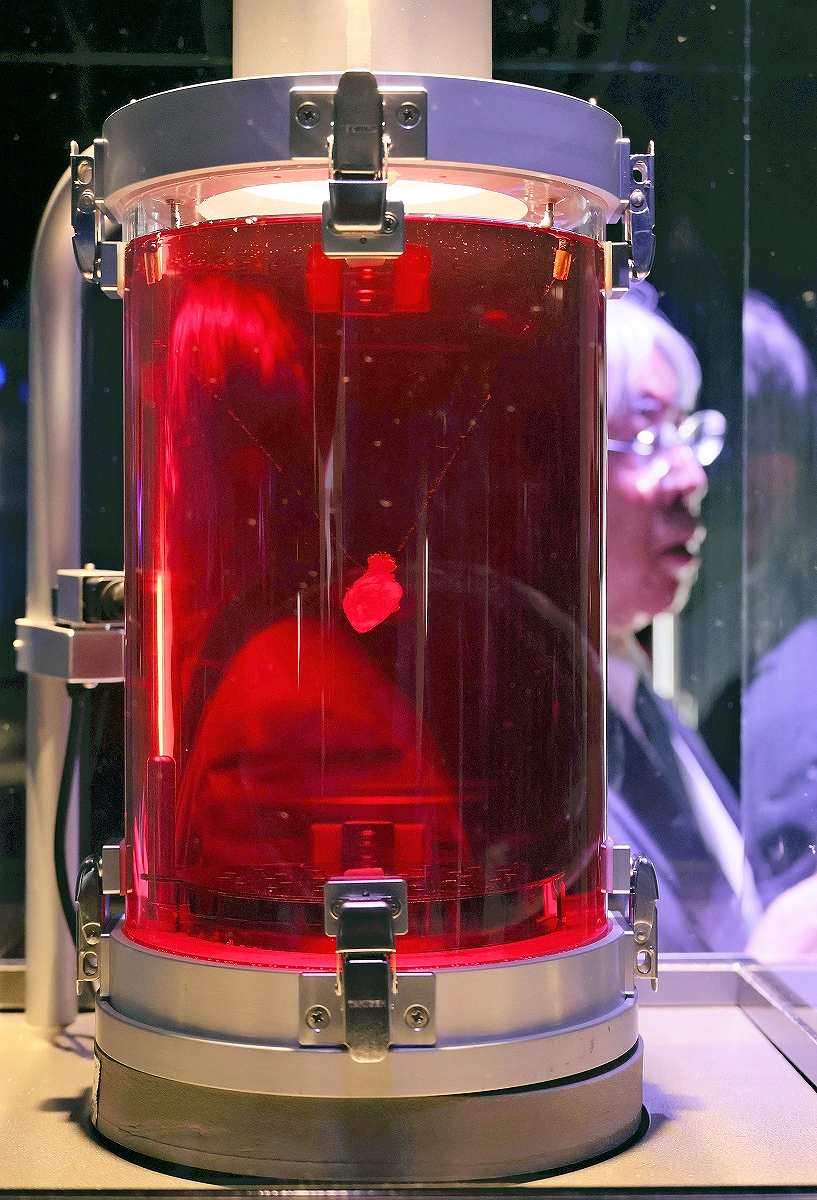
An iPS “heart” is displayed at the Pasona Group Pavilion at the 2025 Osaka-Kansai Expo site in Konohana Ward, Osaka.
20:00 JST, April 14, 2025
Under the theme “People’s Living Lab,” next-generation technologies developed by Japanese companies and research institutions, such as perovskite solar cells and induced pluripotent stem (iPS) cells, are being showcased at the 2025 Osaka-Kansai Expo.
Companies aiming to solve problems common to all humankind are promoting their technologies in such fields as decarbonization, medical care and health.
The theme of the Expo is “Designing Future Society for Our Lives.” Regarding the fields of medical care and health, a “heart” made from iPS cells is on display at a pavilion belonging to major staffing agency Pasona Group Inc. The heart was developed by Tokyo-based startup Cuorips Inc., and visitors can watch it beat.
On decarbonization, many companies are promoting perovskite solar cells, which are light and flexible, and hydrogen-related technologies.
Sekisui Chemical Co. installed a 250-meter long perovskite solar power system at the bus terminal in front of the Expo site. Electricity generated during the day is used to power the lights at night.
Toyoda Gosei Co. and Kyoto-based startup EneCoat Technologies Co. have developed a vest that generates electricity, which will be worn by some staff members throughout the event.
Panasonic Holdings Corp. outside its pavilion is exhibiting a prototype of a glass-based perovskite solar cell with artwork inscribed on its surface. “We would like to demonstrate our efforts towards achieving a sustainable future for people all over the world,” Michiko Ogawa, an executive officer of the company, told reporters.
Technologies that are expected to bring changes to lifestyle and transportation are also on display.
NTT Corp. is promoting its Innovative Optical and Wireless Network (IOWN), a next-generation communication infrastructure that would enable high-speed, low-latency and large-volume data transfer. The company has also installed a communication device capable of transmitting not only visual and audio data but also haptic sensations.
Kubota Corp. is showcasing autonomous robots capable of carrying out agricultural tasks as well as civil engineering and construction work.
Some of the electric buses operating inside the Expo site are Level 4 autonomous driving vehicles, which can operate without the assistance or intervention of a human driver, and are equipped with a system to automatically power themselves while running.


Related Tags


Most Read
Popular articles in the past 24 hours
-

Young People in Japan Grapple with Social Media Addiction
-

Milano Cortina 2026: Speed Skater Miho Takagi Extends Olympic Med...
-
Ruling Coalition Calls for Opposition Participation in ‘National ...
-

Revitalization of Shipbuilding Industry: Counter Chinese, S. Kore...
-

Japan’s Updated ‘Free and Open Indo-Pacific’ Initiative to Streng...
-

Milano Cortina 2026: Japan’s Dual Mogul Silver Medalist Iku...
-

Sexual Abuse by Doctors: Despicable Acts that Betray Patient Trus...
-

Milano Cortina 2026: Riku Miura and Ryuichi Kihara Win Japan̵...
Popular articles in the past week
-

Videos Plagiarized, Reposted with False Subtitles Claiming ‘Ryuky...
-

Woman with No Overseas Travel History Infected with Measles in Na...
-

Milano Cortina 2026: Kokomo Murase Comes Out on Top After Overcom...
-
CRA Leadership Election Will Center on Party Rebuilding; Lower Ho...
-
Tokyo’s New Record-Breaking Fountain Named ‘Tokyo Aqua Symphony’
-
Crime in Japan Ticks Up for 4th Straight Year
-

Japanese Constitutional Revision Debate Expected to be Revived Af...
-

Chemical Tanker Collides with Fishing Boat off Kobe with No Fuel ...
Popular articles in the past month
-

Japan Institute to Use Domestic Commercial Optical Lattice Clock ...
-

Israeli Ambassador to Japan Speaks about Japan’s Role in the Reco...
-

Man Infected with Measles May Have Come in Contact with Many Peop...
-

China Eyes Rare Earth Foothold in Malaysia to Maintain Dominance,...
-

Prudential Life Insurance Plans to Fully Compensate for Damages C...
-

Woman with Measles Visited Hospital in Tokyo Multiple Times Befor...
-

Australian Woman Dies After Mishap on Ski Lift in Nagano Prefectu...
-
Foreign Snowboarder in Serious Condition After Hanging in Midair ...
Top Articles in Science & Nature
-
Japan Institute to Use Domestic Commercial Optical Lattice Clock to Set Japan Standard Time
-

Space Mission Demonstrates Importance of International Cooperation, Astronaut Kimiya Yui Says
-
Japan to Face Shortfall of 3.39 Million Workers in AI, Robotics in 2040; Clerical Workers Seen to Be in Surplus
-
Record 700 Startups to Gather at SusHi Tech Tokyo in April; Event Will Center on Themes Like Artificial Intelligence and Robotics
JN ACCESS RANKING
-
Japan Institute to Use Domestic Commercial Optical Lattice Clock to Set Japan Standard Time
-
Israeli Ambassador to Japan Speaks about Japan’s Role in the Reconstruction of Gaza
-
Man Infected with Measles May Have Come in Contact with Many People in Tokyo, Went to Store, Restaurant Around When Symptoms Emerged
-
Prudential Life Insurance Plans to Fully Compensate for Damages Caused by Fraudulent Actions Without Waiting for Third-Party Committee Review
-
Woman with Measles Visited Hospital in Tokyo Multiple Times Before Being Diagnosed with Disease