
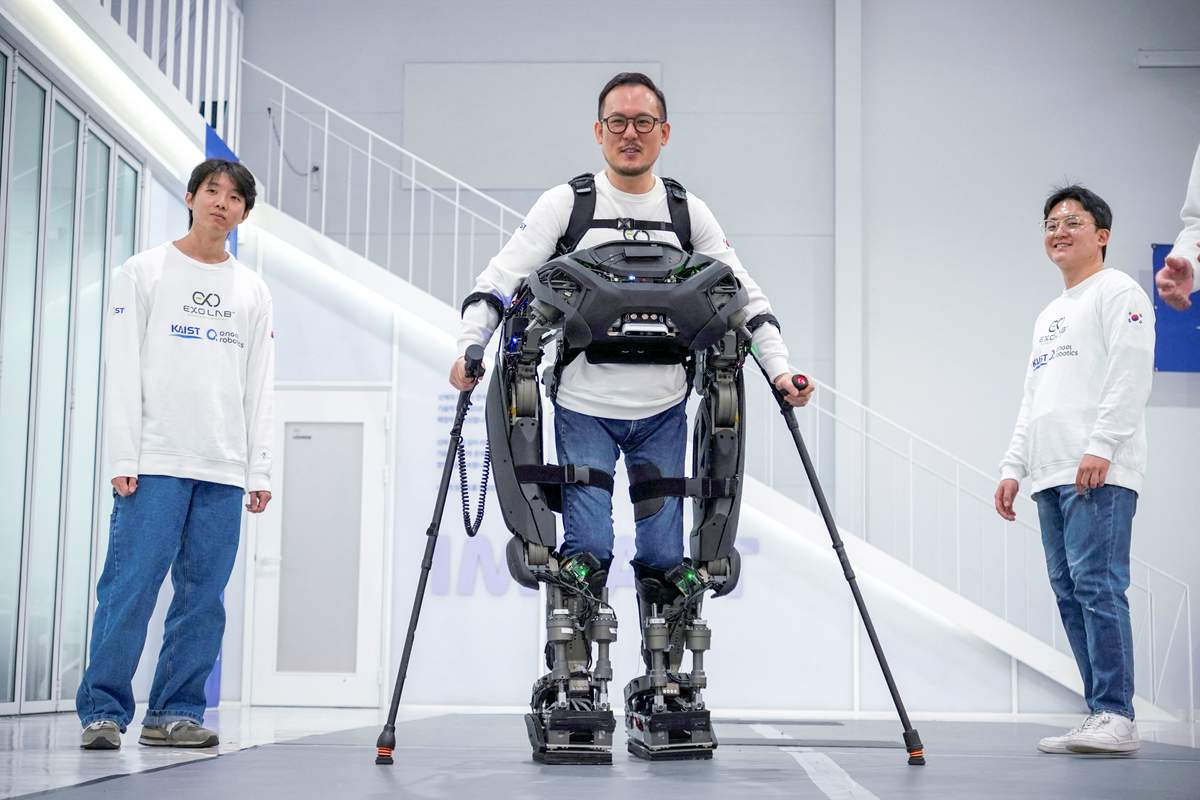
Kim Seung-hwan demonstrates the prototype of exoskeleton WalkON Suit F1 robot, in Daejeon, South Korea, on Nov. 27.
16:38 JST, January 8, 2025
DAEJEON, South Korea (Reuters) — South Korean researchers have developed a lightweight wearable robot that can walk up to paraplegic users and lock itself onto them, enabling them to walk, maneuver obstacles and climb staircases.
The Exoskeleton Laboratory team at the Korea Advanced Institute of Science and Technology (KAIST) said their goal is to create a robot that seamlessly integrates into the daily lives of individuals with disabilities.
Kim Seung-hwan, who is himself a paraplegic and part of the KAIST team, demonstrated the prototype which helped him walk at a speed of 3.2 kph, climb a flight of stairs and take sideways steps to slide into a bench.
“It can approach me wherever I am, even when I’m sitting in a wheelchair, and be worn to help me stand up, which is one of its most distinct features,” Kim said.
The powered exoskeleton, named WalkON Suit F1, features aluminum and titanium composition to weigh in at 50 kilograms, and is powered by 12 electronic motors that simulate the movements of human joints while walking.
Park Jeong-su, another member of the KAIST team, said he was inspired by the movie “Iron Man.” “After watching Iron Man, I thought it would be great if I can help people with a robot in real life.”
To ensure the user’s balance while walking, the robot is equipped with sensors on its soles and in the upper body that monitor 1,000 signals per second and anticipate the user’s intended movements.
Lenses on the front of the robot work as eyes which analyze its surroundings, identify the height of stairs and detect obstacles to compensate for the lack of sensory ability of users with complete paraplegia, Park said.
Kim Seung-hwan won the gold medal while wearing the WalkON Suit F1 in the exoskeleton category at Cybathlon 2024, which saw developers with varying physical disabilities demonstrate assistive robots in eight categories.
“I wanted to tell my son … that I also used to able to walk. I wanted to share a diverse range of experiences with him,” said Kim.




Most Read
Popular articles in the past 24 hours
-

Young People in Japan Grapple with Social Media Addiction
-

Milano Cortina 2026: Speed Skater Miho Takagi Extends Olympic Med...
-
Ruling Coalition Calls for Opposition Participation in ‘National ...
-

Revitalization of Shipbuilding Industry: Counter Chinese, S. Kore...
-

Japan’s Updated ‘Free and Open Indo-Pacific’ Initiative to Streng...
-

Milano Cortina 2026: Japan’s Dual Mogul Silver Medalist Iku...
-

Sexual Abuse by Doctors: Despicable Acts that Betray Patient Trus...
-

Milano Cortina 2026: Riku Miura and Ryuichi Kihara Win Japan̵...
Popular articles in the past week
-

Videos Plagiarized, Reposted with False Subtitles Claiming ‘Ryuky...
-

Woman with No Overseas Travel History Infected with Measles in Na...
-

Milano Cortina 2026: Kokomo Murase Comes Out on Top After Overcom...
-

CRA Leadership Election Will Center on Party Rebuilding; Lower Ho...
-

Tokyo’s New Record-Breaking Fountain Named ‘Tokyo Aqua Symphony’
-

Crime in Japan Ticks Up for 4th Straight Year
-

Japanese Constitutional Revision Debate Expected to be Revived Af...
-

Chemical Tanker Collides with Fishing Boat off Kobe with No Fuel ...
Popular articles in the past month
-

Japan Institute to Use Domestic Commercial Optical Lattice Clock ...
-

Israeli Ambassador to Japan Speaks about Japan’s Role in the Reco...
-

Man Infected with Measles May Have Come in Contact with Many Peop...
-

China Eyes Rare Earth Foothold in Malaysia to Maintain Dominance,...
-

Prudential Life Insurance Plans to Fully Compensate for Damages C...
-

Woman with Measles Visited Hospital in Tokyo Multiple Times Befor...
-

Australian Woman Dies After Mishap on Ski Lift in Nagano Prefectu...
-

Foreign Snowboarder in Serious Condition After Hanging in Midair ...
Top Articles in Science & Nature
-
Japan Institute to Use Domestic Commercial Optical Lattice Clock to Set Japan Standard Time
-

Space Mission Demonstrates Importance of International Cooperation, Astronaut Kimiya Yui Says
-

Japan to Face Shortfall of 3.39 Million Workers in AI, Robotics in 2040; Clerical Workers Seen to Be in Surplus
-

Record 700 Startups to Gather at SusHi Tech Tokyo in April; Event Will Center on Themes Like Artificial Intelligence and Robotics
JN ACCESS RANKING
-
Japan Institute to Use Domestic Commercial Optical Lattice Clock to Set Japan Standard Time
-
Israeli Ambassador to Japan Speaks about Japan’s Role in the Reconstruction of Gaza
-
Man Infected with Measles May Have Come in Contact with Many People in Tokyo, Went to Store, Restaurant Around When Symptoms Emerged
-
Prudential Life Insurance Plans to Fully Compensate for Damages Caused by Fraudulent Actions Without Waiting for Third-Party Committee Review
-
Woman with Measles Visited Hospital in Tokyo Multiple Times Before Being Diagnosed with Disease