
Japan Government Hails End to Negative Interest Rate Policy; Opposition Members Raise Concerns Over Timing of Decision

Prime Minister’s Office
16:34 JST, March 20, 2024
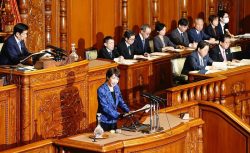
The government and the ruling parties have hailed the Bank of Japan’s decision to end its negative interest rate policy, while also calling for measures to prevent an adverse impact on the economy.
Some advocates of monetary easing and increased spending expressed dissatisfaction, however, with opposition party members questioning the timing of the policy change.
“It’s been deemed that we’re beginning to see an exit from deflation,” Kisaburo Tokai, the ruling Liberal Democratic Party’s Policy Research Council Chairperson, told reporters on Tuesday. “This is a major policy shift and should be viewed positively.”
Chief Cabinet Secretary Yoshimasa Hayashi said at a press conference, “It’s important for the government and the BOJ to continue to work together to end deflation and achieve sustained economic growth.”
The negative interest rate policy was ended based on the judgment that a stable rise in prices accompanied by wage increases can be expected. Natsuo Yamaguchi, the leader of the LDP’s coalition partner Komeito, stressed the need for the government to take action so that the move will not lead the nation back to deflation.
“It’s important to increase disposable income by promoting wage increases for small and medium-sized enterprises and non-regular workers, as well as through a series of fixed-rate tax cuts,” Yamaguchi said.
The negative interest rate policy was an extension of former Prime Minister Shinzo Abe’s Abenomics economic policy of bold monetary easing.
“In reality, the recovery in domestic demand is weak, and it’s premature to end the policy,” said Tomu Tanigawa, who co-chairs an LDP Diet member group promoting “responsible and aggressive fiscal policy.” Many of the group’s members were close to Abe.
“Market interest rates are likely to move upward, which will increase the burden on businesses and households,” Tanigawa said.
Opposition party members expressed various reservations. Constitutional Democratic Party of Japan Secretary General Katsuya Okada said at a press conference that the central bank lacked an exit strategy.
The end to the policy came too late, Okada said. “[The policy] dragged on while various harmful effects occurred.”
Fumitake Fujita, the secretary general of Nippon Ishin (Japan Innovation Party), said: “The timing is controversial. We want to wait and see how effective it is.”




Most Read
Popular articles in the past 24 hours
-

Japanese Watermelon Shipments Starts in Leading Production Distri...
-

Takeshima Day: Persistently Demanding Resolution from South Korea...
-

Tokyo Skytree Observation Deck Remains Closed for Inspection afte...
-

Impact on Japanese Economy Unclear with Trump’s New Tariffs, Shif...
-

CARTOON OF THE DAY (February 25)
-

Hanzomon Line Service Suspended between Kudanshita, Oshiage Stati...
-
Hanzomon Line Service Resumes
-
Japan GSDF, Indian Army Begin Joint Antiterror Drills
Popular articles in the past week
-

Producer Behind Pop Group XG Arrested for Cocaine Possession
-

iPS Treatments Pass Key Milestone, but Broader Applications Far f...
-

Japan, U.S. Name 3 Inaugural Investment Projects; Reached Agreeme...
-

Tokyo Skytree's Elevator Stops, Trapping 20 People; All Rescued (...
-

Japan’s Major Real Estate Firms Expanding Overseas Businesses to ...
-

Baby Monkey Punch Captures Hearts at Chiba Pref. Zoo, on Social M...
-

Milano Cortina 2026: Japanese Figure Skater Kaori Sakamoto’...
-
Reciprocal Tariffs Ruled Illegal: Judiciary Would Not Tolerate Pr...
Popular articles in the past month
-
Producer Behind Pop Group XG Arrested for Cocaine Possession
-

Japan PM Takaichi’s Cabinet Resigns en Masse
-

Japan Institute to Use Domestic Commercial Optical Lattice Clock ...
-

Man Infected with Measles Reportedly Dined at Restaurant in Tokyo...
-

Israeli Ambassador to Japan Speaks about Japan’s Role in the Reco...
-

Videos Plagiarized, Reposted with False Subtitles Claiming ‘Ryuky...
-

Man Infected with Measles May Have Come in Contact with Many Peop...
-

Prudential Life Insurance Plans to Fully Compensate for Damages C...
Top Articles in Politics
-
Japan PM Takaichi’s Cabinet Resigns en Masse
-

Sanae Takaichi Elected Prime Minister of Japan; Keeps All Cabinet Appointees from Previous Term
-

Japan’s Govt to Submit Road Map for Growth Strategy in March, PM Takaichi to Announce in Upcoming Policy Speech
-

LDP Wins Historic Landslide Victory
-

LDP Wins Landslide Victory, Secures Single-party Majority; Ruling Coalition with JIP Poised to Secure Over 300 seats (UPDATE 1)
JN ACCESS RANKING
-
Producer Behind Pop Group XG Arrested for Cocaine Possession
-
Japan PM Takaichi’s Cabinet Resigns en Masse
-
Man Infected with Measles Reportedly Dined at Restaurant in Tokyo Station
-
Israeli Ambassador to Japan Speaks about Japan’s Role in the Reconstruction of Gaza
-
Videos Plagiarized, Reposted with False Subtitles Claiming ‘Ryukyu Belongs to China’; Anti-China False Information Also Posted in Japan