
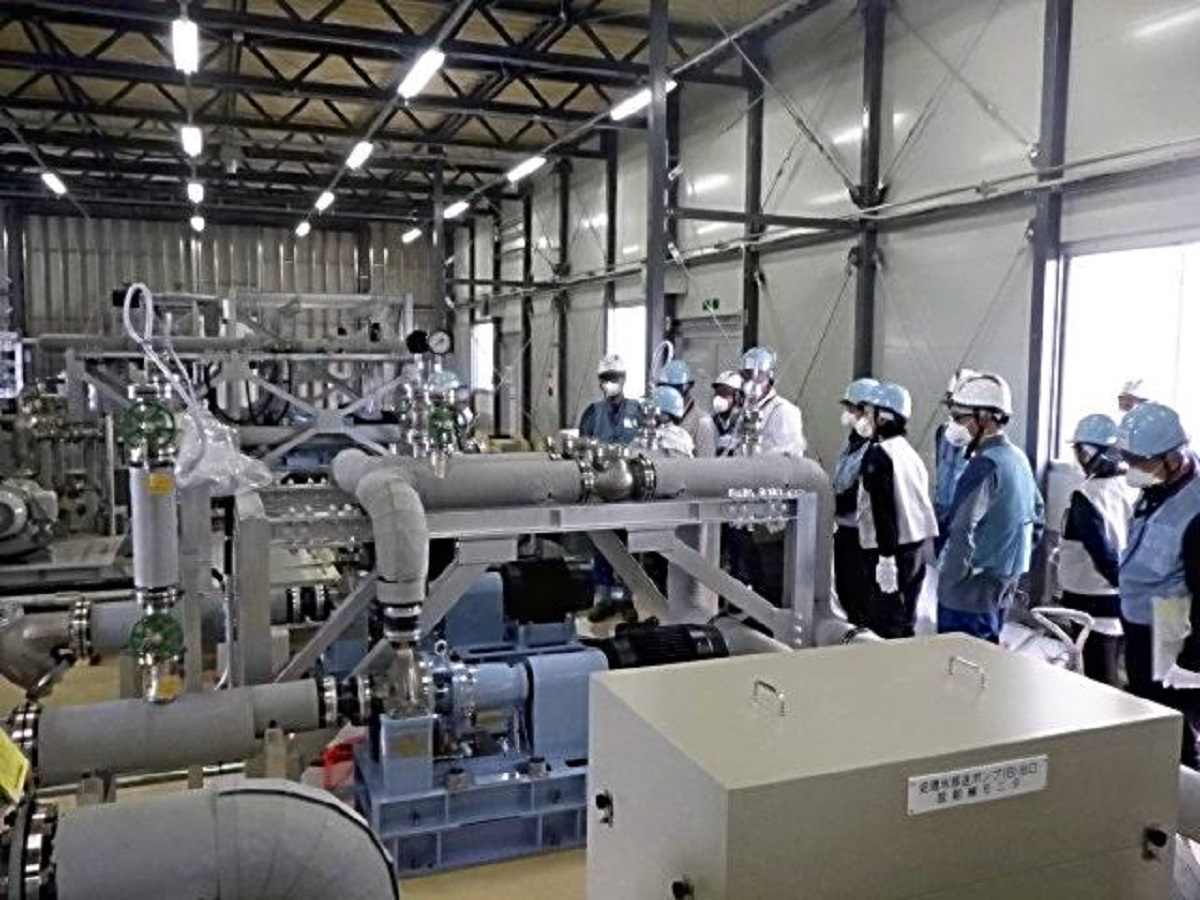
Members of an IAEA expert team inspect emergency isolation valves at the Fukushima No. 1 nuclear plant in Fukushima on May 24.
18:14 JST, July 5, 2023
The International Atomic Energy Agency’s comprehensive report released on Tuesday gave a highly positive review of the planned discharge of treated water from Tokyo Electric Power Company Holdings, Inc.’s Fukushima No. 1 nuclear power plant into the ocean. Some experts also praised the 140-page report as a detailed evaluation of the discharge plan.
Impartial review
IAEA Director General Rafael Grossi stressed the importance of the organization’s work to provide a comprehensive, impartial and scientific evaluation — and expressed confidence that it had done so — at a press conference in Tokyo following the release of the report.
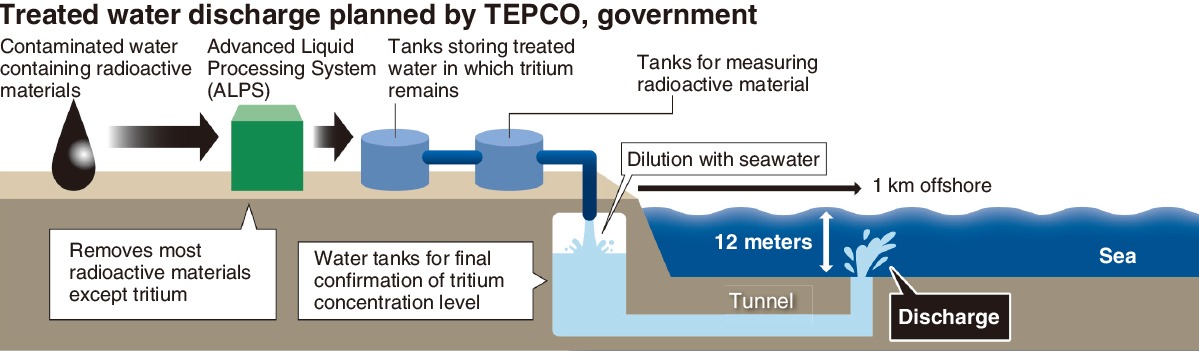
The IAEA expert team that conducted the assessment focused on accident prevention measures at the treated water discharge facility built by TEPCO. To avoid a situation in which treated water with tritium concentrations exceeding the regulatory standard might accidentally flow into the ocean, TEPCO has prepared multiple emergency measures in case an anomaly is detected. These measures include installing emergency isolation valves to automatically stop the discharge process within 10 seconds at two locations and setting up three seawater transfer pumps to dilute treated water.
The IAEA experts focused on examining these measures during their on-site inspection, according to the sources.
The team also carefully examined TEPCO’s ability to measure radioactive materials. The IAEA experts were present at the site where treated water was sampled, and independent analysis by three IAEA laboratories and other laboratories in four countries, including the United States and South Korea, were conducted to confirm that the results were consistent with TEPCO’s analysis.
International concerns
The spread of concern in neighboring countries over the impact of the treated water discharge was also considered.
Although TEPCO had estimated what the concentration of tritium would be in the sea area near the nuclear power plant once the discharge started, the IAEA said the company should also estimate the impact on neighboring countries.
TEPCO then made an additional estimate that the concentration level would be sufficiently low even in a sea area measuring about 490 kilometers by 270 kilometers. The comprehensive report concluded that “the estimated [radiation] dose to populations in neighboring countries will be negligible.”
Grossi also announced that the IAEA will continue to ensure the safety of the discharge plan by establishing an office with a full-time presence of IAEA officials at the plant.
At the press conference, he stressed that the IAEA will continue to be in Japan, in response to a reporter from China’s state-run Xinhua News Agency who raised questions about safety.
Nuclear watchdog
The IAEA is an affiliate of the United Nations, with 176 member countries. It employs about 2,500 staff members from various countries with expertise in the field. The IAEA formulates safety standards for the use of nuclear energy, and all member states develop their nuclear-related legal systems based on these standards.
Its nuclear inspections of North Korea and Iran, which are pursuing nuclear development, have earned it an international reputation as a “nuclear watchdog,” and in 2005 it was awarded the Nobel Peace Prize. Currently, the organization has deployed experts to nuclear power plants in Ukraine, which is under attack by Russia.
Thus, the comprehensive report of the IAEA team, which included experts from China and South Korea, countries that are opposed to the release, carries weight.
Hiroshi Kainuma, an associate professor of sociology at the University of Tokyo, said, “The fact that the report is a scientific and institutional review by practitioners and experts on nuclear energy has significant implications.”
Toyoshi Fuketa, a former chairman of the Nuclear Regulation Authority, also praised the report. “The report is much more detailed than is generally considered necessary. The IAEA’s safety standard puts great emphasis on ensuring safety. So the fact that the discharge plan is in line with its standard is a message assuring that the plan has an ample margin of safety,” Fuketa said.






Most Read
Popular articles in the past 24 hours
-
Japan Seeks to Counter China's Expanding Influence in Pacific by ...
-

Japan's Diet Begins Debate on Takaichi's Budget Plans, ‘Proactive...
-

Exhibition Featuring Yoshiharu Tsuge’s Manga World Underway in Ch...
-

Tokyo Skytree Observation Deck Remains Closed for Inspection afte...
-

Impact on Japanese Economy Unclear with Trump’s New Tariffs, Shif...
-

Japanese Watermelon Shipments Starts in Leading Production Distri...
-

Hanzomon Line Service Suspended between Kudanshita, Oshiage Stati...
-

Japan's Services Inflation Steady, Signals Wage-Driven Price Pres...
Popular articles in the past week
-

Producer Behind Pop Group XG Arrested for Cocaine Possession
-

Japan, U.S. Name 3 Inaugural Investment Projects; Reached Agreeme...
-

iPS Treatments Pass Key Milestone, but Broader Applications Far f...
-

Tokyo Skytree's Elevator Stops, Trapping 20 People; All Rescued (...
-

Director Naomi Kawase's New Film Explores Heart Transplants in Ja...
-

Japan’s Major Real Estate Firms Expanding Overseas Businesses to ...
-

Milano Cortina 2026: Japan’s Mari Fukada Wins Gold in Women’s Sno...
-

Milano Cortina 2026: Japanese Figure Skater Kaori Sakamoto’...
Popular articles in the past month
-
Producer Behind Pop Group XG Arrested for Cocaine Possession
-

Japan PM Takaichi’s Cabinet Resigns en Masse
-

Japan Institute to Use Domestic Commercial Optical Lattice Clock ...
-

Man Infected with Measles Reportedly Dined at Restaurant in Tokyo...
-

Israeli Ambassador to Japan Speaks about Japan’s Role in the Reco...
-

Videos Plagiarized, Reposted with False Subtitles Claiming ‘Ryuky...
-

Man Infected with Measles May Have Come in Contact with Many Peop...
-

Prudential Life Insurance Plans to Fully Compensate for Damages C...
Top Articles in Politics
-
Japan PM Takaichi’s Cabinet Resigns en Masse
-

Sanae Takaichi Elected Prime Minister of Japan; Keeps All Cabinet Appointees from Previous Term
-

Japan’s Govt to Submit Road Map for Growth Strategy in March, PM Takaichi to Announce in Upcoming Policy Speech
-

LDP Wins Historic Landslide Victory
-

LDP Wins Landslide Victory, Secures Single-party Majority; Ruling Coalition with JIP Poised to Secure Over 300 seats (UPDATE 1)
JN ACCESS RANKING
-
Producer Behind Pop Group XG Arrested for Cocaine Possession
-
Japan PM Takaichi’s Cabinet Resigns en Masse
-
Man Infected with Measles Reportedly Dined at Restaurant in Tokyo Station
-
Israeli Ambassador to Japan Speaks about Japan’s Role in the Reconstruction of Gaza
-
Videos Plagiarized, Reposted with False Subtitles Claiming ‘Ryukyu Belongs to China’; Anti-China False Information Also Posted in Japan