
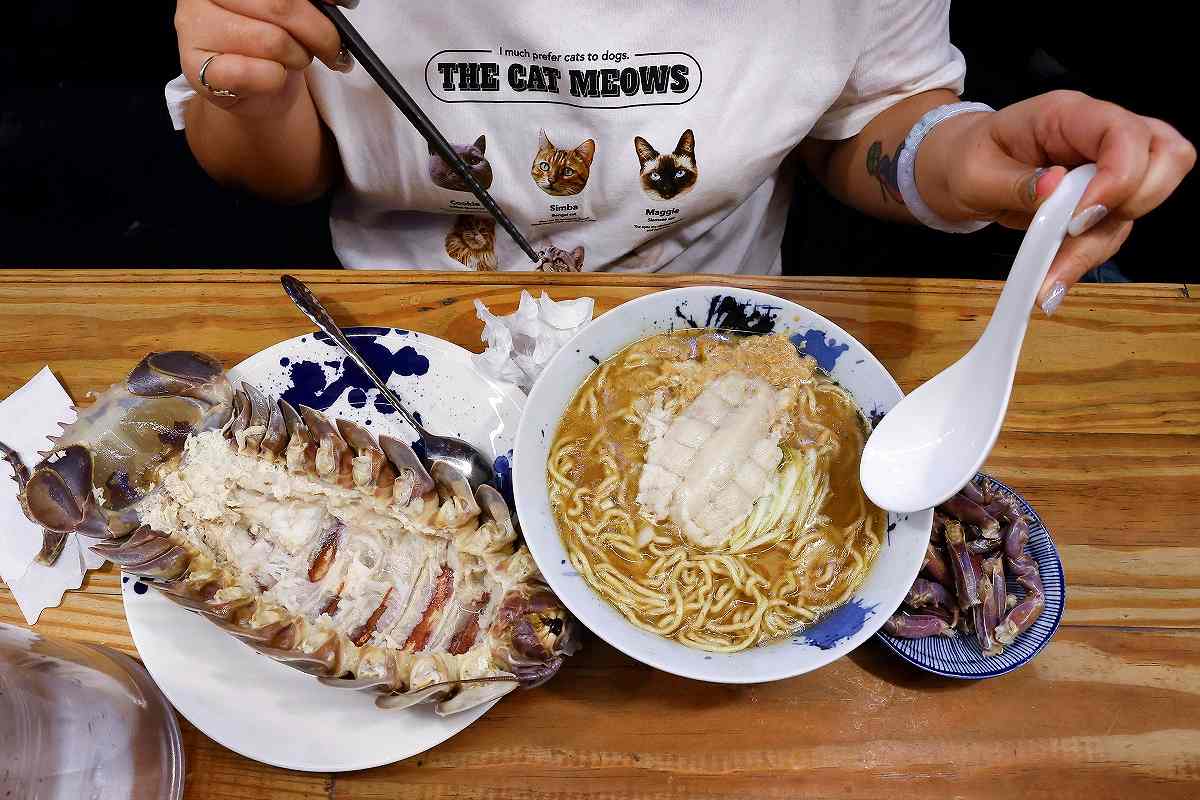
Giant isopod ramen is served at a restaurant in Taipei on May 27.
12:34 JST, June 10, 2023
TAIPEI (Reuters) — A 14-legged giant isopod is the highlight of a new dish at a ramen restaurant in Taipei and it has people queuing up — both for pictures and for a bite from this bowl of noodles.
Since the The Ramen Boy launched the limited-edition noodle bowl on May 22, declaring in a social media post that it had “finally got this dream ingredient,” more than a 100 people have joined a waiting list to dine at the restaurant.
“It is so attractive because of its appearance — it looks very cute,” said the 37-year-old owner of the restaurant, who wanted to be identified only as Mr. Hu, as he held up a giant isopod while customers took pictures.
“As for the cooking method, we use the simplest way, steam, so there is no difficulty to process it.”
The restaurant steams the isopod for 10 minutes before adding it to the top of a bowl of ramen with thick chicken and fish broth. Each bowl costs 1,480 Taiwan dollars ($48).
A customer said the meat tastes like a cross between crab and lobster with a dense texture and some chewiness.
Giant isopods — a distant cousin of crabs and prawns — are the largest among the thousands of species in the crustacean group, the NOAA Ocean Exploration said on its website.
They are usually found about 170-2,140 meters deep in the ocean, with 80% of them living at a depth of 365-730 meters, Taiwan’s Animal Planet said in a Facebook page.
A Taiwanese expert identified the species as Bathynomus jamesi, discovered near the Dongsha islands on the South China Sea. They are thought to be caught at between 300-500 meters.
Since the ramen launched, some scholars have expressed concerns over the potential ecological impact of bottom trawling fishing tactics as well as possible health risks.
But customers at the restaurant disagree.
“If it’s just a special menu, and the giant isopods were caught unintentionally like the restaurant owner says they were, everyone should try it if they get a chance,” said 34-year-old Digell Huang, who works as a genetic counselor.
“I am very honored to have this opportunity to taste it,” she added as she ate from a bowl of the isopod-topped noodle.
A scholar, however, warned against potential health risks, saying the largely unknown species may contain toxins or heavy metal such as mercury.
The Bathynomus jamesi species was recognized officially in Taiwan last year and there is not much data on it, said Huang Ming-chih, a biotechnology associate professor specializing in deep-sea invertebrates at the National University of Tainan.
“The best practice would be to do more research … build a complete database and then allow people to eat, it would be better that way,” he added.






Most Read
Popular articles in the past 24 hours
-

Nippon Life Insurance's U.S. Arm Sues OpenAI Over Legal Assistanc...
-

Milano Cortina Paralympics Open: Games Represent a Wish for Inclu...
-

Sake Mash Brewed Aboard ISS Returns to Japan; Final Product Alrea...
-

Japan to Send SDF Jet to Maldives for Iran Evacuations; Planes to...
-

Japan’s Takaichi Avoids Comment on Legality of U.S.-Israeli Strik...
-

Ohtani Helps Get Samurai Japan Off to Stellar Start in WBC Opener...
-

Yamamoto's High School Coach Discovered His Pitching Talent; Dodg...
-

Foreign Minister Motegi Conveys Japan's Concerns to Israel Over W...
Popular articles in the past week
-

South Korea Tightens Rules on Foreigners Buying Homes in Seoul Me...
-

Ibaraki Pref.'s 1st Foreign Bus Driver Hired in Tsukuba
-

Amid Strait of Hormuz Blockade, Shipping Companies Scramble to Ge...
-

2 Unpublished Early Novellas by Japan's Kenzaburo Oe Discovered, ...
-

Strait of Hormuz Closure Shakes Markets; Prolonged Closure Could ...
-

Iran Situation: Japan Must Exert Diplomatic Efforts without Merel...
-

Measles Patient Visited Hospital in Bunkyo Ward, Tokyo, Metropoli...
-

Japanese Shipping Giants Halt Strait of Hormuz Transit as Iran Co...
Popular articles in the past month
-

Producer Behind Pop Group XG Arrested for Cocaine Possession
-

Japan PM Takaichi’s Cabinet Resigns en Masse
-

Man Infected with Measles Reportedly Dined at Restaurant in Tokyo...
-

Videos Plagiarized, Reposted with False Subtitles Claiming ‘Ryuky...
-

Prudential Life Insurance Plans to Fully Compensate for Damages C...
-

Woman with Measles Visited Hospital in Tokyo Multiple Times Befor...
-

iPS Treatments Pass Key Milestone, but Broader Applications Far f...
-

Sanae Takaichi Elected Prime Minister of Japan; Keeps All Cabinet...
Top Articles in World
-
Videos Plagiarized, Reposted with False Subtitles Claiming ‘Ryukyu Belongs to China’; Anti-China False Information Also Posted in Japan
-

Nepal Bus Crash Kills 19 People, Injures 25 Including One Japanese National
-
South Korea Tightens Rules on Foreigners Buying Homes in Seoul Metro Area
-

Ukrainian Ambassador Closely Watching Japan’s Revision of Defense Export Rules, Hopes for Future Arms Support
-

China, India Tapping into Promising African Market; Beijing Announces Tariff Cuts, Both Countries Aim to Expand Exports
JN ACCESS RANKING
-
Producer Behind Pop Group XG Arrested for Cocaine Possession
-
Japan PM Takaichi’s Cabinet Resigns en Masse
-
Man Infected with Measles Reportedly Dined at Restaurant in Tokyo Station
-
Videos Plagiarized, Reposted with False Subtitles Claiming ‘Ryukyu Belongs to China’; Anti-China False Information Also Posted in Japan
-
Prudential Life Insurance Plans to Fully Compensate for Damages Caused by Fraudulent Actions Without Waiting for Third-Party Committee Review