
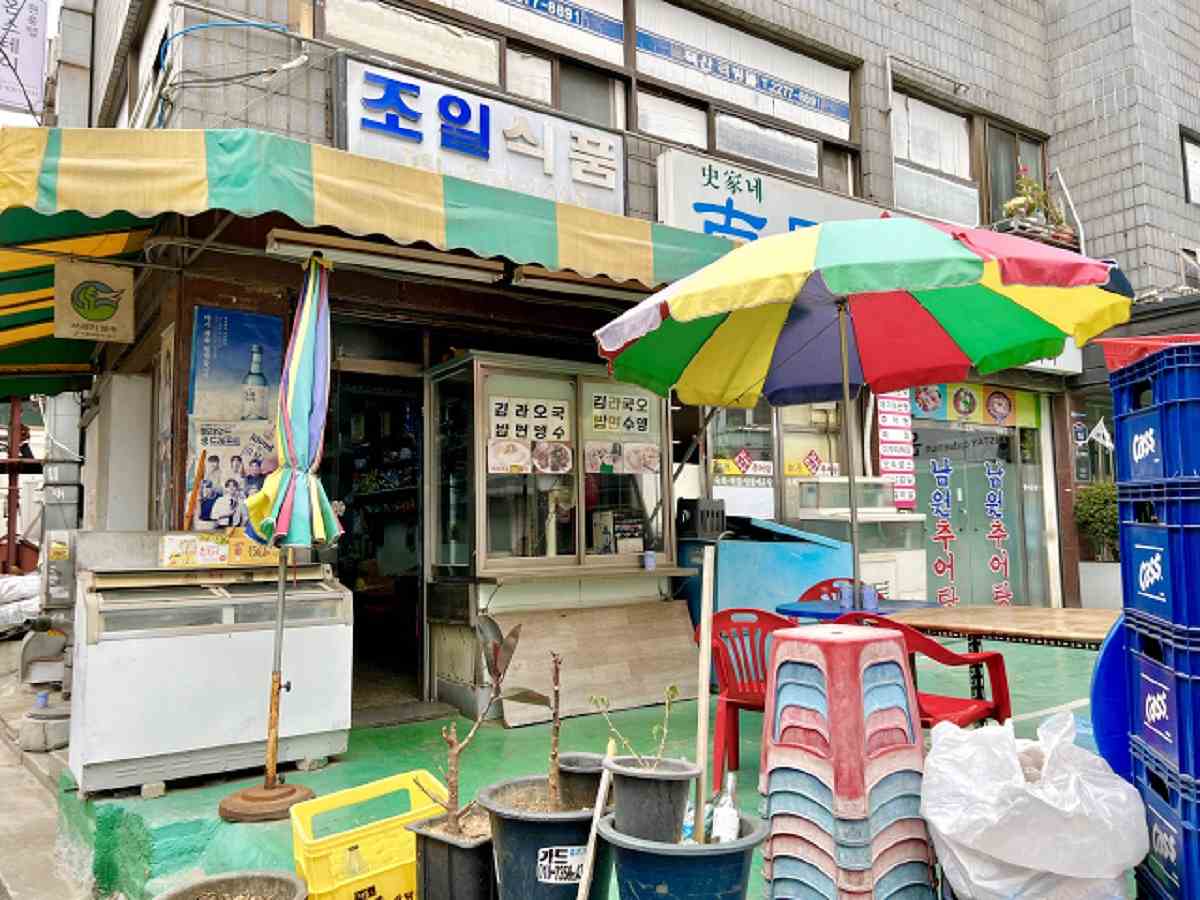
Joil Food in the Euljiro area in central Seoul
16:00 JST, May 6, 2023
Located in the narrow alleyways of Seoul’s industrial Euljiro district — dubbed “Hipjiro” for its renaissance as a hot spot for younger locals — Joil Food is one of the city’s growing number of popular “imokase” joints.
Stemming from the Japanese term “omakase,” which translates into “leaving it up to you,” an imokase establishment is a small eatery where the chef, who locals call “imo,” serves an affordable meal for customers that varies by season.
Imo means “aunt” in Korean, but it’s a common term people use to address older female servers at small mom-and-pop places.
Formerly a supermarket, Joil Food is a small restaurant with less than five tables run by a woman in her 70s named Yoon So-rae.
Yoon’s menu depends largely on what she has on hand in the kitchen that day. The owner-chef said she can serve gyeranmari (Korean egg roll), hamjeon (egg-battered cooked ham), jjajangmyeon (black bean sauce noodles), kkomak-muchim (seasoned cockles), and dakbokkeumtang (spicy braised chicken breast stew) — all for 40,000 won ($30). Her menu course usually ranges between 40,000 won and 60,000 won, she said.
While the food is far from fancy, Joil Food is a must-go spot in the city among the young generation. Among its customers are Daesung of K-pop boy band Big Bang and TV personality Cho Sae-ho. Through it all, Yoon says she’s dumbfounded at the popularity of her restaurant.
Yoon thinks the younger generation is turning to imokase, which she defines as simple meals, since anything retro has become trendy on social media. Many of her customers find her restaurant through Instagram, she said.
“Restaurants usually offer fancy dishes and have beautiful interior design, but I think my place can offer a glimpse of the past for the younger generation, who are my main customers,” Yoon told The Korea Herald.
Seoul has seen a rise of imokase, where middle-aged restaurant owners decide on and serve up home-cooked meals for customers, reminiscent of comfort food cooked by a grandmother growing up.
Most imokase customers are in their 20s and 30s, as the food is affordable. Imokase joints also offer diners the unique experience of traveling back in time to the ’80s and ’90s with retro signs, wallpaper and kitchenware. Back then, small restaurants were more common than western-style franchised restaurants.
For Ju Young-eun, a 24-year-old student, the restaurants evoke nostalgia.
“It’s not the kind of food people who live alone can make [at home], and the food they offer reminds me of my mom and the food she prepared just for me,” Ju said.






Most Read
Popular articles in the past 24 hours
-
Pass Rate for Overseas Driver's License Conversion Test in Japan ...
-

Milano Cortina 2026: Ceremony for Winter Paralympic Torch Relay T...
-

WBC to Begin: All the Pieces are in Place for Japan’s Second Stra...
-
Tokyo High Court Upholds Unification Church Dissolution Order
-

How Trump Assassination Attempts Played into His Decision to Atta...
-

PM Sanae Takaichi: Iran Situation Won’t Immediately Affect Electr...
-

Japanese Speedskater Takagi Announces Retirement
-

Trump's Asian Allies Fear Iran War Will Sap Defenses against Chin...
Popular articles in the past week
-
Tokyo Spends Big on Children, Wins Over Parents
-

Japan’s Miura, Kihara Announce Withdrawal from Figure Skating Wor...
-
BOJ Keeping Eye on Economy and Takaichi's ‘Proactive Fiscal Polic...
-
South Korea Tightens Rules on Foreigners Buying Homes in Seoul Me...
-
Tokyo Measles Patient Traveled to Fukuoka Aboard JAL Planes; Susp...
-
Nidec Chairman Resigns Amid Accounting Scandal at Major Japanese ...
-

Tourists Ignore Safety Barriers Near Famous Zao ‘Snow Monsters’ i...
-

Strait of Hormuz Closure Shakes Markets; Prolonged Closure Could ...
Popular articles in the past month
-

Producer Behind Pop Group XG Arrested for Cocaine Possession
-

Japan PM Takaichi’s Cabinet Resigns en Masse
-

Man Infected with Measles Reportedly Dined at Restaurant in Tokyo...
-

Israeli Ambassador to Japan Speaks about Japan’s Role in the Reco...
-

Videos Plagiarized, Reposted with False Subtitles Claiming ‘Ryuky...
-

Prudential Life Insurance Plans to Fully Compensate for Damages C...
-

Woman with Measles Visited Hospital in Tokyo Multiple Times Befor...
-

iPS Treatments Pass Key Milestone, but Broader Applications Far f...
Top Articles in World
-
Israeli Ambassador to Japan Speaks about Japan’s Role in the Reconstruction of Gaza
-
Videos Plagiarized, Reposted with False Subtitles Claiming ‘Ryukyu Belongs to China’; Anti-China False Information Also Posted in Japan
-

Nepal Bus Crash Kills 19 People, Injures 25 Including One Japanese National
-

Ukrainian Ambassador Closely Watching Japan’s Revision of Defense Export Rules, Hopes for Future Arms Support
-
China, India Tapping into Promising African Market; Beijing Announces Tariff Cuts, Both Countries Aim to Expand Exports
JN ACCESS RANKING
-
Producer Behind Pop Group XG Arrested for Cocaine Possession
-
Japan PM Takaichi’s Cabinet Resigns en Masse
-
Man Infected with Measles Reportedly Dined at Restaurant in Tokyo Station
-
Israeli Ambassador to Japan Speaks about Japan’s Role in the Reconstruction of Gaza
-
Videos Plagiarized, Reposted with False Subtitles Claiming ‘Ryukyu Belongs to China’; Anti-China False Information Also Posted in Japan