
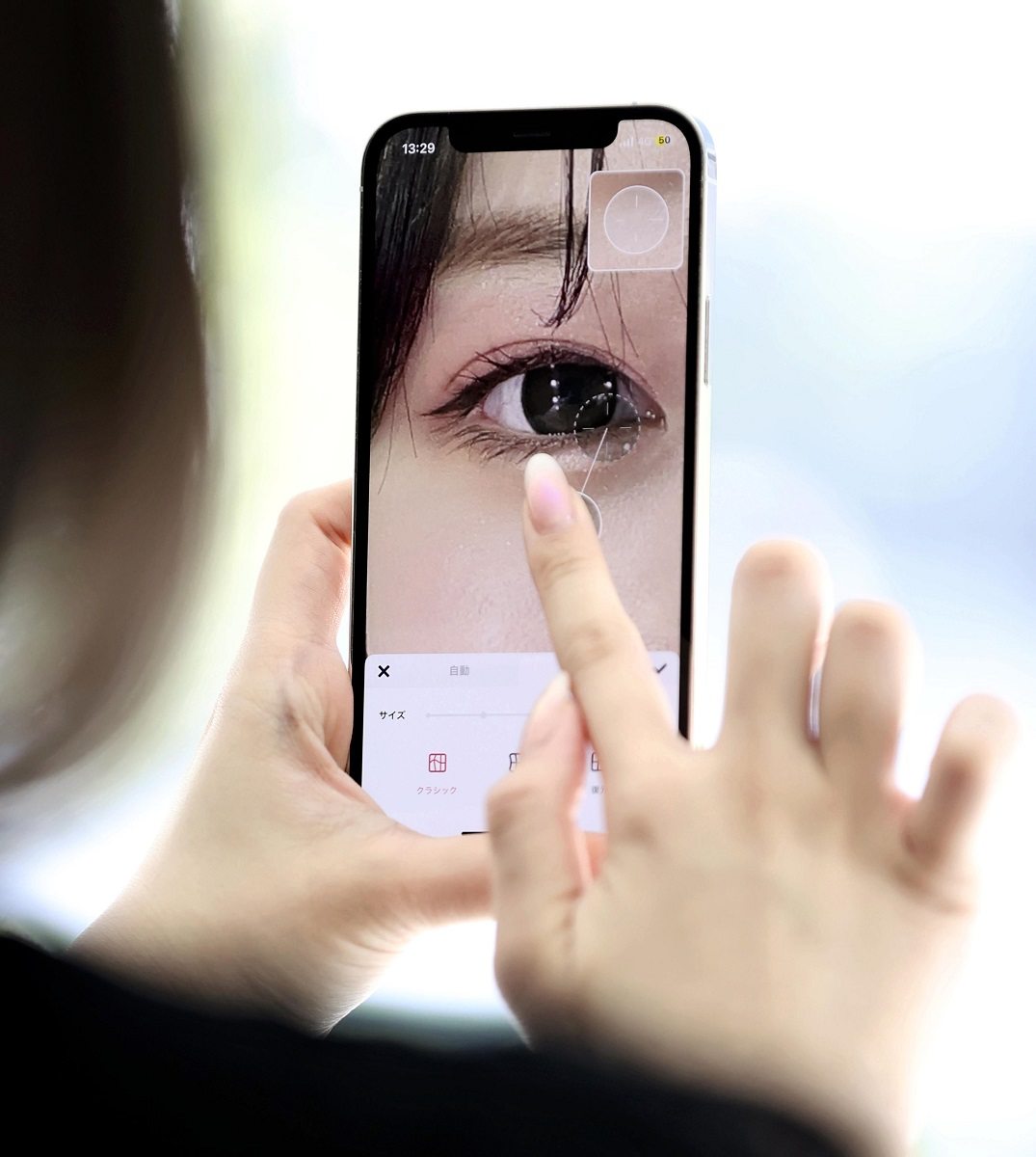
A woman uses smartphone app to alter a selfie
6:00 JST, April 7, 2023
The internet and social media allow anyone to transmit information. People’s behaviors are often altered by waves of information that are excessively tailored to their individual interests and concerns. This is the first installment in a series probing the impact of online content on our cognition through interviews with people who have suffered mentally and physically after being affected by unbalanced information.
***
About two years ago, a now 20-year-old university sophomore in the Tokyo metropolitan area began to put her smartphone aside.
The woman suffered from an eating disorder — in her case, a constant cycle of anorexia and binge eating — causing her to become physically and mentally unwell.
Many people strive toward societal standards of beauty, but the woman became totally obsessed with this concept by viewing “successful people” on social media while searching for hints on how to realize her desires.
During her first year at high school, she recalls being impressed by slender senior girls at a school festival.
She was aware that she was a little plump in relation to her 160-centimeter height. She also had been stung by remarks such as “You’re a little fat” by her father and elder brother.
Upon searching online for such terms as “diet” and “extreme weight loss,” she found her smartphone flooded with related information. Watching just one video on the topics prompted a succession of similar “recommended” videos to appear in her app.
Many websites employ users’ browsing histories, among other factors, to recommend similar pages and video clips. The woman was inspired to try a low-calorie diet after watching such videos. After she lost about 3 kilograms in a month, people around her praised her weight loss. As a result, she began eating only low-calorie foods such as shirataki noodles and chicken breast, and lost 20 kilograms within six months, taking her weight to below 50 kilograms.
Even so, she became hesitant to go out due to being overly self-conscious. She lost interest in manga and anime she had once loved, and instead kept searching for new weight loss methods on her smartphone.
Soon after spring break, she became unable to attend school. Her worried mother took her to see a doctor who diagnosed an eating disorder, which is a form of mental illness.
Once she started spending most of her time at home, the student took to Twitter, where she found many others suffering from similar disorders. After she followed one particular person, the app began recommending a succession of similar accounts and she ended up following about 200 people.
Some super-thin users posted selfies in which their ribs were clearly visible. The more the student viewed such images, the more determined she became to be like them.
Unable to keep up with her classes, she transferred to a new school after the summer break. Shortly after, she descended into a constant cycle of dieting and binge eating.
By autumn, her weight was down to about 38 kilograms, but she still felt frustrated because her ribs weren’t visible enough. Exhausted, she quit Twitter in the winter of her third year of high school, just before the university entrance exams.
“I was continually looking at social media and had become convinced that losing weight was all that mattered,” said the student, who still sees a psychiatrist. “I realized then that [social media] wasn’t for me.”
According to the Health, Labor and Welfare Ministry, as of the end of fiscal 2019, about 245,000 people across the nation were suffering from eating disorders, and many are young women in their teens and 20s.
Reinforcing views
Fresh and novel information posted on social media quickly attracts attention. But as soon as one views such information, many sites’ algorithms serve up a succession of similar content, giving rise to filter bubble in which people are continually shown information that confirms and exploits their basic interests.
In cognitive psychology, the effect of repeatedly being shown similar information is known to make people believe their thinking is “correct” and “favorable.” Additionally, when online content is widely shared and gains “likes,” it makes many users feel that the information is credible. People also tend to make decisions based on easily recallable information, such as recently viewed data, when drawing conclusions and making decisions.
As a result of such psychological reinforcement, some individuals opt to undergo excessive cosmetic surgery or embark upon aggressive diets after repeatedly hearing about the experiences of others who took similar steps or after viewing software-edited images online.
“Social media has some dangerous characteristics that can lead people to become addicted or dependent in a vicious-cycle way,” said Kazutoshi Sasahara, an associate professor of computational social science at Tokyo Institute of Technology. “Young people who have little experience and are still in the process of forming their personalities may be particularly vulnerable to falling into this trap.”










Most Read
Popular articles in the past 24 hours
-

Samurai Japan Grabs 2nd WBC Win, Beating South Korea 8-6
-

Japan's 2nd Round of U.S. Investments May Be Worth Over $100 Bill...
-

Japanese Beauty Products Gaining Attention in Paris
-

Fukuoka: Front Gate to Return to Fukuoka Castle; City Mulls Purch...
-

Niigata Univ. to Partner with Oisix Ra Daichi to Establish New Ed...
-

Japan Again Calls on U.S. for Exemption from New Tariff as Akazaw...
-

Japan’s Takaichi Avoids Comment on Legality of U.S.-Israeli Strik...
-

Ohtani Helps Get Samurai Japan Off to Stellar Start in WBC Opener...
Popular articles in the past week
-

Ibaraki Pref.'s 1st Foreign Bus Driver Hired in Tsukuba
-

Amid Strait of Hormuz Blockade, Shipping Companies Scramble to Ge...
-

2 Unpublished Early Novellas by Japan's Kenzaburo Oe Discovered, ...
-

Strait of Hormuz Closure Shakes Markets; Prolonged Closure Could ...
-

Iran Situation: Japan Must Exert Diplomatic Efforts without Merel...
-

Measles Patient Visited Hospital in Bunkyo Ward, Tokyo, Metropoli...
-

Japanese Shipping Giants Halt Strait of Hormuz Transit as Iran Co...
-

Parents of Japanese Teen Shot in U.S. Strive for Gun Control
Popular articles in the past month
-

Producer Behind Pop Group XG Arrested for Cocaine Possession
-

Japan PM Takaichi’s Cabinet Resigns en Masse
-

Man Infected with Measles Reportedly Dined at Restaurant in Tokyo...
-

Videos Plagiarized, Reposted with False Subtitles Claiming ‘Ryuky...
-

Prudential Life Insurance Plans to Fully Compensate for Damages C...
-

Woman with Measles Visited Hospital in Tokyo Multiple Times Befor...
-

iPS Treatments Pass Key Milestone, but Broader Applications Far f...
-

Sanae Takaichi Elected Prime Minister of Japan; Keeps All Cabinet...
Top Articles in Society
-
Producer Behind Pop Group XG Arrested for Cocaine Possession
-
Man Infected with Measles Reportedly Dined at Restaurant in Tokyo Station
-
Woman with Measles Visited Hospital in Tokyo Multiple Times Before Being Diagnosed with Disease
-

Bus Carrying 40 Passengers Catches Fire on Chuo Expressway; All Evacuate Safely
-

Tokyo Skytree’s Elevator Stops, Trapping 20 People; All Rescued (Update 1)
JN ACCESS RANKING
-
Producer Behind Pop Group XG Arrested for Cocaine Possession
-
Japan PM Takaichi’s Cabinet Resigns en Masse
-
Man Infected with Measles Reportedly Dined at Restaurant in Tokyo Station
-
Videos Plagiarized, Reposted with False Subtitles Claiming ‘Ryukyu Belongs to China’; Anti-China False Information Also Posted in Japan
-
Prudential Life Insurance Plans to Fully Compensate for Damages Caused by Fraudulent Actions Without Waiting for Third-Party Committee Review