
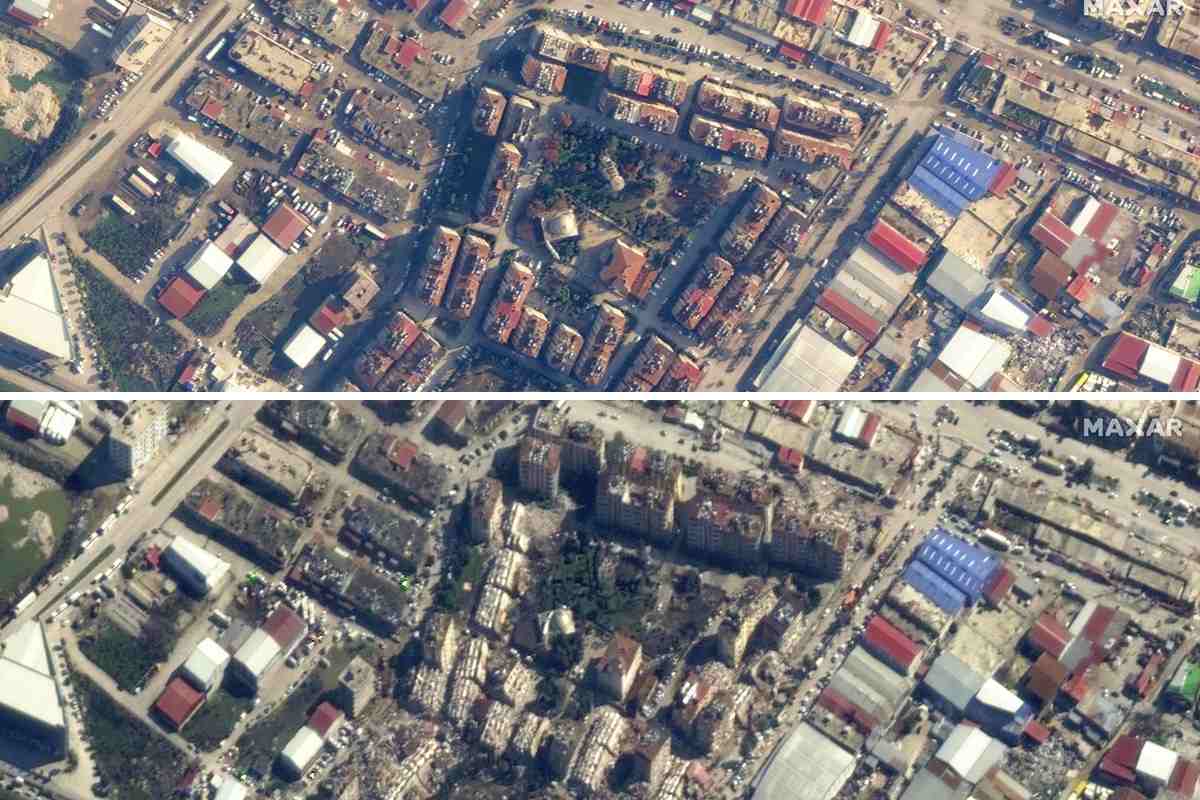
Above: A satellite photo of Antakya, a city in southern Turkey, in December 2022 before the earthquake. Apartment buildings can be seen in the middle of the photo.
Below: Antakya after the quake on Feb. 8. Many of the apartment buildings have collapsed.
21:00 JST, February 14, 2023
The amount of energy released by the 7.8-magnitude earthquake that struck southern Turkey and northwestern Syria was more than 20 times larger than that of the 1995 Great Hanshin Earthquake, making it one of the largest inland quakes in recorded history, according to research institutes.
A week after the earthquake, which was followed by a 7.5-magnitude aftershock, the death toll had exceeded 35,000. The quake is already the sixth-worst worldwide in the 21st century in terms of dead and missing persons.
According to the U.S. Geological Survey, the aftershock occurred about nine hours after the main temblor.
Tohoku University and other institutes estimated that the energy released by the mainshock was about 22 times larger than that of the Hanshin quake. When the energy is converted using the Japanese seismic intensity scale set by the Japan Meteorological Agency, part of the affected area was found to have experienced a tremor tantamount to the scale’s highest rating of 7, they said.
The earthquake was triggered by a large slip along an underlying fault. According to an analysis by the Geospatial Information Authority of Japan based on data from the Japan Aerospace Exploration Agency’s Earth-observation satellite Daichi-2, the horizontal slip along the fault was up to four meters, about four times larger than in the Hanshin quake.
The massive damage incurred is also believed to have been due in part to large population centers being struck.
Akira Wada, a professor emeritus of quake-resistant architecture at the Tokyo Institute of Technology, analyzed images of Antakya, a city in southern Turkey, taken by a Maxar Technologies Inc. satellite before and after the tremor.
He found that one area in which many five-story apartment buildings toppled onto their sides was developed with little space between the buildings, and that some were possibly taken down by the collapse of a neighboring block.
According to the Handbook of Scientific Tables, an earthquake in Haiti in 2010 had the highest toll of dead and missing in the 21st century at 316,000, followed by the 2004 Sumatra-Andaman quake at 227,898, the 2005 Pakistan quake with at least 86,000, the 2008 Sichuan quake at 69,227 and the 2003 Bam quake in Iran at 43,200.







Most Read
Popular articles in the past 24 hours
-

Japanese High School Student Aims to Share Kaiten History Through...
-

PM Takaichi Spells out Plans to Advance Bold Policy Shifts in Spe...
-

Chronic Issues Erode Thailand’s Economy as Political Confusion Pe...
-

Japanese Version of Shohei Ohtani's Picture Book Published
-

Tottori: 95-Year-Old Japanese Descendent from Philippines Visits ...
-

Japan to Monitor Trump Administration's Response to U.S. Supreme ...
-

Milano Cortina 2026: Speed Skater Takagi Finishes 6th in the 1,50...
-

Osaka: 40 Ninjas Display Shuriken Throwing Skills at Japan Champi...
Popular articles in the past week
-

Japan PM Takaichi’s Cabinet Resigns en Masse
-

Man Infected with Measles Reportedly Dined at Restaurant in Tokyo...
-

Sanae Takaichi Elected Prime Minister of Japan; Keeps All Cabinet...
-

Japan's Govt to Submit Road Map for Growth Strategy in March, PM ...
-

Bus Carrying 40 Passengers Catches Fire on Chuo Expressway; All E...
-

Milano Cortina 2026: Figure Skaters Riku Miura, Ryuichi Kihara Pa...
-

Japan, U.S. Name 3 Inaugural Investment Projects; Reached Agreeme...
-

U.S. Firm to Build Training Hub in Fukushima N-plant for Debris R...
Popular articles in the past month
-
Japan PM Takaichi’s Cabinet Resigns en Masse
-

Japan Institute to Use Domestic Commercial Optical Lattice Clock ...
-

Israeli Ambassador to Japan Speaks about Japan’s Role in the Reco...
-
Man Infected with Measles Reportedly Dined at Restaurant in Tokyo...
-

Videos Plagiarized, Reposted with False Subtitles Claiming ‘Ryuky...
-

Man Infected with Measles May Have Come in Contact with Many Peop...
-

Prudential Life Insurance Plans to Fully Compensate for Damages C...
-

Woman with Measles Visited Hospital in Tokyo Multiple Times Befor...
Top Articles in World
-
Israeli Ambassador to Japan Speaks about Japan’s Role in the Reconstruction of Gaza
-
Videos Plagiarized, Reposted with False Subtitles Claiming ‘Ryukyu Belongs to China’; Anti-China False Information Also Posted in Japan
-

North Korea Possibly Launches Ballistic Missile
-

Chinese Embassy in Japan Reiterates Call for Chinese People to Refrain from Traveling to Japan; Call Comes in Wake of ¥400 Mil. Robbery
-
Russia: Visa Required for Visiting Graves in Northern Territories, Lifting of Sanctions Also Necessary
JN ACCESS RANKING
-
Japan PM Takaichi’s Cabinet Resigns en Masse
-
Japan Institute to Use Domestic Commercial Optical Lattice Clock to Set Japan Standard Time
-
Israeli Ambassador to Japan Speaks about Japan’s Role in the Reconstruction of Gaza
-
Man Infected with Measles Reportedly Dined at Restaurant in Tokyo Station
-
Videos Plagiarized, Reposted with False Subtitles Claiming ‘Ryukyu Belongs to China’; Anti-China False Information Also Posted in Japan