
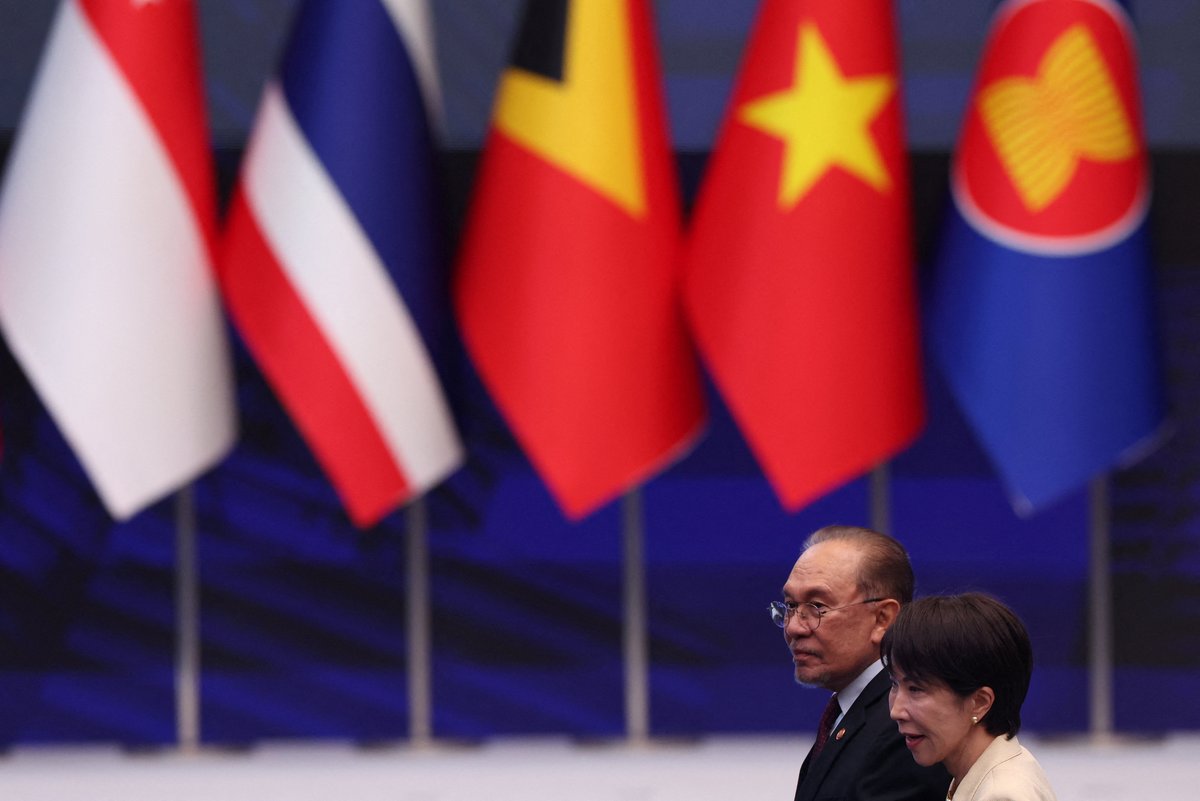
Prime Minister Sanae Takaichi and Malaysia’s Prime Minister Anwar Ibrahim walk at the venue for the 28th ASEAN-Japan Summit as part of the 47th ASEAN Summit in Kuala Lumpur on Sunday.
14:25 JST, October 27, 2025
BEIJING/SEOUL — China and South Korea appear wary of Prime Minister Sanae Takaichi’s conservative political stance. The two countries seem intent on gauging how her stance will be reflected in Japan’s foreign policy.
Since taking office in March 2013, Chinese President Xi Jinping has sent congratulatory messages to foreign leaders upon their inauguration. He has sent such messages to three Japanese prime ministers — Yoshihide Suga, Fumio Kishida and Shigeru Ishiba — on their inauguration days and announced that he had done so.
Takaichi took office last Tuesday, but as of Sunday evening, the Xi administration has not announced whether it had sent a congratulatory message to her. So far, it has only been confirmed that Chinese Premier Li Qiang sent a congratulatory message to Takaichi, according to sources familiar with Japan-China relations.
The Global Times, an affiliate of the Chinese Communist Party’s official newspaper, has described Takaichi as “a leading figure of Japan’s right-wing conservatives.”
Before taking office, Takaichi would visit Yasukuni Shrine on occasions such as the anniversary of the end of World War II and has stressed her stance on protecting Japan’s sovereignty in territorial issues, thereby winning support from conservative voters.
A diplomatic source in Beijing analyzed China’s recent moves as “a possible indication that Beijing is trying to gauge moves by the Takaichi administration going forward.”
South Korean President Lee Jae Myung’s administration sent National Security Adviser Wi Sunglac to Japan on Oct. 21, the day Takaichi’s Cabinet was formed. The following day, Wi held talks with Keiichi Ichikawa, secretary general of the National Security Secretariat, and both agreed on maintaining and developing good bilateral relations.
Wi also met with Liberal Democratic Party Vice President Taro Aso on the same day, according to a South Korean presidential office source. This is a sign that the Lee administration, which is pursuing pragmatic diplomacy that prioritizes national interests, has continuously demonstrated its stance of placing importance on Japan.
However, South Korea’s Yonhap News Agency published an article on Oct. 21 saying Takaichi has made hardline statements on topics such as historical views and territorial issues. It also said that if she visits Yasukuni Shrine, Japan-South Korea relations would suddenly take a sharp turn toward a difficult state.
A South Korean presidential office official anticipated active interactions between the two countries, but also stressed hope that “Japan will face history squarely and act in a manner reflecting genuine remorse.”






Most Read
Popular articles in the past 24 hours
-
Japanese Students Use Traditional Pickle to Create Novel Wagashi ...
-
‘Dry Bonsai’ Gives New Life to Withered Trees, Allows Free Artist...
-

McDonald's Japan Raises Prices; Big Mac to Cost ¥500, Double Chee...
-

Nepal Bus Crash Kills 19 People, Injures 25 Including One Japanes...
-

Japan’s Nikkei Stock Average Rises as AI-Related Stocks Shine; Co...
-

Astellas Collaborates with Vir to Develop Its Experimental Prosta...
-

Early-Blooming Kawazu Cherry Blossoms Create Sea of Pink at Park ...
-
Joruri Bunraku Narrative Performed in Honor of Donald Keene by La...
Popular articles in the past week
-

Producer Behind Pop Group XG Arrested for Cocaine Possession
-

Japan PM Takaichi’s Cabinet Resigns en Masse
-

Sanae Takaichi Elected Prime Minister of Japan; Keeps All Cabinet...
-

Japan's Govt to Submit Road Map for Growth Strategy in March, PM ...
-

Bus Carrying 40 Passengers Catches Fire on Chuo Expressway; All E...
-

U.S. Firm to Build Training Hub in Fukushima N-plant for Debris R...
-

Japan, U.S. Name 3 Inaugural Investment Projects; Reached Agreeme...
-

Riku-Ryu Pair Wins Gold Medal: Their Strong Bond Leads to Major C...
Popular articles in the past month
-
Producer Behind Pop Group XG Arrested for Cocaine Possession
-
Japan PM Takaichi’s Cabinet Resigns en Masse
-

Japan Institute to Use Domestic Commercial Optical Lattice Clock ...
-

Man Infected with Measles Reportedly Dined at Restaurant in Tokyo...
-

Israeli Ambassador to Japan Speaks about Japan’s Role in the Reco...
-

Videos Plagiarized, Reposted with False Subtitles Claiming ‘Ryuky...
-

Man Infected with Measles May Have Come in Contact with Many Peop...
-

Prudential Life Insurance Plans to Fully Compensate for Damages C...
Top Articles in World
-
Israeli Ambassador to Japan Speaks about Japan’s Role in the Reconstruction of Gaza
-
Videos Plagiarized, Reposted with False Subtitles Claiming ‘Ryukyu Belongs to China’; Anti-China False Information Also Posted in Japan
-
Chinese Embassy in Japan Reiterates Call for Chinese People to Refrain from Traveling to Japan; Call Comes in Wake of ¥400 Mil. Robbery
-
Russia: Visa Required for Visiting Graves in Northern Territories, Lifting of Sanctions Also Necessary
-

China, India Tapping into Promising African Market; Beijing Announces Tariff Cuts, Both Countries Aim to Expand Exports
JN ACCESS RANKING
-
Producer Behind Pop Group XG Arrested for Cocaine Possession
-
Japan PM Takaichi’s Cabinet Resigns en Masse
-
Japan Institute to Use Domestic Commercial Optical Lattice Clock to Set Japan Standard Time
-
Man Infected with Measles Reportedly Dined at Restaurant in Tokyo Station
-
Israeli Ambassador to Japan Speaks about Japan’s Role in the Reconstruction of Gaza