
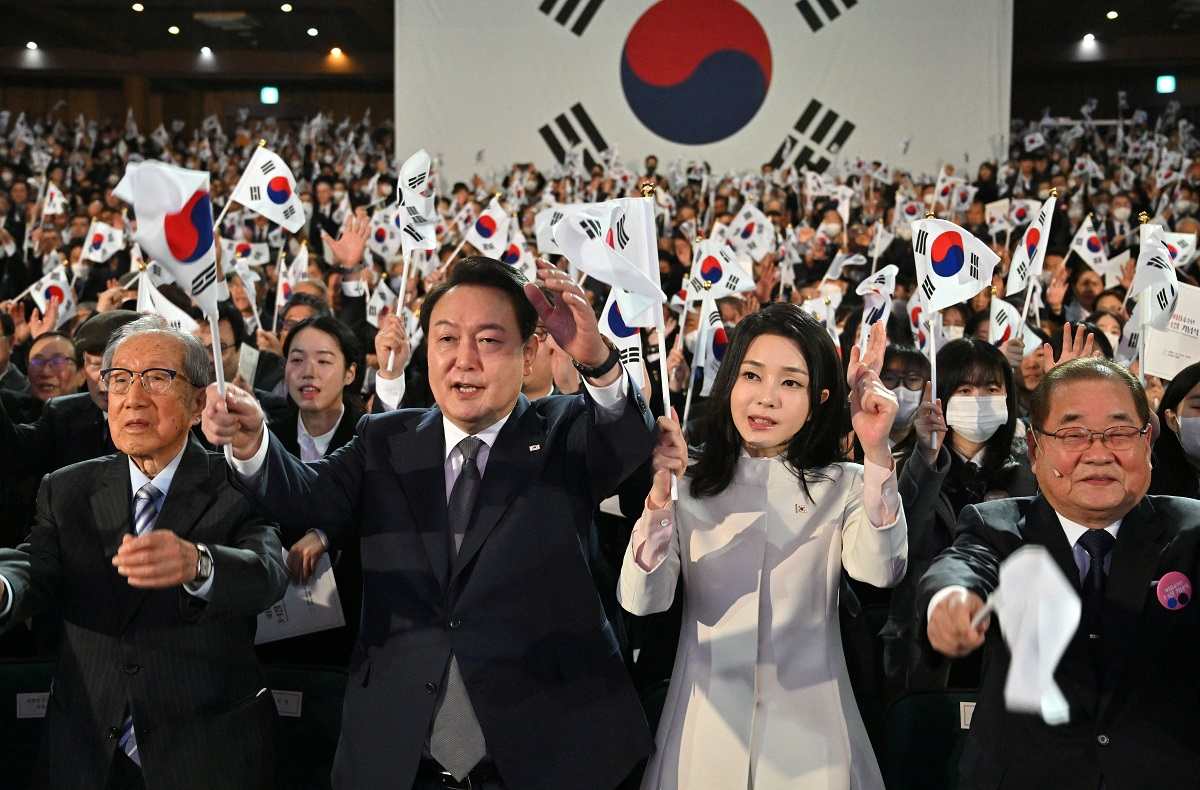
South Korea’s President Yoon Suk-yeol, center, waves the national flag in Seoul on Wednesday during a ceremony to mark the 104th anniversary of the March First Independence Movement against Japan’s colonial rule.
2:00 JST, March 3, 2023
SEOUL — South Korean President Yoon Suk-yeol’s reference to Japan as a “partner” at a ceremony commemorating the March First Independence Movement on Wednesday indicates a shift from previous administrations’ emphasis on historical issues with Japan.
“We must stand in solidarity with countries that share universal values in order to contribute to promoting the freedom of global citizens and the common prosperity of all humankind,” Yoon said in his speech.
In South Korea, March 1 is a symbolic date commemorating resistance to Japan’s colonial rule, and past presidents have repeatedly made speeches urging Japan to reflect and act on historical issues. Former President Park Geun-hye, a conservative like Yoon, once surprised Japan by saying, “The historic dynamic of one party being a perpetrator and the other party a victim will remain unchanged even after a 1,000 years have passed.”
Leftist forces in South Korea reacted strongly to Yoon’s speech on Wednesday. Lee Jae-myung, the leader of the Democratic Party of Korea, the largest leftist opposition party, said on Facebook that it is impossible to build trust without historical responsibility and legal compensation. Lee accused Yoon of undermining the spirit of the independence movement.
The electronic edition of The Kyunghyang Shinmun newspaper quoted several experts who criticized Yoon for showing “indulgence” to Japan on historical issues. The electronic edition of The Hankyoreh newspaper said President Yoon’s speech drew criticism from numerous people.
Yoon’s emphasis on improving relations with Japan apparently stems from his sense of crisis over changes in the international situation, including the growing threat of North Korea’s nuclear and missile development.
Since last year, the Yoon administration has repeatedly conducted joint drills and exercises with the United States, as well as with both Japan and the United States, in preparation for a North Korean contingency. This is a shift from former President Moon Jae-in’s administration, which emphasized reconciliation with the North.
Last December, Yoon announced his Indo-Pacific Strategy, which stipulates among other things opposition to changing the status quo by force. Regarding China, Yoon has demonstrated his position of being in step with the United States and Japan.
Choi Eunmi, a research fellow at the Asan Institute for Policy Studies, said Yoon’s speech was a message that he will not use anti-Japanese sentiment as a political tool in the future. She also said Yoon may be hoping that Japan will move toward a sincere response, which South Korea is seeking, to the ongoing lawsuit over former wartime requisitioned workers from the Korean Peninsula.
South Korean people’s perception of Japan appears to have improved since the time of the Moon administration, during which they boycotted Japanese products. According to a survey released in January by the JoongAng Ilbo newspaper, the favorable perception of Japan among South Korean people was 42.2 on a 100-point scale as of 2022, an increase of 8.6 points from the previous year.



Most Read
Popular articles in the past 24 hours
-

Milano Cortina 2026: Ceremony for Winter Paralympic Torch Relay T...
-

WBC to Begin: All the Pieces are in Place for Japan’s Second Stra...
-
Tokyo High Court Upholds Unification Church Dissolution Order
-
How Trump Assassination Attempts Played into His Decision to Atta...
-
PM Sanae Takaichi: Iran Situation Won’t Immediately Affect Electr...
-

CARTOON OF THE DAY (March 4)
-

Trump's Asian Allies Fear Iran War Will Sap Defenses against Chin...
-

Japanese Speedskater Takagi Announces Retirement
Popular articles in the past week
-
Tokyo Spends Big on Children, Wins Over Parents
-
Japan’s Miura, Kihara Announce Withdrawal from Figure Skating Wor...
-

South Korea Tightens Rules on Foreigners Buying Homes in Seoul Me...
-
BOJ Keeping Eye on Economy and Takaichi's ‘Proactive Fiscal Polic...
-
Tokyo Measles Patient Traveled to Fukuoka Aboard JAL Planes; Susp...
-
Nidec Chairman Resigns Amid Accounting Scandal at Major Japanese ...
-

Strait of Hormuz Closure Shakes Markets; Prolonged Closure Could ...
-
Tourists Ignore Safety Barriers Near Famous Zao ‘Snow Monsters’ i...
Popular articles in the past month
-

Producer Behind Pop Group XG Arrested for Cocaine Possession
-

Japan PM Takaichi’s Cabinet Resigns en Masse
-

Man Infected with Measles Reportedly Dined at Restaurant in Tokyo...
-

Israeli Ambassador to Japan Speaks about Japan’s Role in the Reco...
-

Videos Plagiarized, Reposted with False Subtitles Claiming ‘Ryuky...
-

Prudential Life Insurance Plans to Fully Compensate for Damages C...
-

Woman with Measles Visited Hospital in Tokyo Multiple Times Befor...
-

iPS Treatments Pass Key Milestone, but Broader Applications Far f...
Top Articles in World
-
Israeli Ambassador to Japan Speaks about Japan’s Role in the Reconstruction of Gaza
-
Videos Plagiarized, Reposted with False Subtitles Claiming ‘Ryukyu Belongs to China’; Anti-China False Information Also Posted in Japan
-

Nepal Bus Crash Kills 19 People, Injures 25 Including One Japanese National
-

Ukrainian Ambassador Closely Watching Japan’s Revision of Defense Export Rules, Hopes for Future Arms Support
-

China, India Tapping into Promising African Market; Beijing Announces Tariff Cuts, Both Countries Aim to Expand Exports
JN ACCESS RANKING
-
Producer Behind Pop Group XG Arrested for Cocaine Possession
-
Japan PM Takaichi’s Cabinet Resigns en Masse
-
Man Infected with Measles Reportedly Dined at Restaurant in Tokyo Station
-
Israeli Ambassador to Japan Speaks about Japan’s Role in the Reconstruction of Gaza
-
Videos Plagiarized, Reposted with False Subtitles Claiming ‘Ryukyu Belongs to China’; Anti-China False Information Also Posted in Japan