
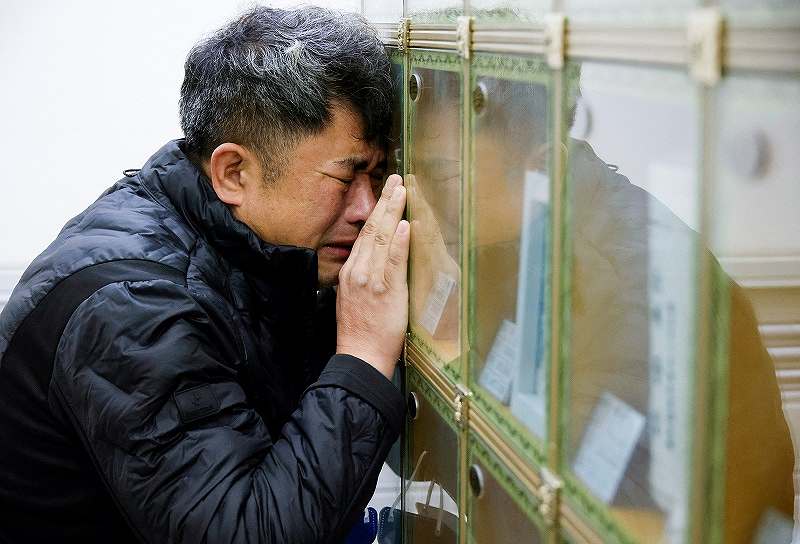
Cho Gi-dong, who lost his 24-year-old daughter in the Halloween crush in Seoul, cries at a columbarium where her remains are kept in Daejeon, South Korea, on Nov. 29.
10:50 JST, December 8, 2022
SEOUL (Reuters) — Taking time off work, South Korean bus driver Cho Gi-Dong has visited a crypt where the remains of his 24-year-old daughter are kept almost every day since she perished in a deadly crush on the night of Halloween in October.
Ye-jin was among 158 people who died in the disaster on narrow lane in Seoul on Oct. 29. She was Cho’s only child.
“My heart still throbs as if there’s a rock in here, but I cannot take that out,” Cho said, pointing to his chest as he stood in the vault of the crematorium in the central city of Daejeon.
“Children who lost their parents are orphans, but there’s no word for parents who lost their children. I have found one — a sinner. I felt so guilty for losing her,” he said, holding back his tears as he gripped a wallet he had gifted Ye-jin when she went to college five years ago.
Dressed as Princess Jasmine from the Disney animated film “Aladdin,” Ye-jin had gone for a night out in the capital Seoul with two friends. They also lost their lives.
The disaster unfolded as revelers flooded the alleyways of the nightlife district of Itaewon to celebrate the first COVID-19 curbs-free Halloween festivities in three years.
Most of the dead from that nightmarish night had been in their 20s and 30s. Many of the dead were suffocated in the crush. Nearly 200 others escaped with injuries.
Cho requested leave after Ye-jin’s death, deprived of sleep and feeling helpless about having been unable to save her life.
His sorrow turned to anger especially after the release of transcripts of emergency calls showing that people had repeatedly warned of the dangers and urged intervention hours before the disaster struck.
Police faced stringent public criticism and scrutiny over its responses to those calls, and an investigation is underway into authorities’ overall handling of the disaster.
Last month, some relatives of victims held a news conference demanding a government apology and a thorough investigation.
President Yoon Suk-yeol, Interior Minister Lee Sang-min and National Police Commissioner General Yoon Hee-keun have pledged to conduct a transparent investigation and to take necessary steps once it concludes.
Cho said he has not received any offer of help from the government except for guidance on how he can be reimbursed for funeral costs and receive what is termed “consolation money.”
“We don’t need money, we live well enough without that money. That’s not the way to console us bereaved families,” Cho said.
“If we get a proper apology and see those responsible strictly punished, it would reduce my anger by a tenth, or one-ten thousandth, at least by a little bit.”
Lee Ju-hee, from a collective of human rights lawyers called Minbyun, said nearly 60 families have joined a campaign for justice.
“Eventually some would seek damages suits,” Lee said. “But what’s important to us right now is the truth — why our children had to die on the street that we have walked past all the time believing it would be safe.”







Most Read
Popular articles in the past 24 hours
-

JR Tokai Breaks Ground on Yamanashi Maglev Station; Will Be Part ...
-

Milano Cortina 2026: Japan’s Alpine Skier Muraoka Extends P...
-
Rising Kabuki Star Works to Ensure Deaf Audience's Enjoyment of P...
-

Lady Bess: Iroha Okuda, Mayuko Kominami Discuss Performing Elizab...
-

Japan Considering Taking Part in U.S. ‘Golden Dome’ Defense Syste...
-

46 Evacuated from UAE, Oman on Japanese Govt-chartered Flight
-

Driver Dies in Collision with Express Train at Crossing in Mito; ...
-
Japan's TEPCO Releases Footage from Fukushima N-Plant Reactor
Popular articles in the past week
-

Japan Figure Skating Legend Yuzuru Hanyu Is Proud Disaster Surviv...
-

Nippon Life Insurance's U.S. Arm Sues OpenAI Over Legal Assistanc...
-
Govt to Utilize ODA for Ensuring Economic Security; Securing Ener...
-
Massive Sewer Pipe Found Jutting Out of Highway in Osaka
-
15 Measles Patients Confirmed in Tokyo in Past 6 Days; 1 May Have...
-

Japan Govt to Tighten Requirements to Receive Permanent Residency...
-

Beckoning Cats Get Makeover to Fit Modern Lifestyles with Sleek D...
-
Japan Govt Survey Finds Just 10% of Workers Want Working Hours to...
Popular articles in the past month
-

Producer Behind Pop Group XG Arrested for Cocaine Possession
-

Japan PM Takaichi’s Cabinet Resigns en Masse
-

Man Infected with Measles Reportedly Dined at Restaurant in Tokyo...
-

Videos Plagiarized, Reposted with False Subtitles Claiming ‘Ryuky...
-
Japan Figure Skating Legend Yuzuru Hanyu Is Proud Disaster Surviv...
-

iPS Treatments Pass Key Milestone, but Broader Applications Far f...
-

Sanae Takaichi Elected Prime Minister of Japan; Keeps All Cabinet...
-

Nepal Bus Crash Kills 19 People, Injures 25 Including One Japanes...
Top Articles in World
-
Videos Plagiarized, Reposted with False Subtitles Claiming ‘Ryukyu Belongs to China’; Anti-China False Information Also Posted in Japan
-
Nepal Bus Crash Kills 19 People, Injures 25 Including One Japanese National
-

South Korea Tightens Rules on Foreigners Buying Homes in Seoul Metro Area
-
Govt to Utilize ODA for Ensuring Economic Security; Securing Energy, Critical Minerals Sought
-

Ukrainian Ambassador Closely Watching Japan’s Revision of Defense Export Rules, Hopes for Future Arms Support
JN ACCESS RANKING
-
Producer Behind Pop Group XG Arrested for Cocaine Possession
-
Japan PM Takaichi’s Cabinet Resigns en Masse
-
Man Infected with Measles Reportedly Dined at Restaurant in Tokyo Station
-
Videos Plagiarized, Reposted with False Subtitles Claiming ‘Ryukyu Belongs to China’; Anti-China False Information Also Posted in Japan
-
Japan Figure Skating Legend Yuzuru Hanyu Is Proud Disaster Survivor and Gold Medalist, Vows to Continue Support Efforts