
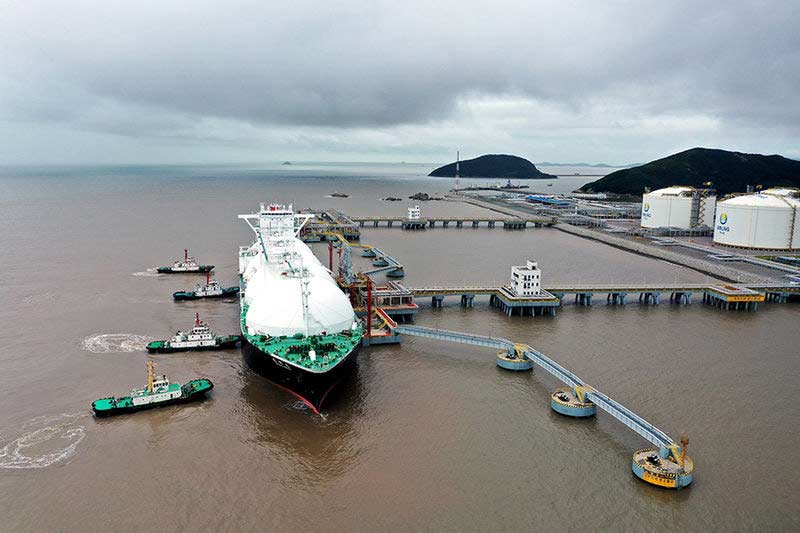
An LNG vessel docks at Zhoushan Port, Zhejiang Province.
November 28, 2021
China is expected to attract more international energy suppliers with its burgeoning natural gas demand to set a record this year, as the domestic economy has emerged from the COVID-19 pandemic faster than expected and the government is on track to meet its long-term carbon neutrality targets, said analysts.
Their comments came after Chinese President Xi Jinping told U.S. President Joe Biden during a virtual conference on Nov. 16 that China and the United States should increase cooperation on natural gas and new energy, and the two countries, together with the international community, should also maintain the security and stability of global energy industrial and supply chains.
According to BloombergNEF, the United States has surpassed Qatar to become the second-biggest liquefied natural gas supplier to China so far this year, only after Australia, and the trend is expected to further increase in the years to come as China’s demand for clean energy like LNG increases.
Li Ziyue, an analyst with BloombergNEF, said U.S. LNG shipments to China in the first three quarters have more than tripled year-on-year, driven by strong gas demand in China as a combined result of economic recovery and emission control measures.
“China is set to see more LNG imports from the United States as at least five Chinese companies are in advanced talks to secure long-term LNG supplies from U.S. exporters,” Li said.
She said the United States is gaining a bigger market share, but is still playing catch-up with Australia, which exported 17 million tons more LNG to China in the first three quarters.
According to Customs statistics, China imported 5.4 million tons of LNG from the United States from January to August, soaring 375% year on year.
China’s major energy companies — including China National Petroleum Corp., China Petroleum and Chemical Corp. and China National Offshore Oil Corp. — are all stepping up imports of LNG from the United States.
China Petroleum and Chemical Corp., also known as Sinopec and the world’s largest refiner by volume, recently inked a 20-year LNG deal with U.S. exporter Venture Global LNG — the single largest LNG trade agreement in terms of volume between the two sides. It will supply 4 million tons of LNG each year. Sinopec’s trading arm Unipec will also buy 3.8 million tons of LNG from Venture Global’s Calcasieu Pass facility.
China National Petroleum Corp., the country’s largest oil and gas company, has recently received LNG shipments from the United States at Jiangsu’s Rudong terminal, where almost 100 million cubic meters of natural gas will be transmitted to Yangtze River Delta regions to ensure sufficient gas supplies.
Under the phase-one trade agreement between China and the United States, which covers China’s increased purchases of U.S. energy products, China is to increase energy imports from the United States — including LNG, crude oil, refined products and coal — by $52.4 billion over two years on top of the 2017 baseline.
The deal is a solid demonstration indicating China is carrying out its promises, while it also comes as China’s demand for clean energy is increasing amid the country’s shift from fossil fuels to green energy, said Gao Lingyun, an expert at the Chinese Academy of Social Sciences in Beijing.





Most Read
Popular articles in the past 24 hours
-

Moai Statue Shows Lasting Bond Between Miyagi Pref. Town, Easter ...
-

Milano Cortina 2026: Japan’s Oguri Wins Para Snowboard Silver at ...
-
Japan's Defense Ministry: North Korea Appears to Have Fired Balli...
-

Aichi Fisheries Cooperatives Use Smart Tech to Farm Triploid Oyst...
-

National Intelligence Council: Proposed Body Must Be Utilized To ...
-
Teachers Support Students’ Inquiry Learning behind the Scenes
-
Japan's Lower House Passes Budget Proposal; Could Be Delayed in U...
-

CARTOON OF THE DAY (March 14)
Popular articles in the past week
-

Japan Figure Skating Legend Yuzuru Hanyu Is Proud Disaster Surviv...
-
Govt to Utilize ODA for Ensuring Economic Security; Securing Ener...
-
15 Measles Patients Confirmed in Tokyo in Past 6 Days; 1 May Have...
-

Massive Sewer Pipe Found Jutting Out of Highway in Osaka
-
Japan Govt to Tighten Requirements to Receive Permanent Residency...
-
JR Tokai Breaks Ground on Yamanashi Maglev Station; Will Be Part ...
-

Power Outage Forces About 980 Passengers in Yokohama to Walk to T...
-

Beckoning Cats Get Makeover to Fit Modern Lifestyles with Sleek D...
Popular articles in the past month
-

Producer Behind Pop Group XG Arrested for Cocaine Possession
-

Japan PM Takaichi’s Cabinet Resigns en Masse
-

Man Infected with Measles Reportedly Dined at Restaurant in Tokyo...
-

Videos Plagiarized, Reposted with False Subtitles Claiming ‘Ryuky...
-
Japan Figure Skating Legend Yuzuru Hanyu Is Proud Disaster Surviv...
-

iPS Treatments Pass Key Milestone, but Broader Applications Far f...
-

Sanae Takaichi Elected Prime Minister of Japan; Keeps All Cabinet...
-

Nepal Bus Crash Kills 19 People, Injures 25 Including One Japanes...
Top Articles in World
-
Videos Plagiarized, Reposted with False Subtitles Claiming ‘Ryukyu Belongs to China’; Anti-China False Information Also Posted in Japan
-
Nepal Bus Crash Kills 19 People, Injures 25 Including One Japanese National
-

South Korea Tightens Rules on Foreigners Buying Homes in Seoul Metro Area
-
Govt to Utilize ODA for Ensuring Economic Security; Securing Energy, Critical Minerals Sought
-

Ukrainian Ambassador Closely Watching Japan’s Revision of Defense Export Rules, Hopes for Future Arms Support
JN ACCESS RANKING
-
Producer Behind Pop Group XG Arrested for Cocaine Possession
-
Japan PM Takaichi’s Cabinet Resigns en Masse
-
Man Infected with Measles Reportedly Dined at Restaurant in Tokyo Station
-
Videos Plagiarized, Reposted with False Subtitles Claiming ‘Ryukyu Belongs to China’; Anti-China False Information Also Posted in Japan
-
Japan Figure Skating Legend Yuzuru Hanyu Is Proud Disaster Survivor and Gold Medalist, Vows to Continue Support Efforts